South Korea 10-Day Itinerary:Seoul, Gyeongju and Busan
Follow a realistic 10-day South Korea route from ICN through Seoul, Gyeongju, Busan and Incheon, with rail planning, closure swaps and Plan B.
Official sources checked 10 September 2026

Ask Narin.
Find answers in this guide
Narin is a fictional AI host.
Loading your saved chat…
NarinAsk me a question about this guide. Answers include links to the guides.
Official sources checked September 10, 2026: rail booking rules, station names, palace schedules, major attraction hours, ICN procedures and the route structure below. Train inventory, local arrivals, hotel luggage policies, lift outages, temporary closures and weather still require a travel-day check.
30-second answer
Use one rail spine: ICN → Seoul → Gyeongju → Busan → Seoul or Yeongjong → ICN. The nine-night split is Seoul 4 / Gyeongju 1 / Busan 2 / Seoul or Yeongjong 2. This gives Seoul three full sightseeing days, protects a night in Gyeongju, keeps Busan in one geography and returns you toward the airport before departure day.
Book the flight and refundable hotels first. When ordinary KORAIL sales open, buy the three long-distance legs for Days 5, 6 and 8. Keep Day 1 attraction-free, make Day 4 the swap day, and choose only one Day 9 branch: Incheon Open Port, a final Seoul day, or a verified airport-positioning night.
This version suits a first trip with three intercity travel days. If Jeju is essential, remove a region rather than adding another flight. Before entering Korea or leaving an airside connection, use the Korea Visa Navigator.
Jump to: route table · booking order · weekday swaps · Gyeongju · Busan · Plan B · final checks
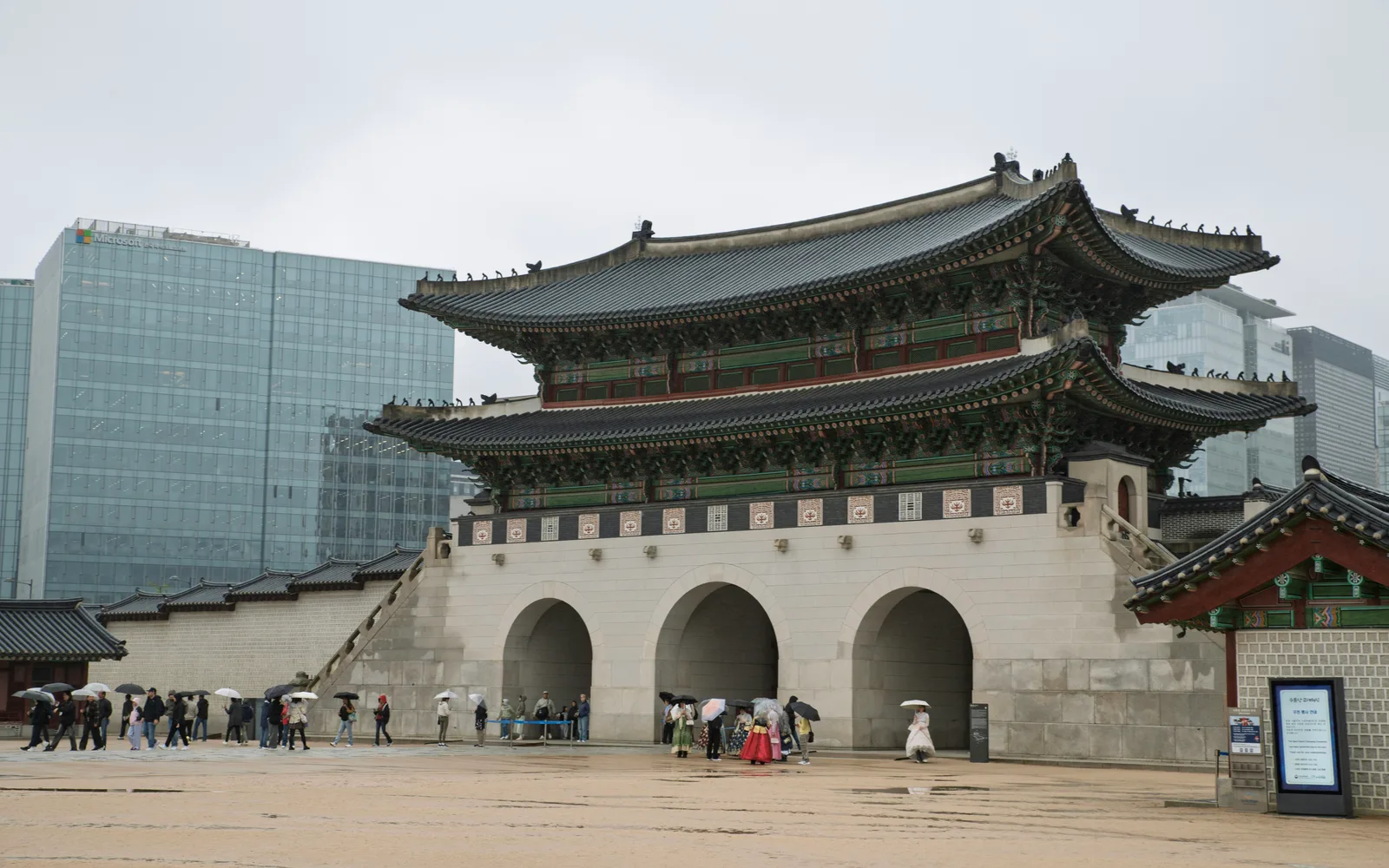
Gwanghwamun at Gyeongbokgung on a rainy day, as identified by the photographer; published April 29, 2026. Opening hours, access controls and the surrounding streets can change. Photo by Trac Vu on Unsplash. Cropped, resized and converted to WebP.
The route at a glance
| Day | Sleep | Main plan | Planning load | Backup |
|---|---|---|---|---|
| 1 | Seoul | ICN → exact hotel; eat and walk nearby | Arrival-dependent | Hotel only |
| 2 | Seoul | One operating palace → Insadong/Ikseon | Full day, little transit | National Museum of Korea |
| 3 | Seoul | National Museum of Korea → one nearby choice | Light to medium | Museum only |
| 4 | Seoul | Seoul Forest + Seongsu, or the missed priority | Light | Rest and repack |
| 5 | Gyeongju | Morning KTX → central bag drop → heritage loop → Donggung and Wolji | About 4–5 hours door to door before sightseeing | Museum plus one outdoor stop |
| 6 | Busan | Bulguksa or Gyeongju National Museum → Busan | About 2.5–3.5 hours hotel to hotel after the morning visit | Museum and earlier train |
| 7 | Busan | Gamcheon → Jagalchi/BIFF/Gukje | 6–8 hours | Old-port museum route |
| 8 | Seoul | Busan → Seoul; meal near hotel | About 4–5 hours hotel to hotel | Transfer only |
| 9 | Seoul or Yeongjong | Incheon Open Port or final Seoul day or airport positioning | Branch-dependent | Move toward ICN |
| 10 | Departure | Correct hotel → correct ICN terminal → flight | Airline-dependent | Preplanned taxi or airport hotel |
The travel bands include the main transfer steps but are not operator journey times. Actual trains, traffic, platform walks, waiting and hotel locations change the day.
Book in this order
1. Confirm the flight, entry path and terminal logic
Record the ICN arrival and departure terminals from the operating airline, not from an old airline-by-terminal list. Codeshares can use a terminal different from the marketing carrier. Save the IIAC departure search and the site's terminal guide.
2. Reserve the nine hotel nights
Use this base pattern:
- Nights 1–4: Seoul. Favor a short, lift-served walk from a subway station over a famous district name.
- Night 5: central Gyeongju. A hotel near Hwangridan-gil, Daereungwon or the express-bus terminal reduces the station-to-sightseeing penalty.
- Nights 6–7: Busan. Busan Station or Nampo keeps this guide's old-port day compact.
- Nights 8–9: Seoul, or Night 8 Seoul and Night 9 Yeongjong/ICN for an early flight.
Do not book “an Incheon hotel” for airport convenience without checking the district and terminal transfer. Open Port, Songdo and ICN are separate clusters. Use the airport-hotel guide for terminal-area options.
3. Buy the three intercity rail legs
Search Seoul → Gyeongju, Gyeongju → Busan and Busan → Seoul in the official KORAIL reservation system. Ordinary tickets open at 07:00 one month before departure; holiday sales can follow special dates and payment deadlines. The English web sales window normally ends 20 minutes before departure, but waiting that long is a poor plan for a multi-city itinerary.
For travel September 23–27, 2026, KORAIL's announced Chuseok sale uses September 3–4 for eligible priority customers and September 7–11 for general customers, with separate days by route and train. The September 11 sale covers Gyeongbu-line KTX. The notice requires an integrated KORAIL membership and payment by September 15 for general-sale reservations; follow its exact eligibility and payment instructions.
KORAIL introduced its integrated high-speed network from September 1, 2026, with the Korail+ (코레일+) booking app. Use the live KORAIL interface and compare Seoul and Suseo when either station suits your hotel. Ignore older screenshots that permanently divide Seoul/KTX and Suseo/SRT. Read the current integration announcement.
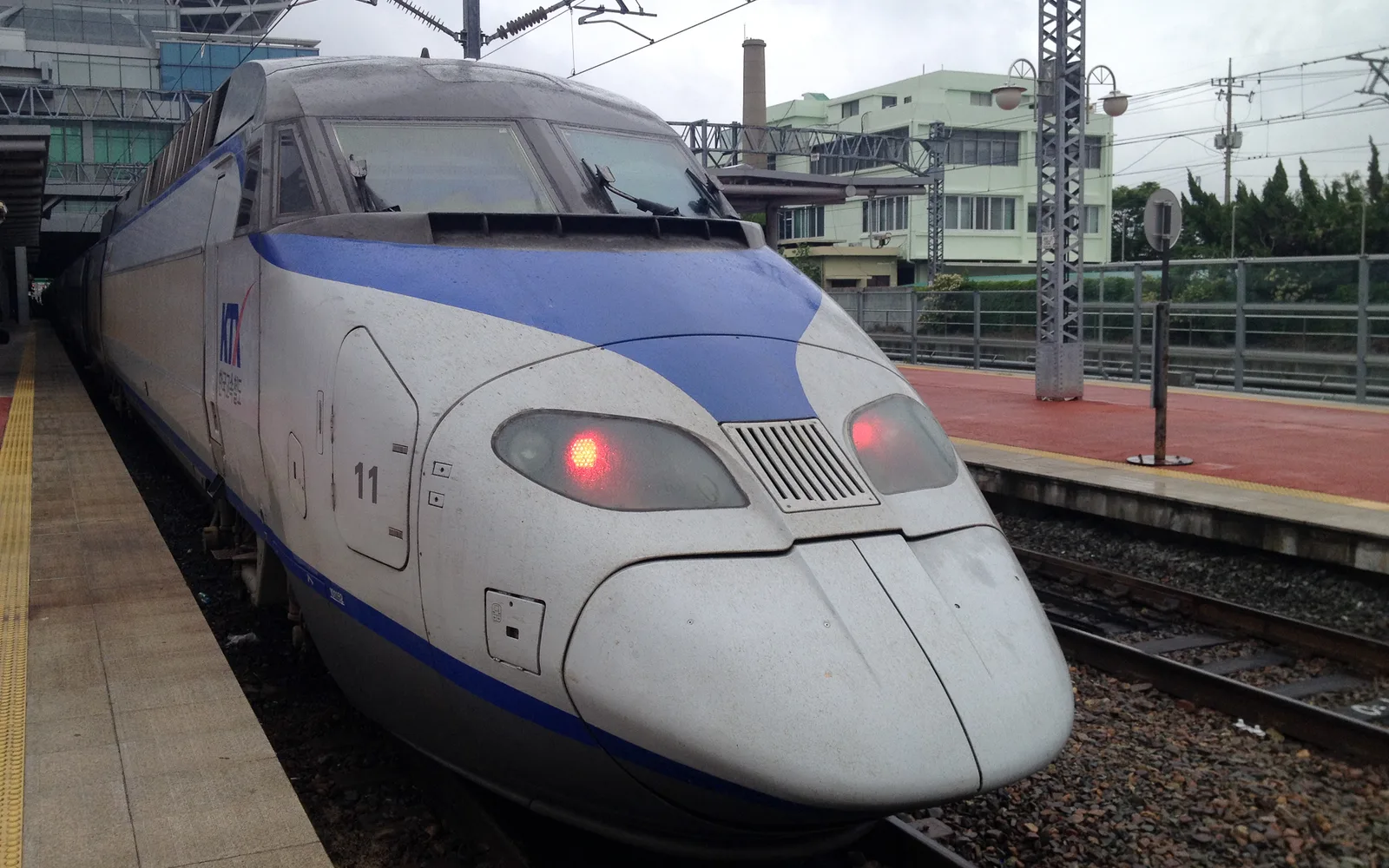
A KTX-I at Busan Station, photographed June 3, 2014. The train, platform and livery are historical context, not a current timetable or equipment promise. “KTX-I in Busan Station (15618537248).jpg” by Doug Letterman, CC BY 2.0, via Wikimedia Commons/Flickr. Cropped, resized and converted to WebP.
4. Add timed or closure-sensitive attractions
Map your actual dates to weekdays before assigning palaces, museums or markets. Reserve only after the intercity framework is stable. A venue ticket should not force you to risk the train that protects the next hotel night.
5. Set up local transport and weather tools
Use a transport card for eligible subway and bus rides, not for KTX. The T-money guide covers purchase and cash reload rules. Install the tools in the essential Korea apps guide, but keep operator pages for rail, airport and attraction facts.
Map the days to the calendar
“Day 2” is not always Monday or Tuesday. Write the weekday beside each date, then make these swaps:
| Constraint | Standing rule checked September 10, 2026 | Best response |
|---|---|---|
| Gyeongbokgung | Normally closed Tuesday; substitute-holiday rule can move the closure | Use Changdeokgung on Tuesday, or move Gyeongbokgung to another Seoul day |
| Changdeokgung | Normally closed Monday; Secret Garden uses a separate ticket | Use Gyeongbokgung or the National Museum |
| National Museum of Korea | Open most Mondays, but uses named holiday and quarterly gallery closures | Read the date-specific museum calendar |
| Gyeongju National Museum | Closed Jan 1, Seollal Day and Chuseok Day | Use the central outdoor loop if conditions are safe |
| Busan Modern & Contemporary History Museum | Closed Monday, or the following day when Monday is a public holiday | Keep the outdoor old-port route or move the museum |
| Jagalchi main market | Closed the 1st, 3rd and 5th Tuesdays | Use BIFF/Gukje and verify individual businesses |
| Incheon municipal museums | Usually closed Monday, with source-specific holiday rules | Use the outdoor lower route, Seoul or airport positioning |
| KTX during Seollal or Chuseok | Special booking windows can replace the normal one-month sale | Follow the current KORAIL holiday notice |
The Royal Palaces schedule, National Museum calendar, Busan museum record and Jemulpo Cultural Foundation schedule are the controlling pages for these standing rules.
Day 1: ICN to the Seoul hotel
Clear immigration, collect checked baggage when required, and choose transport by the hotel's exact station or bus stop. AREX Express runs non-stop to Seoul Station. The All-Stop train serves Gongdeok, Hongik University and Seoul Station. Airport buses are route-specific, and an ordinary taxi uses the meter plus the applicable toll.
Use the Incheon Airport to Seoul guide to compare the current train, bus and taxi options for your district. Check the displayed terminus on a late All-Stop train because some services do not continue to central Seoul.
After check-in, eat and walk close to the hotel. Do not place a timed palace, cross-city dinner or nonrefundable activity on the arrival day. If the flight is late, the entire plan is the hotel.
Day 2: Gyeongbokgung and Insadong
Default sequence
- Reach Gyeongbokgung for opening.
- Spend the late morning in one palace route rather than trying to collect several royal sites.
- Eat near the eastern side of the palace district.
- Continue through Insadong or Ikseon-dong at your own pace.
- End near the hotel or in one evening neighborhood, not across Seoul.
The Royal Palaces operator publishes seasonal Gyeongbokgung hours: 09:00–17:00 in January–February and November–December; 09:00–18:00 in March–May and September–October; and 09:00–18:30 in June–August. Last entry is one hour before closing. The current adult foreign admission is ₩3,000 for ages 19–64. Gyeongbokgung normally closes Tuesday.
Tuesday version
Use Changdeokgung's building area if it is operating. Do not assume the Secret Garden is a casual add-on: it requires both palace and garden tickets, uses limited entry, and begins at least a 15-minute walk inside the grounds. The official FAQ says online garden sales open six days ahead and some capacity is kept for day-of sale.
Historic thresholds, slopes and unpaved garden paths mean neither palace should be described as fully step-free. If that matters, shorten the grounds and keep Day 3's museum as the main anchor.
Day 3: National Museum of Korea and one nearby choice
Start at the National Museum of Korea. The current schedule is 09:30–17:30 on Monday, Tuesday, Thursday, Friday and Sunday, and 09:30–21:00 on Wednesday and Saturday. Last admission is 30 minutes before close. Permanent admission is free; special exhibitions may charge.
Choose the rest of the day by energy:
- stay for a longer museum visit and eat nearby;
- add one short walk or neighborhood after the museum;
- return to the hotel early and move the missed priority to Day 4.
The museum publishes wheelchairs, strollers, lockers, coat storage and a lactation room. Its Children's Museum is a separate timed product, so families should use the live reservation page rather than assume walk-in space.
Day 4: Seoul Forest, Seongsu or the swap day
If Days 2 and 3 worked as planned, use Seoul Forest as the outdoor anchor and continue into Seongsu. KTO's Seoul Forest listing lists the park grounds as free and open 24 hours, but individual facilities keep separate hours and some close Monday. Seongsu shops, cafés and temporary exhibitions also set their own schedules.
If weather, jet lag or a closure changed the first two days, use Day 4 to recover that priority. Keep it unbooked until the palace weekday and forecast are clear. This is also the day to do laundry, repack and confirm the Day 5 train, Gyeongju hotel bag policy and station-to-hotel route.
Avoid a long day trip unless it matters more than the Seoul time it replaces. Day 5 already begins with a hotel checkout and intercity move.
Day 5: Seoul to central Gyeongju
From Gyeongju Station to the historic center
Book Seoul → Gyeongju. The current high-speed stop is Gyeongju Station, renamed from Singyeongju in 2023. The former downtown Gyeongju Station is closed. The working station sits outside the central heritage and hotel area, so the rail ticket does not finish the transfer.
After arrival, use the current Gyeongju ITS or a taxi. Routes 50/51 serve the terminal and Hwangridan-gil corridor; 60/61 serve central heritage stops, but route variations and live arrivals matter. Check the current Gyeongju city-bus fare and the fare displayed on the bus before boarding. With luggage or limited mobility, a taxi reduces transfers.
Allow 4–5 hours from the Seoul hotel to the Gyeongju hotel. That includes checkout, Seoul Station, platform time, KTX, the final city transfer, bag drop and food. It is a planning range, not an operator duration.
Central heritage route after bag drop
Follow this central sequence, allowing extra walking within the grounds and for the optional bridge detour:
- Daereungwon and optional Cheonmachong. Current grounds are free; Cheonmachong is the paid interior. The standing hours are 09:00–22:00, with final entry at 21:30.
- Cheomseongdae. The outdoor monument is free and normally open to 22:00, shortened to 21:00 in winter.
- Woljeonggyo or Gyochon, only if time and walking conditions suit you.
- Donggung and Wolji after dinner. Current hours are 09:00–22:00, ticketing ends 21:30, and adult admission is ₩3,000.
The city links these stops in its central heritage route. Severe weather, events and construction can override standing access. If the day is wet or very hot, use the National Museum first and keep only one outdoor stop.
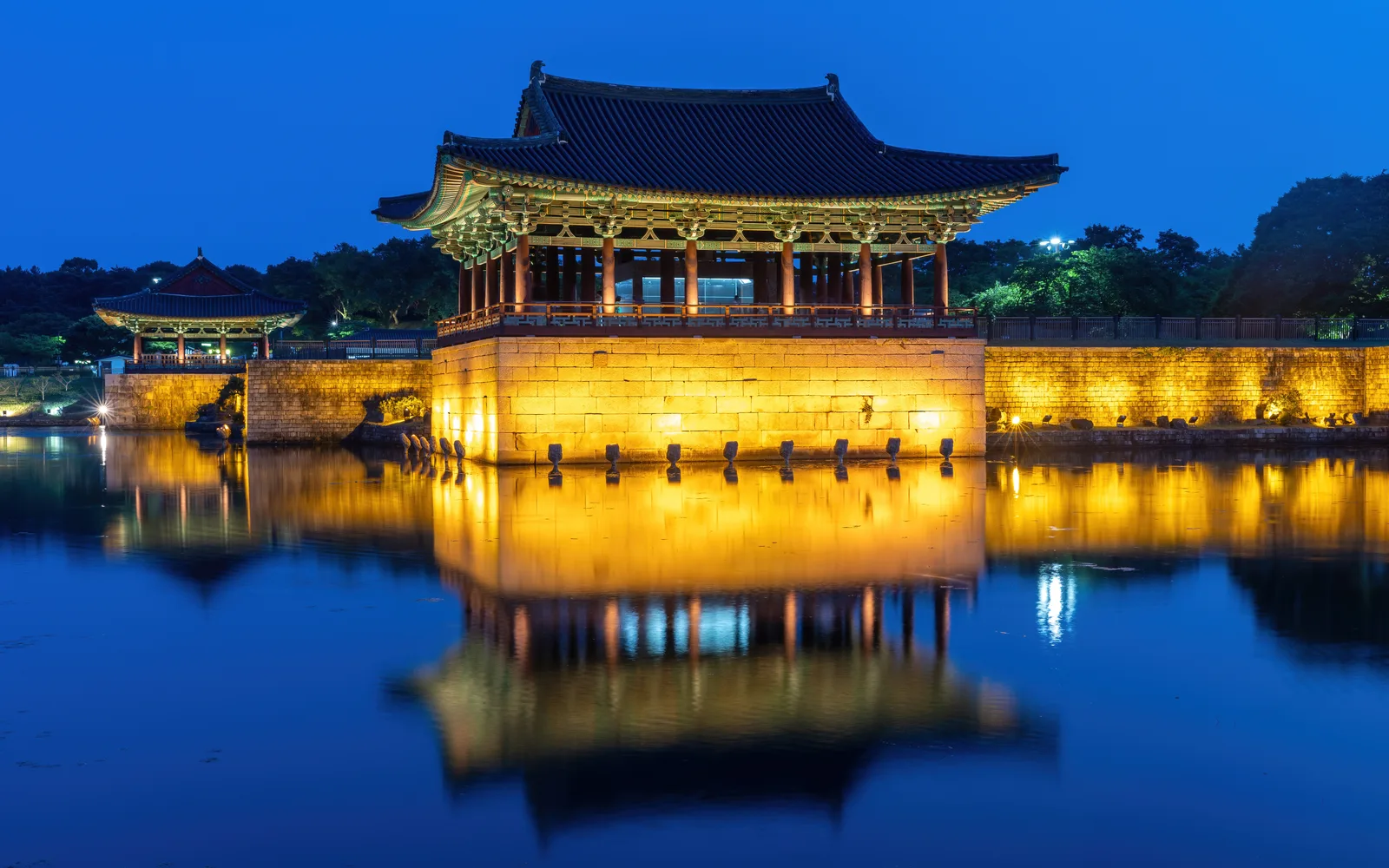
Donggung Palace reflected in Wolji Pond at blue hour, photographed June 10, 2024. Lighting, opening hours and admission arrangements can change. “Water reflection of Donggung Palace in Wolji Pond at blue hour in Gyeongju South Korea” by Basile Morin, CC BY-SA 4.0, via Wikimedia Commons. Cropped, resized and converted to WebP under the same license.
Day 6: One Gyeongju morning, then Busan
Choose one morning plan before buying the Busan train.
| Choice | Use it when | Current official facts | What it costs the day |
|---|---|---|---|
| Bulguksa | Temple is a priority and weather is settled | KTO lists 09:00–18:00 and free admission; check the temple before travel | Cross-city outward and return transport before bag collection |
| Gyeongju National Museum | Rain, heat, children, limited walking or an earlier train | Conservative core 10:00–18:00, general admission free | Shorter local move from the central heritage area |
For Bulguksa, check the live direction and vehicle on routes 10/11. Allow for the displayed wait and return service. Use this chain: breakfast and checkout → confirmed hotel bag hold → Bulguksa → hotel → Gyeongju Station → Busan. Do not add Seokguram by default; it adds a mountain transfer and a second time-sensitive visit.
For the museum, check the live visitor calendar. It closes Jan 1, Seollal Day and Chuseok Day. Official pages conflict over some extended Saturday hours, so rely on the date-specific calendar rather than a screenshot.
Train or bus to Busan?
- A direct high-speed train reaches Busan Station. It is usually the cleaner choice for a Busan Station or Nampo hotel; confirm the service in KORAIL.
- The intercity bus reaches Nopo, on Metro Line 1 in northern Busan. It can suit a hotel on that side of the city but is not Busan Station; confirm the route in the Busan terminal directory.
Search the exact date. Allow about 2.5–3.5 hours from the Gyeongju hotel to the Busan hotel and include both city legs; the train itself is only one component.
After check-in, Gwangalli is an optional evening, not another required transfer. Add it only if the hotel route, weather and energy make sense.
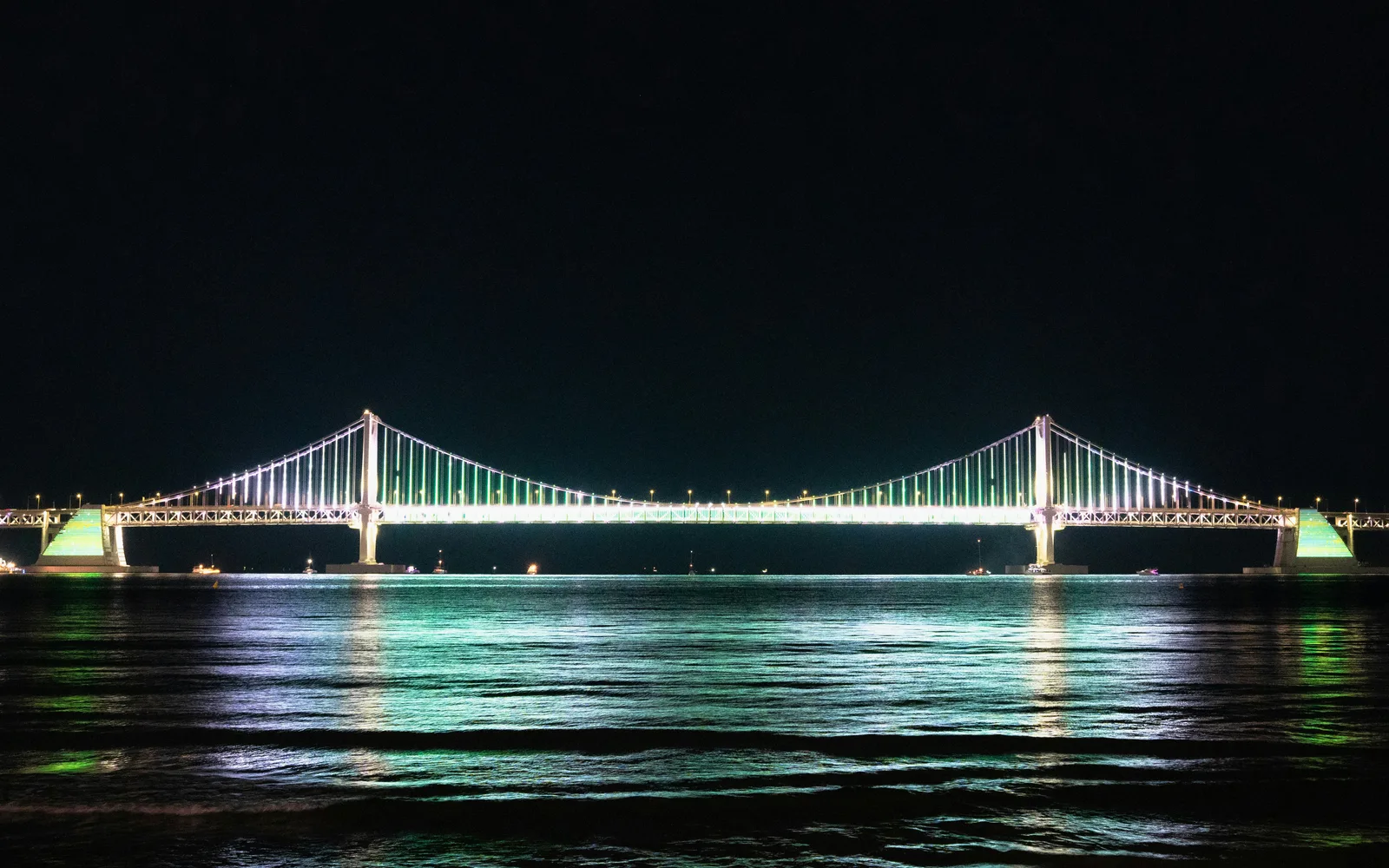
Gwangan Bridge at night from Gwangalli Beach, as identified by the photographer; published October 12, 2024. Illumination, weather and beach conditions can change. Photo by Shibin Joseph on Unsplash. Cropped, resized and converted to WebP.
Day 7: One coherent Busan day
Keep this day in western Busan: Gamcheon → Jagalchi → BIFF/Gukje. Haeundae and the eastern beaches deserve a different day, not a late add-on.
Morning: Gamcheon Culture Village
Visit Busan lists the visitor/business window as 09:00–18:00 from March through October and 09:00–17:00 from November through February. The district is open year-round and has no district admission fee.
Take Metro Line 1 to Toseong Exit 6, then village bus Saha 1-1, Seo-gu 2 or 2-2 to Gamjeong Elementary School and walk about five minutes. Gamcheon is a lived-in hillside neighborhood. Keep voices down, take your trash with you, respect private homes and do not fly a drone.
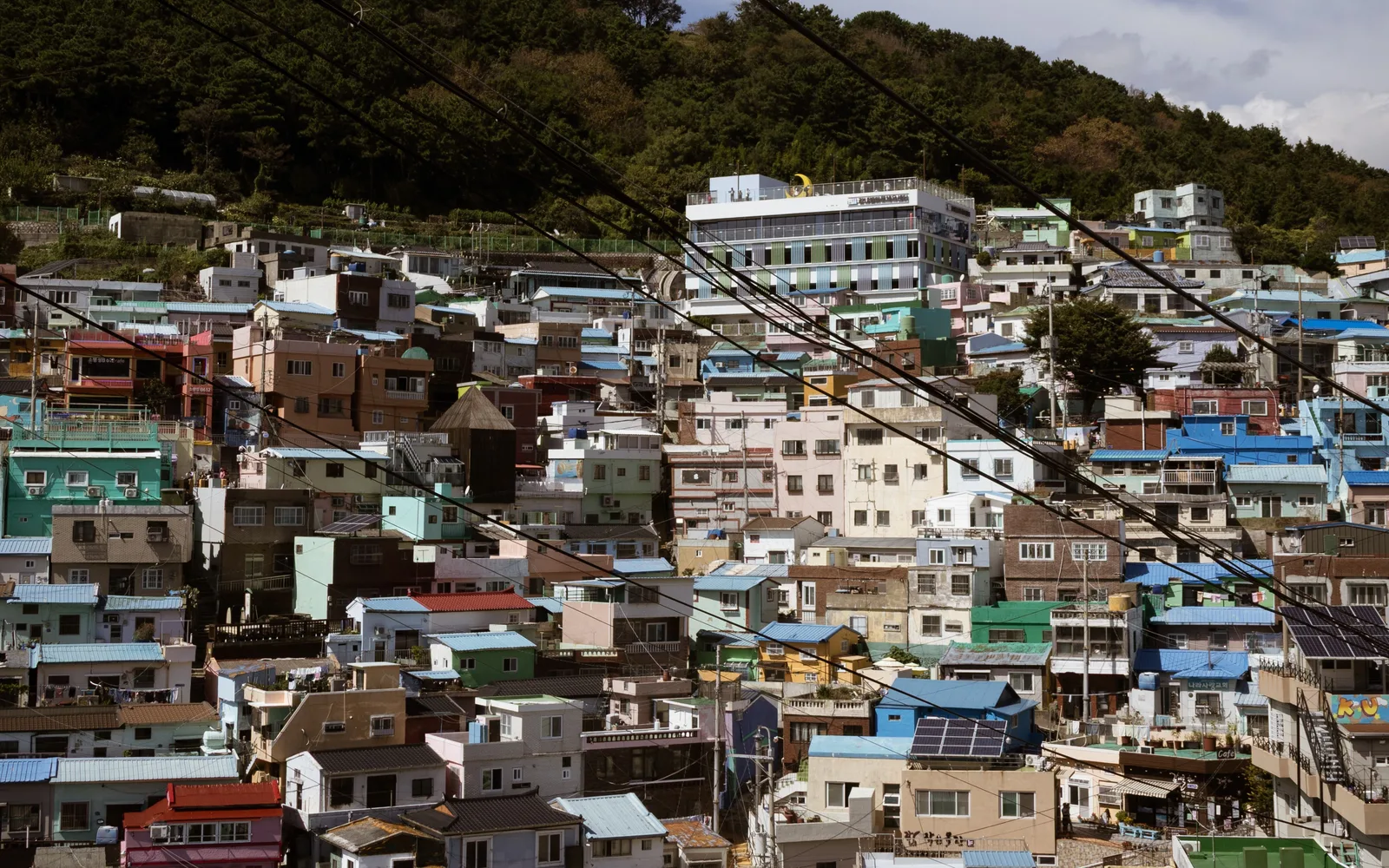
Homes on the hillside in Gamcheon Culture Village, Busan, as identified by the source page. The photograph does not establish current shop hours, route conditions or residential access. Photo by Evija Ciematniece on Pexels; date not disclosed, page checked August 24, 2026. Cropped, resized and converted to WebP.
Afternoon: Jagalchi, BIFF and Gukje
Descend to the old-port cluster for lunch and a lower walking route. The main Jagalchi market publishes 05:00–22:00 and closes the 1st, 3rd and 5th Tuesdays. Individual vendors keep their own hours and prices. The official access record places it about six minutes from Nampo Exit 2 or Jagalchi Exit 10.
Continue through BIFF Square or Gukje Market only as far as your energy allows. This is a district sequence, not a promise that every stall is open.
Rain, heat or fewer-stairs version
Use the Busan Modern & Contemporary History Museum, then a shorter BIFF/Gukje segment. The museum opens Tuesday–Sunday 09:00–18:00, closes Monday or the following day when Monday is a public holiday, and is free. Its official listing documents a ramp, lift, accessible toilet, lockers, nursing facilities and a separately reserved children's experience center.
This version removes the hill and one bus transfer. Curbs and street crossings still need a travel-day check.
Day 8: Busan to Seoul
Search Busan → Seoul for the actual date. Also compare Suseo if the final hotel is in southeast Seoul. Allow 4–5 hours hotel to hotel for checkout, station access, waiting, rail, the Seoul station exit and check-in.
Keep the evening simple: food and one walk near the hotel. A timed attraction turns an ordinary delay into a lost booking. This is a transfer day even when the train itself is fast.
Day 9: Choose one final-day branch
Branch A: Incheon Open Port and Chinatown
From Seoul Station, take a direct Line 1 local whose destination display says Incheon and stay on to the final stop. Allow about 70 minutes on the train. The adult fare is ₩2,150 by transport card or ₩2,250 with a single-use ticket, plus a refundable ₩500 deposit for the single-use card. Use Incheon Station Exit 1. See the Seoul Metro fare dataset, Incheon Transit fare rules and Incheon Station access.
Follow the one-day Incheon itinerary and choose one core route plus one optional finish. Do not combine Chinatown, Wolmido, Songdo and ICN. Allow roughly three hours for the round-trip Seoul–Incheon transport before sightseeing time.
Branch B: Final Seoul day
Choose this for shopping, poor weather, fatigue or an afternoon/evening Day 10 flight. It avoids the Incheon return journey and keeps the final packing night predictable.
Branch C: Move toward ICN
Choose a verified Yeongjong or terminal-area property for an early flight. Confirm the actual terminal, landside or airside access, shuttle reservation, pickup point, luggage allowance, first run and taxi fallback. The place name “Incheon” does not prove that a hotel is near either passenger terminal.
Day 10: Work backward from the flight
Use the airline's check-in cutoff and recommended airport-arrival time for the exact flight. Then add terminal walking, bag drop, security, departure immigration, hotel transfer, waiting and a disruption margin.
Recheck the terminal on the e-ticket, in the IIAC live departure search and with the operating airline, especially for a codeshare. The official departure sequence is correct terminal → check-in/bag drop → security → departure immigration → live gate.
Do not use one universal “arrive X hours early” rule for every airline, ticket and date. If the first train or shuttle does not protect the airline's deadline, change the final hotel or preplan an official taxi.
Rail pass, luggage and local payment
Individual tickets or KORAIL PASS
This route uses long-distance rail on three dates. As checked September 10, 2026, the foreign-visitor three-day select KORAIL PASS costs ₩186,000 adult / ₩93,000 child and can be used on three chosen days within ten days. A two-day pass cannot cover all three travel dates.
The pass allows up to two seat reservations per person per day and does not reserve a seat by itself. Its English page still lists SRT and metropolitan rail as exclusions after the September integration announcement. Confirm coverage for the exact departure with KORAIL before buying, particularly a Suseo service. Compare the pass with the three individual fares; it may cost more. Carry the valid pass, passport and required seat ticket. KORAIL says a ticket screenshot is not valid.
Luggage
KORAIL's carry-on rules require each passenger to manage their own luggage, limit it to two pieces, and prohibit using a seat or blocking the aisle. That rule is more reliable than assuming every car has a large empty rack.
Ask each hotel to confirm pre-check-in or split-stay storage. Do not build the route around an unverified station locker. A suitcase accepted on a flight can still be awkward on a local bus, stairs or a crowded train. The packing guide explains how to reduce the transfer load.
Local payment
T-money works on eligible local subways and buses. It does not replace a reserved intercity ticket. Keep a payment backup and some Korean won for cash-only transport-card reloads or small businesses. Review the trip-cost guide by your own hotel, food and attraction choices rather than applying one nationwide daily average.
Accessibility, children and fatigue
This itinerary is not verified as step-free end to end. KTX publishes designated wheelchair spaces, an accessible toilet and wheelchair storage, but the exact train, station lift and boarding assistance still require confirmation. Historic palace thresholds, Gyeongju surfaces, Gamcheon hills and older Incheon streets create different barriers.
Use these substitutions to reduce stairs, slopes and transfers:
| Original plan | Easier-access version | Remaining limit |
|---|---|---|
| Changdeokgung Secret Garden | Palace building area or National Museum of Korea | Historic thresholds remain |
| Full central Gyeongju loop | National Museum plus one nearby outdoor stop | Exact hotel and street route still matter |
| Bulguksa before Busan | National Museum and an earlier train | Not a field-tested step-free chain |
| Gamcheon hillside | Busan museum plus lower old-port streets | Curbs and crossings still vary |
| Jayu Park in Incheon | Lower Chinatown/Open Port museums | Step-minimized, not certified step-free |
Families should enter every passenger correctly when buying rail tickets. Ordinary child rules and KORAIL PASS age bands are separate products. Confirm stroller rules, children's timed sessions, food allergies and vehicle space for the exact day.
Plan B
If the train is sold out
Search another official departure that preserves the next hotel, then use KORAIL's waiting-list option when offered. Compare an official intercity bus only after confirming its terminal at both ends. Do not buy an unverified resale ticket. During Seollal or Chuseok, use the published holiday sale dates and payment deadline.
If heavy rain, heat, snow or poor air changes the day
Keep the overnight cities and replace the exposed module:
- palace garden → National Museum of Korea;
- central Gyeongju night loop → Gyeongju National Museum plus one safe outdoor stop;
- Bulguksa → museum and earlier Busan transfer;
- Gamcheon → Busan museum and lower old-port route;
- Incheon hill route → lower Open Port museums or final Seoul day.
Check the Korea Meteorological Administration forecast, AirKorea and operator notices. Venue and train notices still control.
If you lose a day
Remove Day 4 first. If the loss occurs later, shorten Gyeongju to the museum plus one outdoor stop or make Day 9 a Seoul packing day. Do not remove the final airport margin when the flight is expensive or hard to replace.
If a closure lands on the wrong weekday
Swap the Seoul days instead of crossing the city for a substitute. In Busan, replace a closed market or Monday museum within the same old-port geography. In Incheon, use the final Seoul or airport-positioning branch rather than forcing every museum into one day.
The final 48-hour check
- Open all three intercity tickets and confirm date, departure station, arrival station and passenger names.
- Confirm the Day 5 hotel accepts bags before check-in and the Day 6 hotel holds them after checkout.
- Recheck Gyeongju bus arrivals, the selected Bulguksa or museum plan and the Busan transfer.
- Check attraction closures, timed reservations, weather and air quality.
- Confirm the Day 9 sleeping location and its real route to the departure terminal.
- Recheck the operating airline, ICN terminal, check-in cutoff, live departure status and first practical transport.
- Save tickets, hotel addresses in Korean and essential directions offline.
Frequently asked questions
Are 10 days enough for South Korea?
Yes, for Seoul, one night in Gyeongju, two nights in Busan and a focused final day. Ten days are not enough for a relaxed nationwide trip that also includes Jeju, the east coast and several mountain regions.
How many nights should I spend in each city?
Use four nights in Seoul, one in central Gyeongju, two in Busan, then two in Seoul or one in Seoul and one near ICN. That totals nine nights before the Day 10 flight.
When should I book the KTX trains?
KORAIL's ordinary ticket window opens at 07:00 one month before departure. Holiday sale windows can override that rule. Use the current KORAIL website for your dates and departure station.
Do I need a KORAIL PASS?
Not automatically. Price Seoul–Gyeongju, Gyeongju–Busan and Busan–Seoul as individual tickets, then compare their total with the current three-day select pass and its seat rules.
Should I add Jeju to this 10-day itinerary?
Only if Jeju is a main reason for the trip. Remove Gyeongju, Busan or several Seoul days rather than adding another flight to the same ten-day route.
Is one night in Gyeongju enough?
One night is enough for the central heritage loop and either Bulguksa or the National Museum the next morning. It is not enough for an unhurried visit to Bulguksa, Seokguram and every central sight.
Where should I stay in Busan for this route?
Busan Station or the Nampo area keeps the Day 7 old-port route compact. A Gwangalli or Haeundae base suits an east-coast trip, but it adds travel to Gamcheon and the old port.
Can I take a large suitcase on KTX?
KORAIL says passengers must carry their own luggage, may take no more than two pieces, and may not use a seat or block an aisle. Confirm hotel storage and any station locker instead of assuming space will be available.
Can I use T-money for KTX?
No. Use T-money for eligible local subway and bus travel. Buy KTX and other reserved intercity rail through KORAIL or an official station sales channel.
Can families or travelers with limited mobility use this itinerary?
The route can be reduced to fewer transfers and easier-access venues, but it is not verified as step-free end to end. Confirm the exact train space, station lifts, hotel access and local vehicle for each travel date.
Where should I stay before an early flight from ICN?
Choose a verified Yeongjong or terminal-area hotel, or prove that the first transport from your Seoul hotel reaches the correct terminal before the airline's deadline. Open Port, Songdo and central Incheon are not airport-terminal districts.
Can I reverse the route and visit Busan before Gyeongju?
Yes. Search all three rail legs for your dates and keep the final two nights near Seoul or ICN. The same rules about station transfers, weekday closures and airport margin still apply.
Official sources
Rail and airport
- KORAIL reservation
- KORAIL ticketing rules
- KORAIL PASS
- KORAIL luggage rules
- KORAIL September 2026 integration announcement
- KORAIL 2026 Chuseok ticket sale
- IIAC live departures
- IIAC departure procedure
- AREX Express
- AREX All-Stop fare
Seoul
- Royal Palaces hours and closure rules
- Royal Palaces admission fees
- Changdeokgung reservation and accessibility FAQ
- National Museum of Korea visitor information
- KTO: Seoul Forest visitor information
Gyeongju
- Gyeongju Station rename
- Gyeongju live bus information
- Gyeongju bus fares
- Central heritage route
- KTO: Daereungwon
- KTO: Cheomseongdae
- KTO: Donggung and Wolji
- KTO: Bulguksa visitor information
- Gyeongju National Museum