Incheon Airport Layover Guide:4, 6, 8, 12 Hours and Overnight
Plan an ICN layover by usable time, with current airport facilities, official transit tours, a direct Hongdae route and overnight options.
Official sources checked 10 September 2026

Ask Narin.
Find answers in this guide
Narin is a fictional AI host.
Loading your saved chat…
NarinAsk me a question about this guide. Answers include links to the guides.
30-second answer
Start with your scheduled layover, then subtract every arrival, transport and departure step. The result is your activity time.
| Scheduled layover | Conservative plan |
|---|---|
| Under 4 hours | Complete the transfer and stay near the onward gate. |
| 4 to under 6 hours | Use airport facilities in the correct terminal and controlled zone. |
| 6 to under 8 hours | Stay at the airport by default. Consider an exact live three-hour tour, such as Sinpo, only if its fixed window, 30-minute report time and your full return-to-gate plan fit. |
| 8 to under 12 hours | Choose a scheduled three- or four-hour official Transit Tour only if the live reservation and complete return plan fit; otherwise stay at the airport. |
| 12 hours or more in daytime | Hongdae is the simplest independent Seoul option: AREX all-stop trains run directly from T1 and T2 to Hongik University Station. |
| Overnight | Match the bed to your terminal and side of immigration. |
Do not leave the airport until you have checked entry in the Korea Visa Navigator and confirmed baggage handling, your onward boarding pass, departure terminal and airline deadlines. If any answer remains unresolved, stay at ICN.
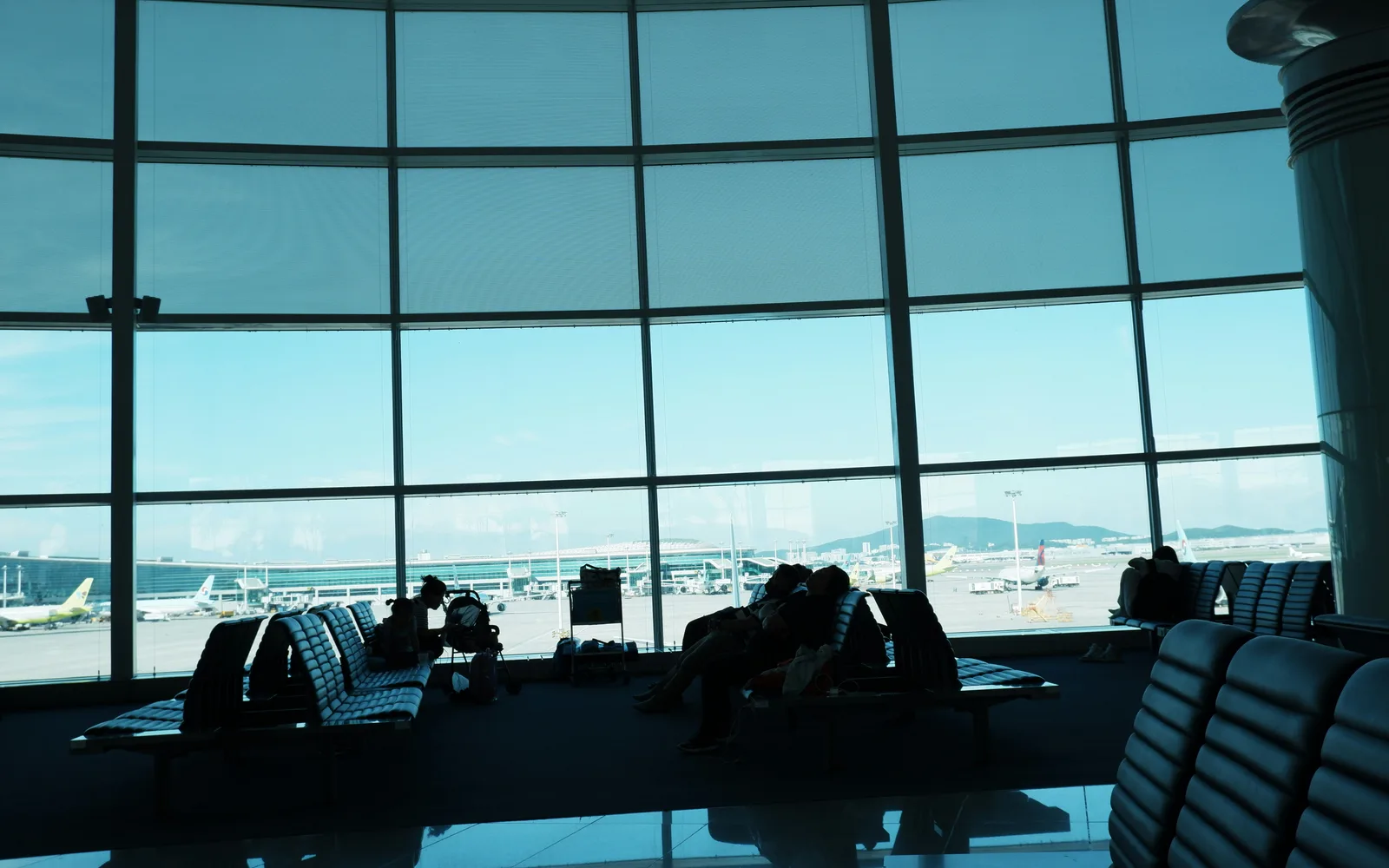
Inside Incheon International Airport. Photo: Itsuka Iwaki, Unsplash License. Cropped and optimized. The people pictured do not endorse this guide.
First decide whether you will enter Korea
The legal entry question and the transfer-mechanics question are separate.
| Path | Entry into Korea | Confirm before departure |
|---|---|---|
| Stay on the controlled international-transfer route with carry-on only or through-checked baggage | No | The operating airlines support the airside connection and can issue or accept the onward travel document airside. |
| Sightsee, collect baggage, use a landside check-in counter, join an off-airport Transit Tour or sleep landside | Yes | The Korea Visa Navigator supports your passport and itinerary, and all connection steps fit. |
| Depend on a special transit-without-visa path | Yes | Every condition for the exact scheme is met. A tour reservation or onward ticket does not guarantee admission. |
Use the Visa Navigator for visa, K-ETA, transit-scheme and arrival-card rules. Because nationality rules can change, this guide does not repeat them.
Ask the operating airlines:
- What final airport code will be printed on the checked-bag tag?
- Will the first airline issue both boarding passes?
- If not, can the onward airline complete its document check at an airside ICN transfer desk?
- Does special baggage, a document check or the ticket arrangement require a landside counter?
- Who handles rebooking if the inbound flight is late?
Through-checking varies by airline and itinerary, even on one ticket. Separate tickets may still allow it. Read the bag tag and ask the operating airlines.
If you must collect baggage at ICN, the sequence is:
immigration → baggage claim → customs as required → onward check-in or bag drop → security → departure immigration → gate
Confirm T1, T2 and the Concourse
Use the e-ticket and the airport's live departure search. A codeshare can use the operating airline's terminal rather than the one expected from the marketing airline.
The IIAC International Transfer Guide shows the controlled routes between T1, the Concourse and T2. Some connections use the airside IAT shuttle train, which runs about every five minutes. Once you board, you cannot reverse direction. The Concourse is an airside gate building, not a public terminal.
Public T1/T2 buses are landside. The current airport route map lists:
- AIRPORT 03: T2 to T1 and onward, every 7–20 minutes, 04:30–23:35.
- AIRPORT 04: T1 to T2 and onward, every 10–20 minutes, 04:30–23:20.
These buses are not an overnight transfer guarantee. A traveler using them must be admitted to Korea and complete the departure process again at the correct terminal.
Calculate activity time
Write down each step that applies. Do not use a scheduled eight-hour layover as eight hours of sightseeing.
| Step | What to include |
|---|---|
| Taxiing, gate arrival and deplaning | Allow for the time before you leave the aircraft |
| Transfer security or Korean immigration | Check the queue after landing |
| Baggage claim and customs | Include these if entering Korea with checked bags |
| Walk and wait for outbound transport | Use your actual terminal and next departure |
| Travel to the destination | Use a current route estimate |
| Return wait and travel | Include a disruption allowance |
| Check-in or bag drop | Use your airline's deadline |
| Security, departure immigration and terminal movement | Allow for queues and any terminal transfer |
| Gate walk plus the airline's boarding margin | Work back from boarding closure |
| Activity time left | Connection time minus every required step above |
Use the operating airline's check-in, bag-drop, document and boarding cutoffs for the exact flight. The airport departure guide asks passengers to reach the gate at least 30–40 minutes before boarding; an earlier airline cutoff still controls.
Cancel or cut short the outing if a delay, queue, closure, weather problem or missed service removes your backup route to ICN.
Four to six hours: use the airport
Find the onward gate and complete the transfer route before choosing a facility. Match the terminal and side of security; a T1 airside listing is not a T2 or landside promise.
On August 4, 2026, the live IIAC convenience directory listed:
| Option | T1 | T2 | What the listing cannot promise |
|---|---|---|---|
| Nap and rest areas | NAP Zone East, Cozy Zone and Relax/Refresh zones on 4F transfer lounges, shown 24 hours | NAP zones on 4F near Gates 231 and 268, shown 24 hours | A free seat, bedding, privacy or quiet |
| Passenger showers | 4F transfer lounges near Gates 25 and 29, 05:00–23:00 | 4F near Gates 231 and 268, 05:00–23:00 | Exact fee, full toiletry list, cleaning closures or queue |
| Transit Hotel | T1 4F near Gate 11, directory shown 24 hours | T2 4F near Gate 252, directory shown 24 hours | Eligibility, a room or an untimed stay |
| K-Culture Zone | T1 east 4F Transit Lounge, 09:00–20:00; the course page describes a free 30-minute activity | Ask the T2 transfer desk for current activities | Same-day program capacity or changes |
On that date, the directory listed no Concourse nap zone, passenger shower or transit hotel. Temporary services may still exist, so ask an information desk without leaving your assigned route.
Use the food guide for current T1, T2 and Concourse restaurants, 24-hour listings and convenience stores. Do not change terminals for a meal.
Six to twelve hours: match one official tour to your schedule
Layover length alone does not determine whether a tour fits. Check the date, terminal, fixed operating window, immigration time, 30-minute report deadline and full return-to-gate plan.
The IIAC course catalogue showed these programs on 4 August 2026:
| Course | Card duration and price label | Published window |
|---|---|---|
| Royal Heritage and Charm: Gyeongbokgung and Insadong | 5 hours, card displays $3 | 09:00–14:00, Tue–Sun; Changdeokgung replaces Gyeongbokgung on Tuesday |
| Embracing Peace: Odusan and Imjingak | 5 hours, free | 09:00–14:00, Wed/Fri |
| DMZ: Third Tunnel and Dora Observatory | 5 hours, card displays $4 | 09:00–14:00, Thu |
| Aegibong Peace Ecopark | 4 hours, free | 09:00–13:00, Mon |
| Gu-eup ferry and Wolmi Park | 4 hours, free | 09:00–13:00, Tue/Sat/Sun |
| Moraenae/Guwol markets and Sorae Port | 5 hours, free | 10:00–15:00, Mon/Tue |
| Hongdae | 4 hours, free | 14:00–18:00, Mon/Tue/Sat/Sun |
| Sinpo Traditional Market | 3 hours, free | 15:00–18:00, daily |
| Seoul Botanic Park | 3 hours, card displays $4 | Bad-weather alternative; no regular schedule shown |
| K-Culture Zone at T1 | 30 minutes, free | 09:00–20:00 |
| Club72 Sky Course | 5 hours, card displays ₩180,000 | 08:00–13:00, daily pickup |
| Orange Dunes Yeongjong | 5 hours, card displays ₩170,000 | 08:00–13:00, Tue/Sat/Sun |
The English Sinpo card says five hours, but its 15:00–18:00 clock window and the Korean IIAC card support three hours. We use three hours here. Confirm the live reservation before relying on it.
Check the reservation page for live inventory; the catalogue only describes programs. The reservation page may list a route absent from the catalogue, while a catalogue card does not confirm seats for your date. IIAC allocates less than half of capacity online, so an online sellout may leave on-arrival seats, but a wait-list is not a safe connection plan.
Operational rules from the Transit Tour Guide:
- The layover must be 24 hours or less. That maximum does not mean every shorter connection fits.
- Bring the passport plus arrival and departure boarding passes.
- Every participant must report to the landside 1F desk at least 30 minutes before the tour, including an online reservation holder.
- Programs and seats can change; online and on-arrival places are first-come, first-served.
- A Concourse arrival must reach the T1 or T2 desk independently.
- If you miss the group away from the airport, you are responsible for getting back to ICN.
IIAC publishes conflicting T2 desk locations. The tour guide says across from Exit 4 at desks 5/6; the service directory says near Exits 5/6 at counters 11/12. Follow your reservation confirmation and current signs, or call T2 at +82-32-741-0060. The T1 desk is listed near Exits 1 and 2 at desks 19/20; its number is +82-32-741-3139.
Treat the displayed $3 or $4 as an unexplained fee, not a confirmed total: IIAC does not publish a complete inclusions table. Confirm golf-tour fees with the operator before paying.
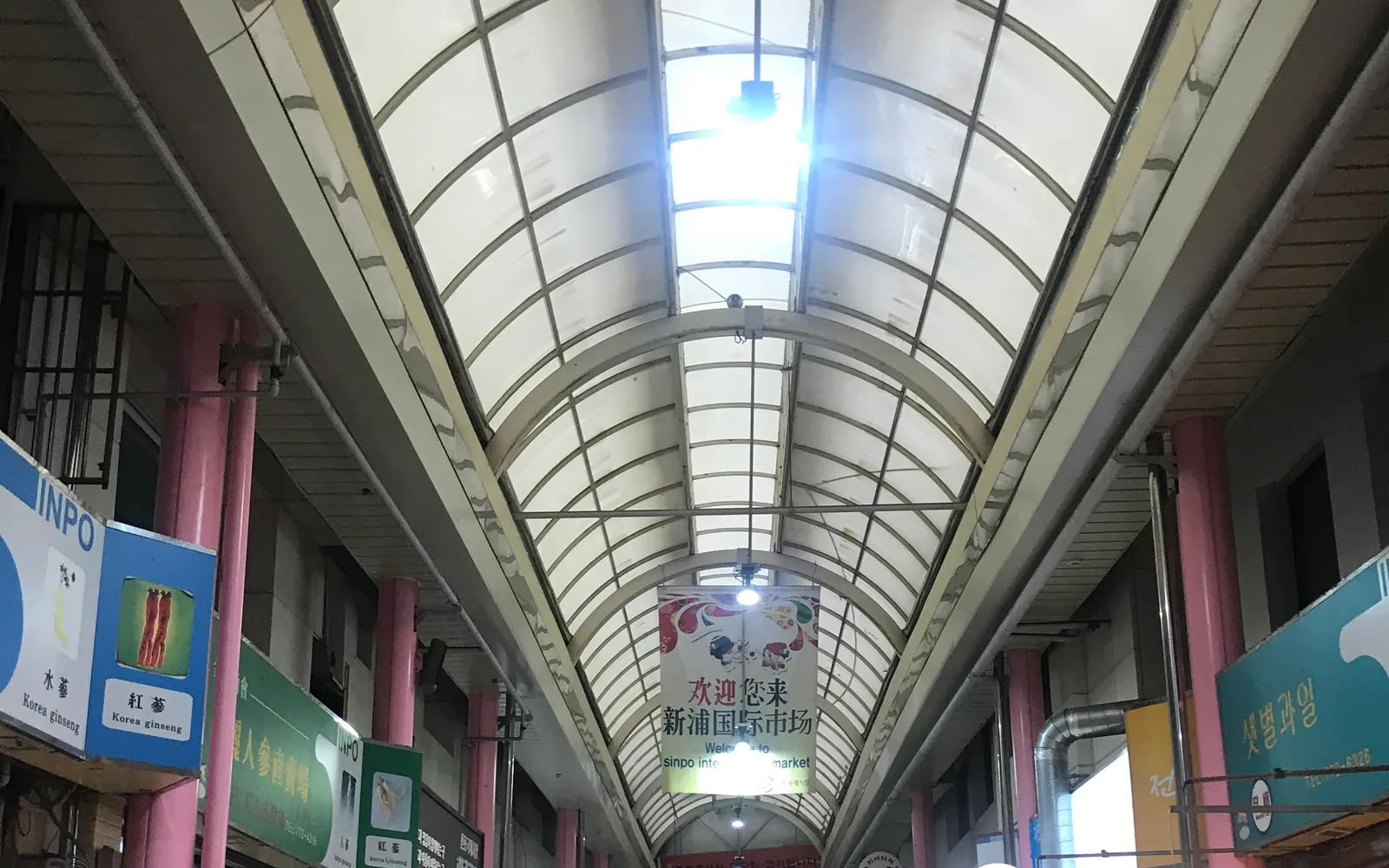
Sinpo International Market, photographed in 2019. Photo: Mming na, CC BY-SA 4.0. Cropped and optimized; this derivative remains under CC BY-SA 4.0. The photo shows the destination, not live tour inventory.
Twelve hours or more: direct AREX to Hongdae
For a daytime layover of 12 hours or more, Hongdae is the simplest independent Seoul option covered here. The airport rail guide places AREX in the B1 Transportation Centers at T1 and T2. All-stop trains run from both terminals to Hongik University Station without a subway change.
The reserved-seat AREX Express skips Hongik University. Do not board it for Hongdae.
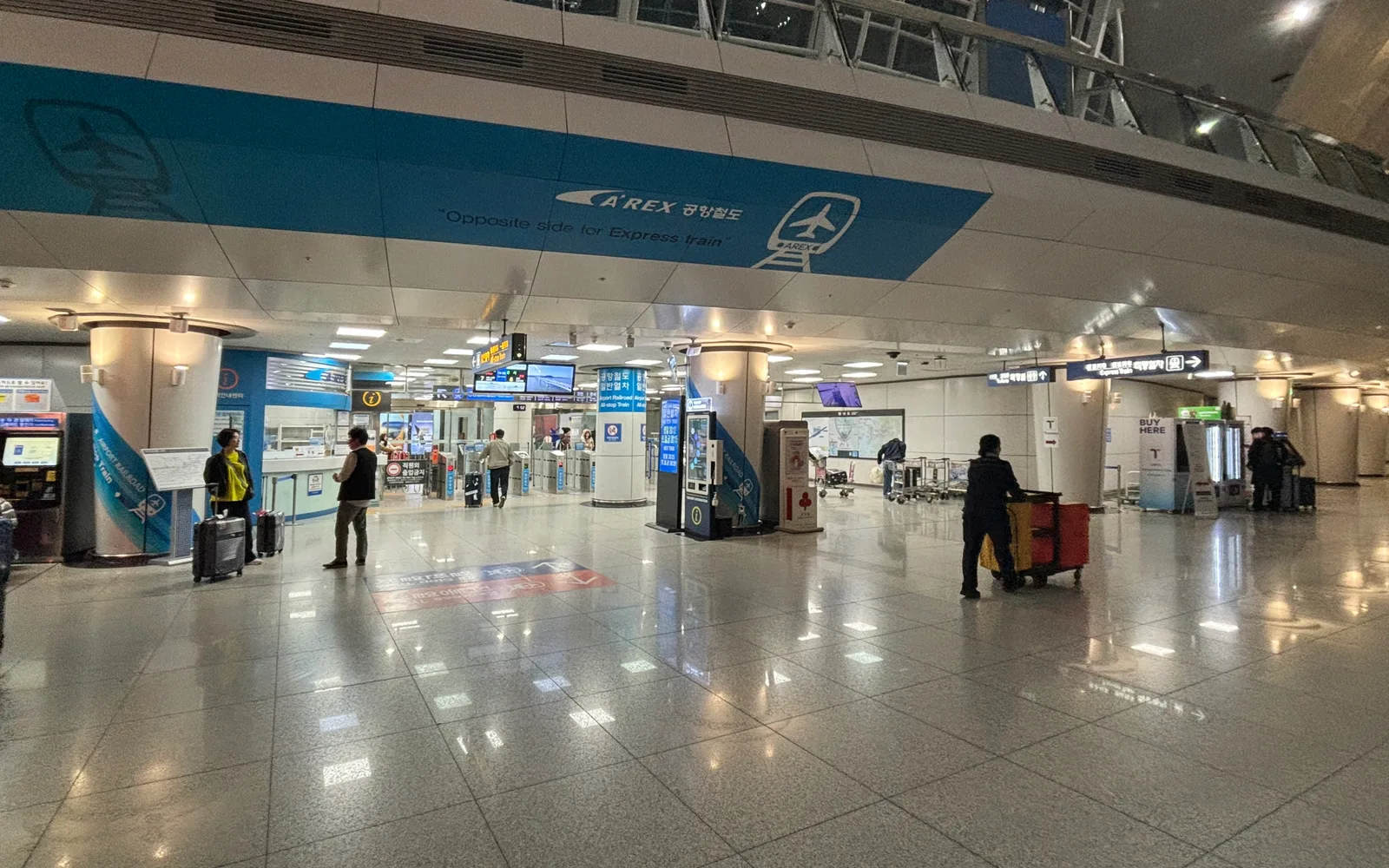
AREX local-train concourse at Incheon Airport Terminal 1, photographed in 2024. Photo: MNXANL, CC BY-SA 4.0. Cropped and optimized; this derivative remains under CC BY-SA 4.0.
Use this route:
- Resolve entry, baggage, onward documents, terminal and airline deadlines.
- Go to the B1 Transportation Center in the T1 or T2 terminal through which you entered Korea.
- Take an AREX all-stop train toward Seoul Station and leave at Hongik University Station.
- Stay in the station-area Hongdae district. Do not add central Seoul or a second neighborhood.
- Before leaving ICN, open the official AREX website, choose Station Information and check the current T1 or T2 and Hongik University timetables. Identify two suitable return trains to the correct terminal.
- Return when the earlier backup becomes the last train that still preserves the complete departure process.
For rough planning, allow about one hour of rail and platform time in each direction, then add station walks, waiting, immigration, security and airline margins. That hour is our conservative allowance, not an AREX journey-time promise. Recheck the official AREX website on the day.
The Seoul Tourism Organization identifies Hongik University Station as an Airport Railroad stop and describes the featured Hongdae area near Exit 4. Choose cafés, shops and streets that do not depend on one timed attraction.
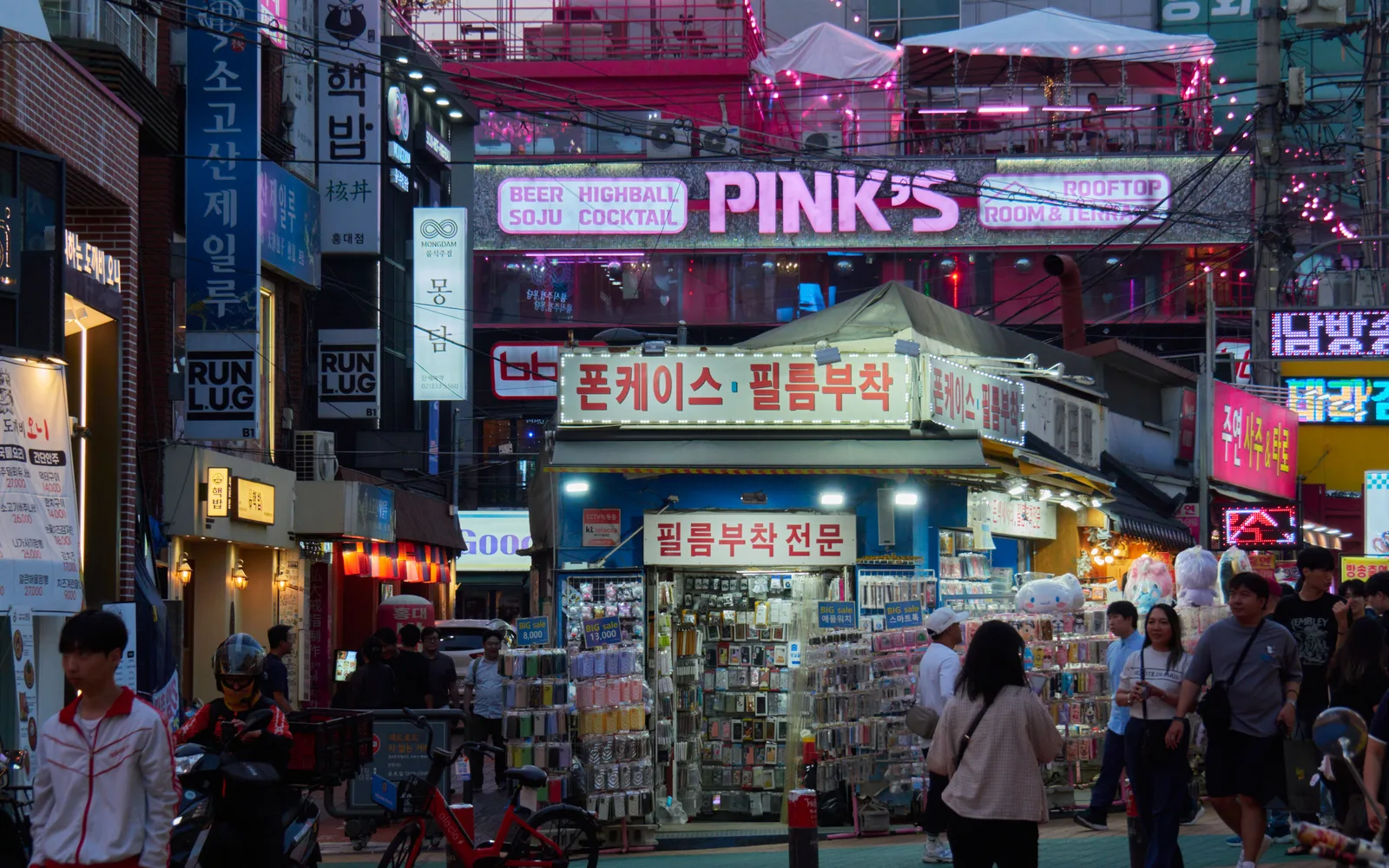
Hongdae at night, photographed in 2024. Photo: lumoplank, CC0 1.0. Cropped and optimized.
Historic Incheon and Yeongjong: verify both directions or take a tour
The official Incheon tourism site groups Chinatown, the Open Port area, Freedom Park, Sinpo Market and Wolmi among its historic waterfront sights. Reaching this district from ICN requires a city-bus journey or rail transfers; there is no direct airport train to Incheon Station.
For a shorter layover, choose the official three-hour Sinpo or four-hour Gu-eup ferry/Wolmi tour. Plan an independent Chinatown trip only after confirming current transport in both directions and a fallback to the correct terminal.
Do not treat Eurwangni as a default six-hour plan. Yeongjong beaches require road transport, suitable weather and a reliable return.
Eurwangni Beach on Yeongjong Island. Photo: Hojin Ryu, Pexels License. Cropped and optimized. The image does not establish transport time or current beach conditions.
Overnight: choose airside or landside first
| Sleep option | Side and terminal | Main access question |
|---|---|---|
| Walkerhill Transit Hotel T1 | Airside, T1 4F near Gate 11 | Does the exact itinerary, boarding pass and baggage routing allow access? |
| Walkerhill Transit Hotel T2 | Airside, T2 4F near Gates 251–252 | Does the onward flight and transfer path remain in T2? |
| T1/T2 nap zones | Airside transfer lounges | Is a space available, and can you remain on that transfer route? |
| Darakhyu T1 or T2 | Landside Transportation Center | Can you enter Korea, and did you book the matching branch and time block? |
| Off-airport hotel | Landside | Does late check-in and the return transport fit the flight? |
Walkerhill's Transit Hotel FAQ says checked bags cannot be collected from the transit area and gives conflicting answers about some international-to-domestic use. Confirm the exact itinerary with the hotel and airline.
Darakhyu is public-side. The operator places T1 Darakhyu in the T1 Transportation Center and T2 Darakhyu on B1 of the T2 Transportation Center. Official sources disagree about the T1 floor label, so follow the operator map and terminal signs.
Use the full hotels near Incheon Airport guide to compare room types, shuttle schedules and whether a Darakhyu room includes a shower or private toilet. Buy food and water before late-night closures; the airport food guide lists current overnight fallbacks.
If the airline caused the overnight disruption, visit its transfer or service desk before paying for a room. Assistance depends on the cause, ticket and carrier policy.
Luggage during a landside outing
Read the final airport on the bag tag. A public-area storage counter requires entry into Korea, and each operator sets its own hours, accepted items and collection deadline.
Use the Incheon Airport luggage storage guide for live counters. Keep the passport, medications and flight documents with you.
Plan B: fall back to an airport-only plan
Switch to the airport-only plan when the inbound flight is late, a queue grows, weather affects transport, a facility closes or the second return service disappears.
If a tour sells out, do not attempt the same itinerary on your own. The coach and group return are part of the tour's timing.
Complete the transfer, confirm the onward gate, then choose food, rest or a same-zone facility. Contact the operating airline as soon as a delay threatens the connection.
Check before you travel
Confirm these details for your own itinerary and travel day:
- whether immigration admits one traveler;
- baggage through-check and airside boarding-pass handling for one ticket and carrier combination;
- the airline's live check-in, bag-drop, document and boarding cutoffs;
- inbound delay, gate position, queues and walking time;
- the current T2 Transit Tour desk signage while two IIAC pages conflict;
- a tour seat, nap seat, shower, lounge or hotel room at that moment;
- the last useful AREX train after disruption;
- actual facility price, consumables, cleaning closure and queue where the directory is silent;
- the complete step-free path for one mobility need.
If any key item remains unresolved, use the airport-only plan.
Frequently asked questions
Can I leave Incheon Airport during a layover?
Only if Korean immigration admits you and you have confirmed entry rules, baggage handling, onward documents, terminals, airline deadlines and safe return transport. Start with the Korea Visa Navigator.
Is a six-hour layover enough for Seoul?
No. A scheduled six-hour layover is too short for an independent Seoul trip. Stay at the airport by default. An exact live three-hour Transit Tour, such as Sinpo, may fit some schedules after you account for its fixed window, 30-minute report rule and the full departure process.
Which official tour fits an eight-hour layover?
Check the live reservation page for a three- or four-hour tour that matches your date and terminal. Catalogue examples include Sinpo, Aegibong, Wolmi and Hongdae, but only live inventory confirms seats.
Are the Transit Tours free?
Many standard cards say free. Others display $3 or $4, and special golf cards display a much larger won amount. Check the live card because IIAC does not publish one complete inclusions table.
Can I visit Hongdae independently?
With at least 12 daytime hours, Hongdae may fit after all entry and connection checks pass. Take the AREX all-stop train from T1 or T2 to Hongik University; the Express skips that station. Choose two return trains before leaving ICN.
Can I stay airside on separate tickets?
Possibly. Confirm that your baggage checks through and that the onward airline can issue or accept the required travel document at an airside ICN transfer desk.
Where can I sleep during an overnight layover?
T1 and T2 have separate airside Transit Hotels and nap areas. Darakhyu and conventional hotels are landside and require entry into Korea. Match the bed to the terminal, baggage and onward route.
Official sources
- Incheon Airport: International Transfer Guide
- Incheon Airport: Transit Tour Guide
- Incheon Airport: current course catalogue
- Incheon Airport: live tour reservation
- Incheon Airport: live convenience directory
- Incheon Airport: Airport Railroad guide
- AREX: official website
- Entry sources in the Korea Visa Navigator