Incheon Airport Terminal Map:T1, T2, Concourse and Transfers
Open the right Incheon Airport map, confirm T1 or T2 by flight number, and follow current airside, shuttle-bus or AREX transfer instructions.
Official sources checked 10 September 2026

Ask Narin.
Find answers in this guide
Narin is a fictional AI host.
Loading your saved chat…
NarinAsk me a question about this guide. Answers include links to the guides.
30-second answer
Confirm the flight first. Search the exact number and date on the official passenger departure page or passenger arrival page. Those live records show the terminal and, when assigned, the counter, gate, baggage belt and arrival exit.
Then open the official interactive Airport Map. Select Terminal 1, Concourse or Terminal 2, followed by the floor and place category. For restaurants, showers, hotels and other services, confirm the Public Area or Duty-Free Area label in the facility directory.
| Your situation | Go to |
|---|---|
| Connecting without entering Korea | Airside international connections |
| Changing terminals after entering Korea | Landside transfer between T1 and T2 |
| Landing at ICN | Arrival route |
| Flying from ICN | Departure route |
| Meeting a passenger | Meeting an arriving passenger |
Use the official map by task
| What you need now | Open this | Use it for |
|---|---|---|
| Departure terminal, counter or gate | Live passenger departures | Flight number, terminal, check-in counter, gate and status |
| Arrival terminal, belt or pickup exit | Live passenger arrivals | Terminal, arrival gate, baggage claim, arrival exit and status |
| A route inside the airport | Interactive Airport Map | Building, floor, category and point-to-point directions |
| A restaurant or passenger service | Facility directory | Terminal, passenger zone, hours, location and phone |
| An international connection | Official transfer routes | Origin and onward terminal; secure-route sequence |
| A public T1–T2 move | Complete shuttle routes | Direction, stop, interval and operating window |
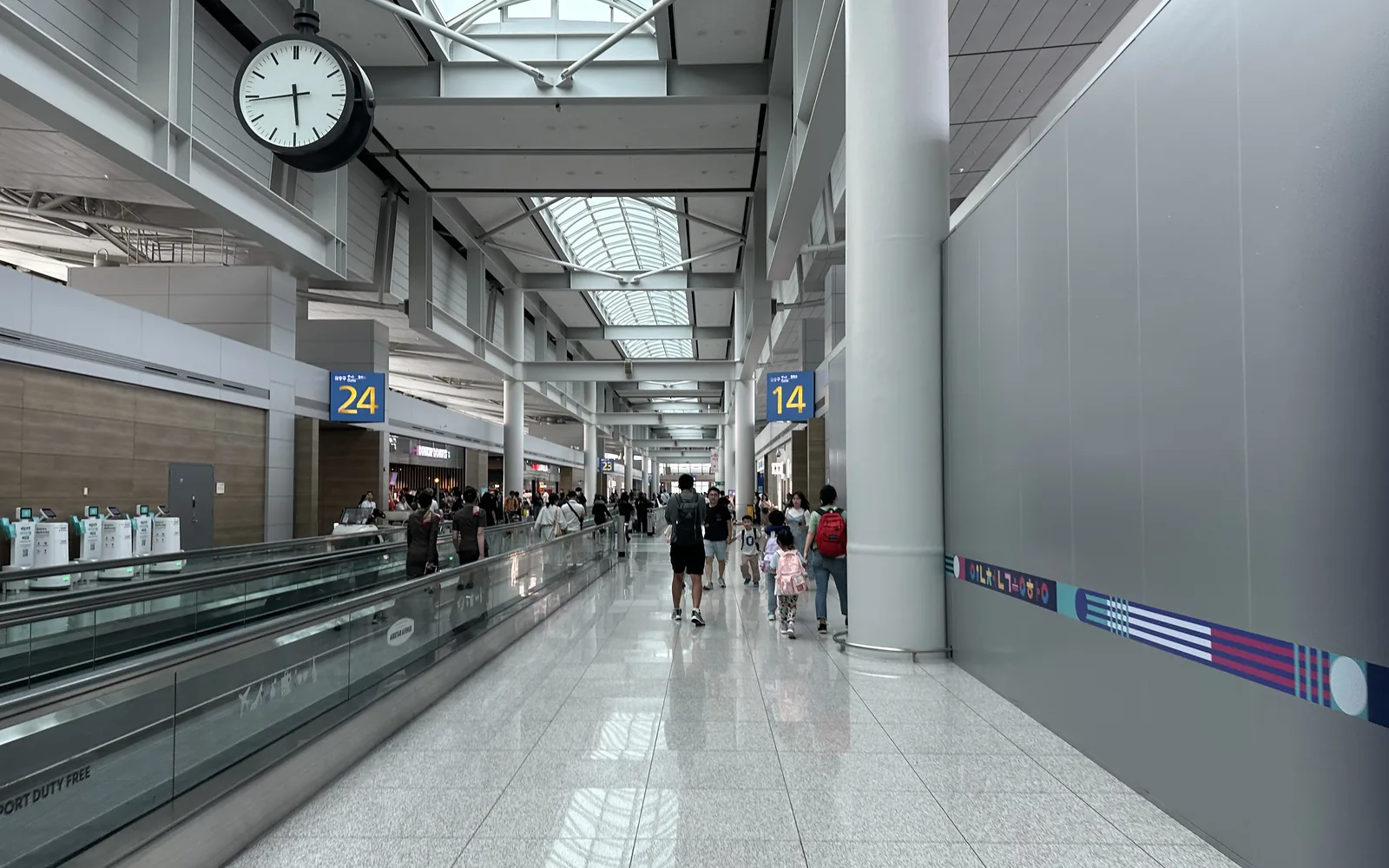
Terminal 1 airside corridor, photographed July 30, 2023. Gate signs 14 and 24 are visible, but construction walls and shops can change. Photo: AirportTerminalGuy, CC BY 4.0. Cropped, resized and converted to WebP.
The interactive map currently offers these floor selectors:
| Building | Floors in the current map |
|---|---|
| Terminal 1 | B2, B1, 1F, 2F, 3F, 4F |
| Concourse | B1, 1F, 2F, 3F, 4F |
| Terminal 2 | B1, M, 1F, 2F, 3F, 4F, 5F |
Choose the building first. Search for the facility, then confirm the floor and passenger zone. A place on the correct floor can still sit behind security or immigration.
For basic orientation:
- International arrival gates are on 2F. Passengers ending their trip at ICN continue through immigration to baggage claim on 1F and then the public arrivals hall.
- Departure check-in is on 3F in both T1 and T2. The public check-in hall and airside gate level share a floor number but are separated by security and departure immigration.
- Transfer screening is generally on 2F, while onward gates are on 3F. The transfer-desk location depends on the itinerary.
- The controlled shuttle train used during some connections is on B1. It is not AREX.
- AREX stations are reached through the public transportation-center route. Airport buses use signed public curb stops; they do not leave from the AREX platform.
Use the directory's actual Public Area, Duty-Free Area, arrival or transfer label. Do not guess access from a gate number, floor or business name.
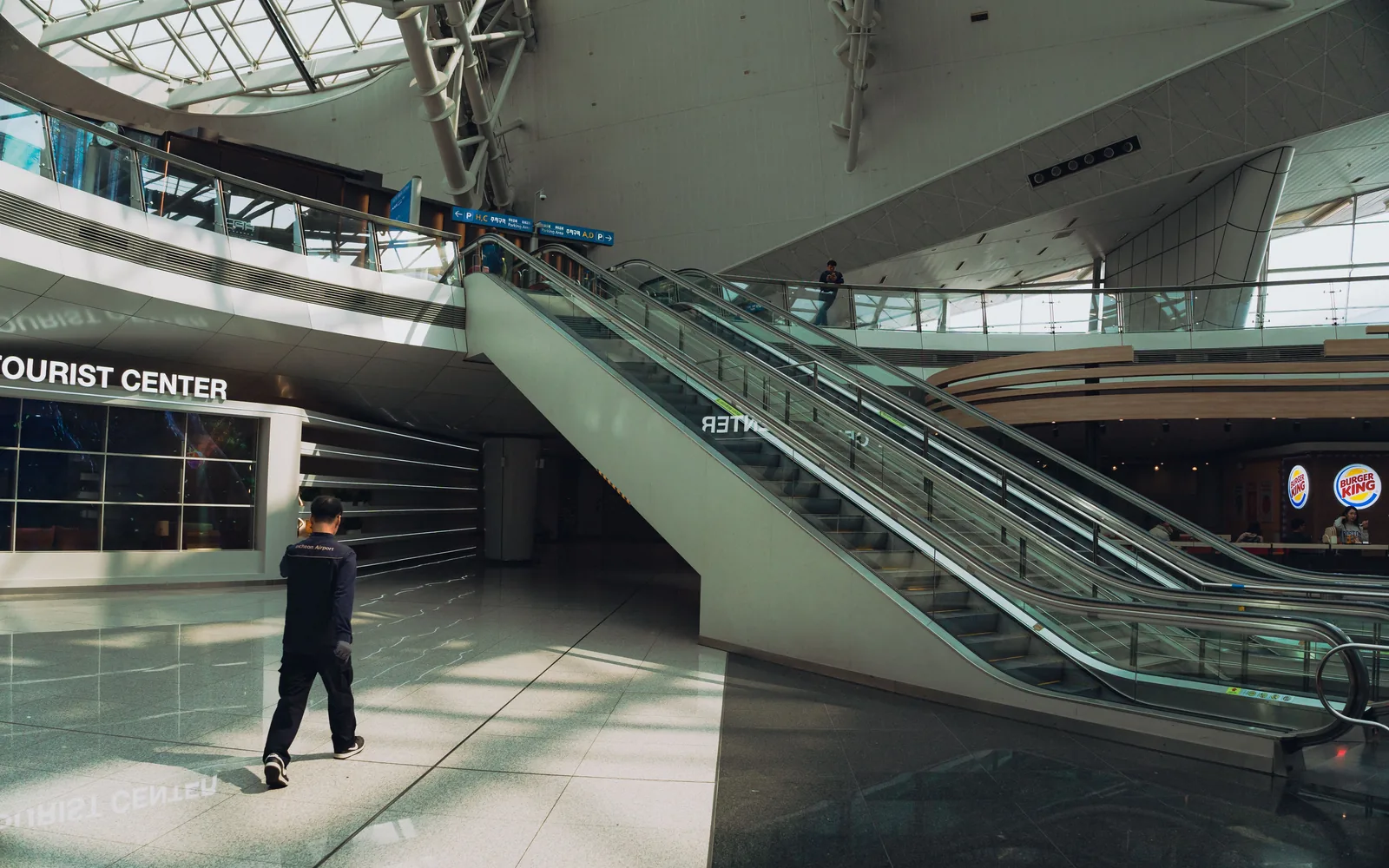
Illustrative Incheon Airport wayfinding scene. Pexels does not identify the terminal or floor, so the photograph is not evidence for a specific route. Photo: Theodore Nguyen, date not disclosed, Pexels License. Cropped and optimized.
T1, Concourse and T2 are different places
Terminal 1
T1 has its own public arrival hall, 3F check-in hall, transportation center and airside gates. The general IIAC gate table places Gates 1–50 in T1.
Concourse
The Concourse is a secure gate building connected to T1, with no landside entrance. IIAC's general table places Gates 101–132 there. Passengers reach it only through the controlled airport process.
The Concourse shuttle-train platform is on B1. Every official transfer itinerary that uses this train displays a no-return warning. Board only for the route to the assigned onward gate.
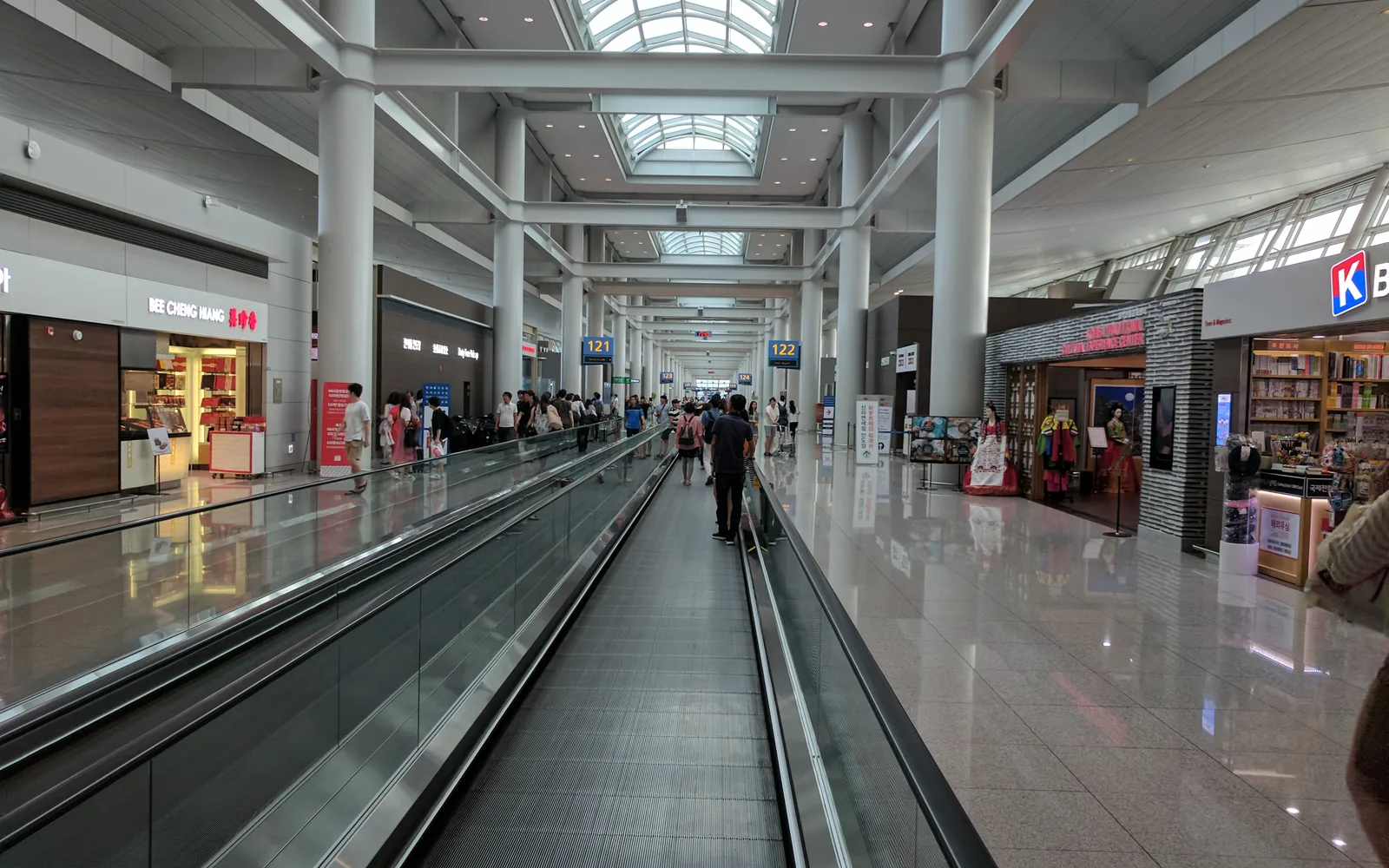
Concourse moving walkway near Gates 121–122, photographed July 29, 2017. Retail and signs may have changed since the photograph. Photo: Robin van der Vliet, CC BY-SA 4.0. Cropped, resized and converted to WebP under the same license.
Terminal 2
T2 has separate public arrivals, departures, transportation-center and airside facilities. IIAC's general departure page says its gates run through 290, while the current IIAC map data includes Gate 291. Because those references disagree, confirm the assigned terminal and gate in the live flight record.
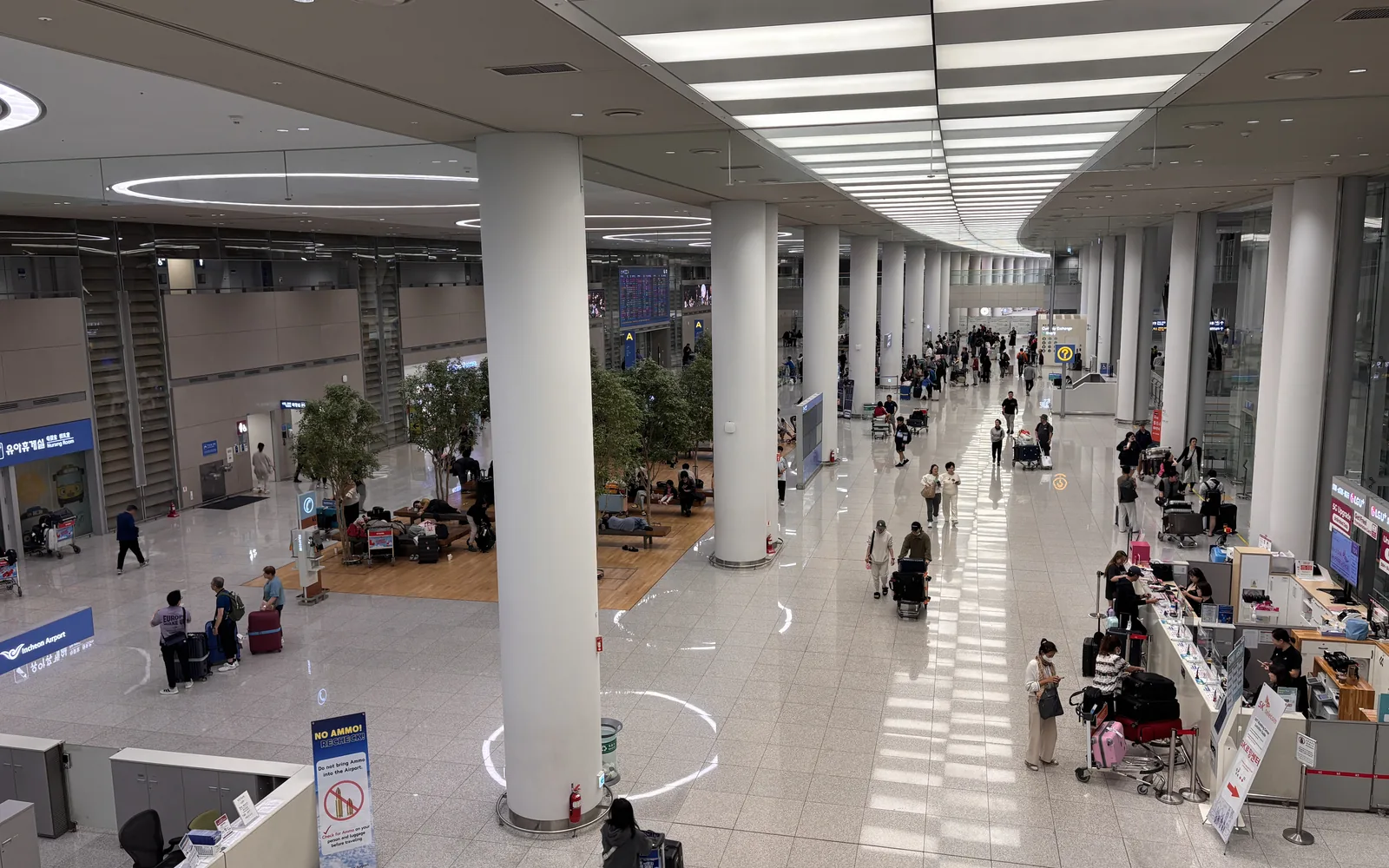
Terminal 2 arrivals hall, photographed in October 2025. The hall-letter signs and service counters can change. Photo: Choikwangmo25, CC0 1.0. Cropped, resized and converted to WebP.
Confirm your terminal before leaving home
Search the operating date and exact flight number in the passenger departure timetable. Match the result to the operating airline on the booking, especially when the ticket shows a codeshare. Recheck on the travel day and on the airport flight displays.
Do not plan from an old “airlines by terminal” graphic. IIAC warns that operational information can change, and a marketing carrier is not always the airline operating the aircraft. If the airport and airline records disagree, contact the operating airline.
For an arrival, use the passenger arrival timetable. It can show the terminal, gate, baggage belt and arrival exit. Those fields may update after touchdown.
Meeting an arriving passenger
Wait landside in the terminal shown on the live record. T1 has arrival halls A–F; T2 has A–B. Use the live arrival exit instead of the hall's static letter range; it tells the person meeting the passenger which part of the public arrivals hall to use.
An arrival-hall letter and a numbered curb door are different landmarks. Keep monitoring the flight after landing and agree on a simple fallback, such as the information desk in the listed arrival hall. The person meeting the passenger cannot enter the controlled gate or baggage-claim area; meet only after the traveler exits into the public arrivals hall.
Airside train, shuttle bus or AREX?
| System | Where it runs | Who uses it | Fare |
|---|---|---|---|
| Airside shuttle train | Controlled T1–Concourse–T2 transfer route on B1 | International transfer passengers whose official route includes the shuttle train | Part of the airport transfer process |
| Airport shuttle bus | Public 3F curb stops at T1 and T2; AIRPORT 03/04 continue beyond the terminals | Landside passengers who have entered Korea | Free |
| AREX All-Stop Train | Public T1 and T2 airport railroad stations | Landside passengers with a rail ticket or transport card | ₩1,200 adult transport-card fare; single-use ticket pricing differs |
Airside international connections
Stay on the green Transfer route unless the airline or airport staff directs you to enter Korea. The secure shuttle train, public curbside bus and AREX are separate systems.
The table below summarizes all nine official international-transfer combinations. Open the link that matches where you arrived and where the onward flight departs.
| Connection | Official route |
|---|---|
| T1 → T1 | Arrival gate → transfer screening on 2F → up to the 3F departure gate |
| T1 → Concourse | T1 screening on 2F → 3F → B1 train to Concourse → up to the 3F gate |
| T1 → T2 | T1 screening → B1 train to Concourse → transfer to the T2 train → up to the T2 3F gate |
| Concourse → T1 | B1 train to T1 → T1 screening on 2F → up to the 3F gate |
| Concourse → Concourse | Concourse screening on 2F → up to the 3F gate |
| Concourse → T2 | Concourse screening → B1 train to T2 → up to the T2 3F gate |
| T2 → T1 | B1 train to Concourse → transfer to the T1 train → T1 screening on 2F → 3F gate |
| T2 → Concourse | B1 train to Concourse → Concourse screening on 2F → 3F gate |
| T2 → T2 | T2 screening on 2F → up to the 3F gate |
The transfer pages publish a five-minute interval for each train leg they use. Treat each shuttle-train leg as one-way and confirm the onward terminal before boarding. Follow the page for the actual gate pair and ask transfer staff if anything is unclear.
If an onward boarding pass was not issued, follow signs to the airline transfer desk. Desk locations differ by route and side of screening. Ask the airline to confirm the minimum connection time, baggage transfer and whether it can issue the onward boarding pass airside.
Our Incheon Airport layover guide covers entry, timing, sleep and food decisions around a connection.
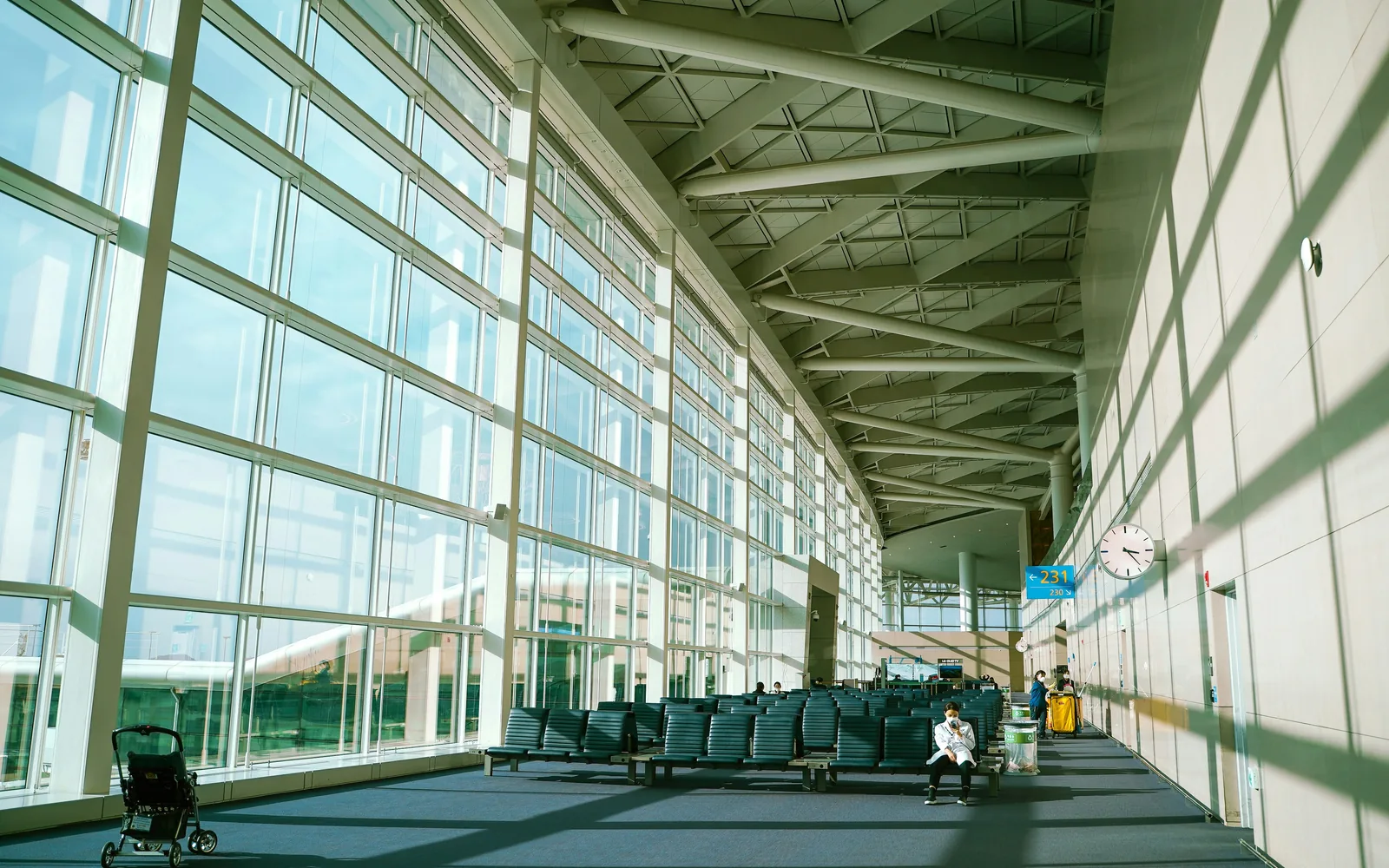
Terminal 2 airside seating near Gates 230–231; the photograph was published April 3, 2020, and seating or signs may have changed. Photo: Lei Jiang (@lj333), Unsplash License. Cropped and optimized.
Separate tickets, baggage and entering Korea
If the bag tag ends at ICN, or the onward airline cannot issue a boarding pass airside, the trip may require immigration, baggage claim, customs, a landside terminal move and check-in again. Ask the first carrier where the bag will next appear and ask the onward carrier whether it can issue your boarding pass while you remain airside.
Use our Korea Visa Navigator before assuming that you may enter Korea. It routes travelers to the appropriate official authority for the passport and itinerary. Do not cross immigration just to find a restaurant or move to a different terminal.
IIAC also publishes a distinct Transit Exclusive Domestic Flights process. International arrivals using that process may not leave the arrival hall. Ask the airline whether the itinerary uses this special process.
Landside transfer between T1 and T2
Travelers who have entered Korea can use the free airport shuttle bus or paid AREX All-Stop Train. A taxi from the official rank is a fallback. ICN does not publish a practical pedestrian route between the terminals.
Free airport shuttle bus
The two directions use different extended routes. Check the sign before boarding.
| Direction | Route and boarding point | Published interval | Published hours |
|---|---|---|---|
| T1 → T2 | AIRPORT 04, T1 public 3F curb outside terminal entrance 8 | 10–20 min | 04:30–23:20 |
| T2 → T1 | AIRPORT 03, T2 public 3F curb outside terminal entrance 7 | 7–20 min | 04:30–23:35 |
AIRPORT 03 serves the T1 public curb near terminal entrances 3 and 12 before continuing to other airport districts. AIRPORT 04 reaches the T2 public curb near the central entrances 6–7 and also serves other stops. Both are free.
The complete route table shows 83 minutes for the full AIRPORT 03 route and 62 minutes for the full AIRPORT 04 route. Those figures cover their extended routes; they are not T1–T2 ride-time promises. Allow for the walk to 3F, the variable wait, traffic and the walk from the destination stop.
After the final free shuttle, check whether AREX is still operating. Otherwise use the official taxi rank. Use AIRPORT 03 or 04 for terminal transfers; AIRPORT 01 and 02 serve parking areas.
Paid AREX All-Stop Train
IIAC estimates six minutes on the train between the airport stations. The current AREX fare table lists a ₩1,200 adult transport-card fare between T1 and T2, checked September 10, 2026. Add time to reach the station, buy or tap your fare and wait for the train.
IIAC lists ₩1,050 on its inter-terminal page, while AREX currently lists ₩1,200. Use the fare shown by AREX when you travel. Our T-money at Incheon Airport guide explains where to get a card and the cash rules; a separate rail ticket is another option.
Do not take an airport baggage trolley through a ticket gate or onto a bus or train unless current signs or staff explicitly permit it. IIAC does not publish a stable trolley-boundary rule for these transfers. If you have a landside layover and will return to the same terminal, the luggage-storage guide lists verified staffed counters.
Arrival route: gate to public transport
If ICN is the destination:
- Arrive at the 2F gate and follow Arrivals signs.
- Complete any passenger quarantine or health screening required for the flight, then immigration.
- Go to the assigned baggage belt on 1F. Check the live display; oversized bags use a separate 1F counter.
- After collecting bags, complete customs and any animal, plant, livestock-product or seafood quarantine inspection that applies.
- Exit into the public arrival hall.
- Choose the signed route for AREX, airport bus, taxi, pickup or hotel transport.
If the trip ends at ICN after a Concourse arrival, follow Arrivals signs and the controlled train to T1; the Concourse has no public arrivals curb.
Ground-transport modes use different ticketing points, floors and stops. Follow the official sign for the mode rather than a generic “transportation” arrow. See Incheon Airport to Seoul to compare AREX, airport bus and taxi options into Seoul, and the hotels near Incheon Airport guide for terminal-specific hotel transfers.
Departure route: curb to gate
- Confirm T1 or T2 in the live passenger departure record.
- Go to that terminal's 3F departure hall.
- Check the airport display for the current counter, then complete check-in and bag drop.
- Follow signs through security and departure immigration.
- Recheck the gate before choosing food, shopping, a lounge or the Concourse train.
The public 3F check-in hall and the airside 3F gate area are separate zones. Once you pass departure immigration and enter the duty-free area, IIAC says you cannot return to the pre-security public area.
For current queues, use IIAC's real-time wait times and expected congestion. The airline's bag-drop and boarding deadlines still apply.
Check oversized baggage with the airline before using the signed 3F oversized counter. On arrival, oversized-claim counters are on 1F. Airline allowance and special-bag acceptance are separate from the airport location map.
Once the gate is known, use the airport food guide, showers guide or transit hotel guide only for options in the same terminal and passenger zone.
Accessibility and terminal assistance
Request airline mobility assistance before travel. A floor map cannot confirm the aircraft handoff, open screening lane, lift status or step-free route for one exact gate pair.
IIAC currently publishes these orientation points:
- accessible passenger drop-offs near T1 Exits 3, 7 and 12 and T2 Exits 4 and 9;
- free manual wheelchairs at all airport information desks;
- help phones and terminal wheelchair or electric-vehicle assistance through an information desk or 1577-2600;
- at least one accessible stall in every terminal restroom;
- electric-wheelchair charging and air stations in both terminals and their transportation centers;
- audio-guidance points on the 3F departure level in T1 and T2.
Use the official mobility-assistance guide and priority-lane rules for current eligibility and service limits. Airport electric-vehicle service does not include baggage handling.
For the landside terminal shuttle, IIAC tells wheelchair users to call 032-741-3217 for the free lift vehicle and recommends advance contact. IIAC pages disagree on the lift vehicle's hours and reservation rules, and service depends on available vehicles and staff. Confirm the time and pickup before relying on it. If it is unavailable, ask the information desk to identify a current step-free alternative.
Check before traveling
Use the flight number and operating airline to confirm the terminal, check-in counter and gate. Recheck the airport display after arriving.
- Ask the airline whether bags are through-checked and whether it can issue the onward boarding pass airside.
- Follow current signs for construction detours and closed screening points; leave extra time for queues and terminal transfers.
- If you need a step-free route or a lift vehicle, arrange assistance for the actual arrival and departure gates. An airport-wide accessibility listing cannot confirm today's elevator availability.
- Check the next shuttle or train and your destination's current opening hours before leaving your terminal.
Plan B
If the downloaded map and airport signs disagree, stop before crossing a controlled boundary. Show the flight number and boarding pass at an information or transfer desk.
If you are in the wrong public terminal, compare the free shuttle's operating window with AREX and the official taxi rank. If you are already airside, do not leave on your own or try to reach public transport. Follow the official transfer route, or ask airline or transfer staff whether the itinerary requires entry into Korea and a landside terminal move.
If the arrival record has no pickup exit yet, wait for the assignment and meet at the terminal's public information desk. If a lift or escalator is out, ask staff for the current accessible route. If a connection is becoming too short, contact the airline transfer desk immediately.
Frequently asked questions
How do I know whether my flight uses Terminal 1 or Terminal 2?
Search the exact flight number and date in the official passenger timetable, then confirm with the operating airline. Codeshares and operational changes make old airline lists unreliable.
What is the official Incheon Airport terminal map?
Use IIAC's interactive Airport Map. Select T1, T2 or Concourse, then the floor and category for the place you need.
Is the Concourse the same as Terminal 2?
No. The Concourse is a controlled airside gate building. It has no public curb or landside entrance.
Can I walk between T1 and T2?
ICN does not publish a practical passenger walking route. Landside, use the free shuttle, paid AREX or an official taxi. Airside, follow the controlled transfer route.
Is the shuttle bus between T1 and T2 free?
Yes. T1 → T2 uses AIRPORT 04 from the T1 public 3F curb outside terminal entrance 8, published 04:30–23:20 every 10–20 minutes. T2 → T1 uses AIRPORT 03 from the T2 public 3F curb outside entrance 7, published 04:30–23:35 every 7–20 minutes.
How much is AREX between T1 and T2?
The current AREX table lists ₩1,200 for an adult using a transport card. IIAC estimates six minutes on the train; add walking, ticketing and waiting time.
Do I use the public shuttle bus for an airside connection?
No. Stay on the green Transfer route and use the controlled airside shuttle train when the itinerary page requires it. The curbside bus and AREX are landside.
Where should I meet an arriving passenger?
Use the terminal and arrival exit in the live arrival record. Monitor it after landing because the baggage belt and exit can change.
Do separate tickets mean I must enter Korea?
They can. If the bag is not through-checked or the airline cannot issue the onward boarding pass airside, the trip may require immigration, baggage claim, customs, a terminal move and another check-in. Ask both airlines and use the Visa Navigator before assuming entry is possible.
Is an accessible terminal-transfer vehicle available?
IIAC asks wheelchair users to call 032-741-3217 for the free lift vehicle and recommends advance contact. Confirm current hours, pickup and availability.
Official sources
- IIAC: interactive Airport Map
- IIAC: live passenger departures
- IIAC: live passenger arrivals
- IIAC: facilities by terminal and passenger zone
- IIAC: departure procedure and gate table
- IIAC: arrival procedure
- IIAC: baggage claim and arrival halls
- IIAC: international transfer guide
- IIAC: complete landside shuttle routes
- IIAC: AIRPORT 03, T2 toward T1
- IIAC: AIRPORT 04, T1 toward T2
- IIAC: inter-terminal transport overview
- AREX: current All-Stop fares
- IIAC: mobility assistance
- IIAC: priority security lane