Incheon Chinatown:Walking Route, Food and How to Get There
Plan Incheon Chinatown from Exit 1 with a practical walking route, current museum hours and prices, food guidance, accessibility notes, and airport directions.
Official sources checked 10 September 2026

Ask Narin.
Find answers in this guide
Narin is a fictional AI host.
Loading your saved chat…
NarinAsk me a question about this guide. Answers include links to the guides.
30-second answer
Take Seoul Subway Line 1 to its final stop, Incheon Station, and use Exit 1. Cross at the marked crossing to the Chinatown gate. Start with the Jjajangmyeon Museum, climb toward the Qing–Japan Boundary Stairs and Jayu Park only if stairs suit you, then descend through the Open Port museum district.
Coming from ICN? See how to get from Incheon Airport to Chinatown. T1 and T2 use different routes.
Allow 1.5–2 hours for Chinatown streets, one museum and a quick meal; 3–4 hours for the hill, Jayu Park, two museums and a meal; or 5–6 hours when you add Songwol-dong or Sinpo Market. These are planning estimates, not official visit times.
The five municipal museum units normally open Tuesday–Sunday, 09:00–18:00, with last admission at 17:30. They close on Monday. After 17:30, plan an outdoor walk and meal rather than a museum visit. The full hill circuit includes steep streets and stairs.
| Your situation | Best starting plan |
|---|---|
| First visit, 1.5–2 hours | Gate → main street → Jjajangmyeon Museum → meal → station |
| History-focused, 3–4 hours | Museum → boundary stairs → Jayu Park → Open Port museums |
| Monday or after 17:30 | Outdoor streets → boundary area or lower Open Port streets → meal |
| Rain, stroller or limited mobility | Lower streets + individually accessible museums; skip the boundary stairs |
| Arriving from ICN T2 | Bus 307 to Incheon Station, then Exit 1 route |
| Arriving from ICN T1 | Bus 306 to Jemulpo-gu Office/Open Port, then reverse the route |
Jump to: getting there · route choices · museum prices · food · accessibility · Plan B
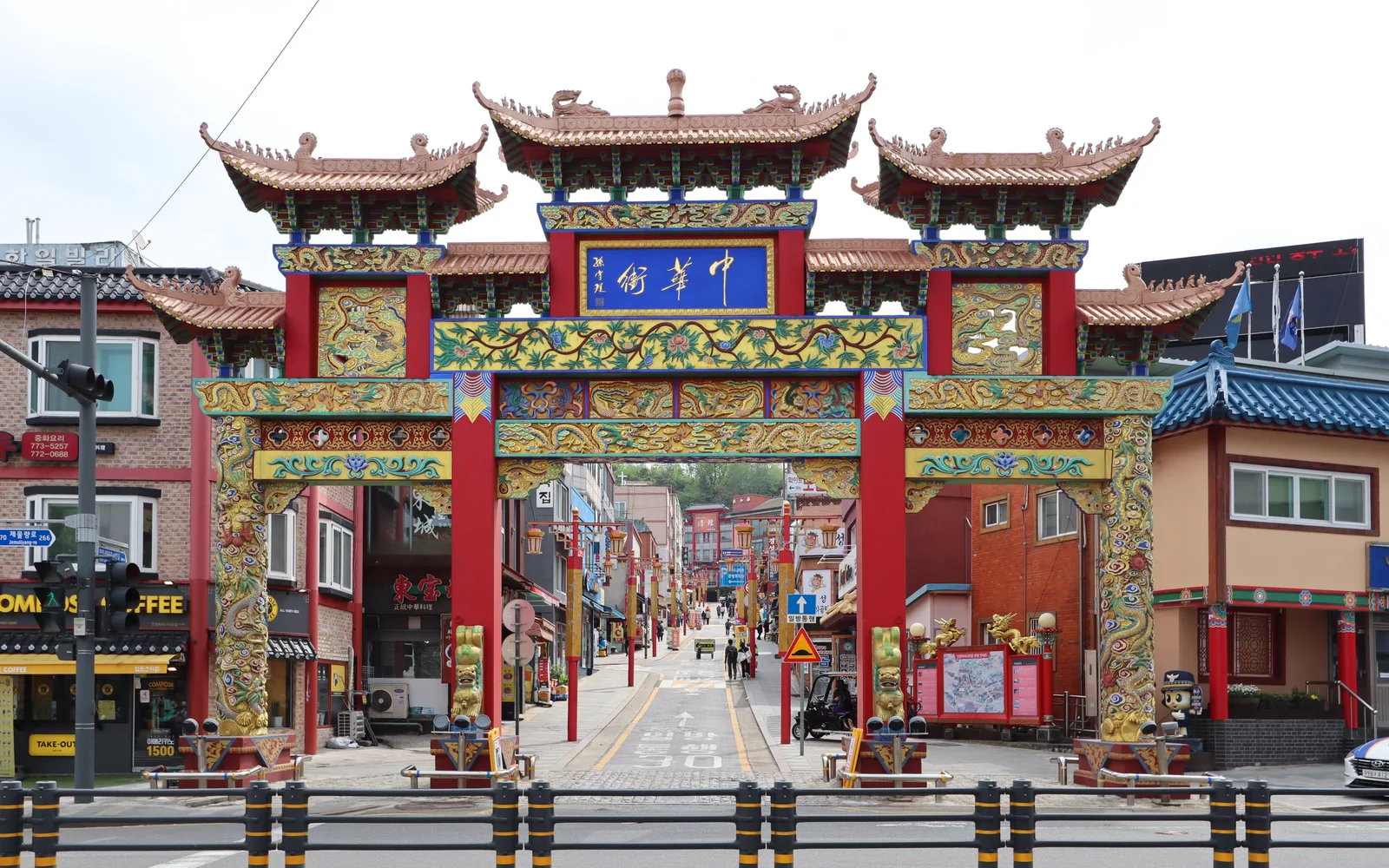
The main Chinatown gate and uphill street, photographed April 30, 2023. Shop signs and traffic controls may have changed. Photo by Mobius6, CC BY-SA 4.0. Cropped, resized and converted to WebP under the same license.
Getting to Incheon Chinatown
From Seoul
From Seoul Station or another Line 1 stop, board a train whose destination display says Incheon and stay on to the final stop. Line 1 branches and some express services terminate at Dongincheon, one stop before Incheon Station. The official Incheon transport page confirms the Line 1 connection; use a live subway planner for the exact platform, fare and final service.
At Incheon Station, use Exit 1. The large gateway is across the road. Cross at the marked crossing rather than through traffic. The Jjajangmyeon Museum's official page places the museum about four minutes from Exit 1.
Incheon Station also serves the Suin–Bundang Line. On the return, check the line and destination instead of following the nearest platform sign.
From Incheon Airport
Chinatown is a landside trip. An international transit passenger must be eligible to enter Korea and pass arrival immigration. Confirm with the airline whether checked baggage is through-tagged or must be collected before leaving the terminal. Use the Korea Visa Navigator for the official entry path. A tour, hotel or long layover does not grant border permission.
| From ICN | Route | Where it starts the walk | What to check live |
|---|---|---|---|
| T2 | Local bus 307 | Incheon Station (Chinatown) | Direction, bay, next bus, luggage space and traffic |
| T1 | Local bus 306 | Jemulpo-gu Office/Open Port side | Stop, next bus and the reverse walking order |
| T1 or T2 | AREX all-stop → Gyeyang → Incheon Line 1 → Bupyeong → Line 1 to Incheon | Incheon Station | Fare, train times, lifts and two transfers |
| T1 or T2 | Designated airport taxi | Incheon Station / Chinatown | Metered total, traffic and night surcharge |
The current Incheon Bus Information System shows 307 serving Incheon Station and T2. Route 306 serves T1 and the Open Port side, but does not stop at Incheon Station. The airport bay references conflict across official pages, so follow the live terminal board rather than a static bay number.
If you arrive on bus 306, follow this order: Jemulpo-gu Office → Open Port museum cluster → Jayu Park and the boundary stairs if conditions suit you → Jjajangmyeon Museum → Chinatown gate → Incheon Station.
Use a Korean transit card on these cashless city buses. The current Incheon fare page lists a ₩1,900 adult base fare for this airport/Yeongjong bus class, with distance additions. It is not a guaranteed full airport-to-Chinatown total. Ordinary local buses also do not guarantee space for a large suitcase.
For a taxi, use the designated airport rank and show 인천역 차이나타운. The fare is metered; do not accept a curbside solicitation or rely on a fixed blog quote.
For an independent airport layover, consider Chinatown only with at least 9–10 hours between flights and after confirming entry eligibility, baggage handling, live travel times, and enough time to reach the correct terminal about three hours before departure. That threshold is a conservative planning margin, not an airport guarantee. With less time, compare the airport's organized option in the ICN Transit Tour guide.
Choose your walking route
The city's Open Port Nuri Trail publishes one-, two- and three-hour route categories. Meals, queues, exhibits, hills and photographs make the real visit longer, so use the choices below as planning bands.
Short Chinatown route: 1.5–2 hours
Incheon Station Exit 1 → Chinatown gate → main street → Jjajangmyeon Museum → meal → station
This route gives the clearest introduction with the least backtracking. It still climbs beyond the gate, but you can turn around before the concession-boundary stairs. On a Monday, replace the museum with an outdoor street loop.
History route: 3–4 hours
Gate → Jjajangmyeon Museum → Uiseondang side street → boundary stairs → Jayu Park and Jemulpo Club → Daebul Hotel Exhibition → Open Port Museum → Hanjung Culture Center → station
Choose this 3–4-hour route if the port-opening story is your priority. It includes a steep hill and stairs, so choose one or two interiors before the 17:30 last admission.
Full route: 5–6 hours
The 5–6-hour plan has room for either Songwol-dong Fairy Tale Village or Sinpo International Market. Adding both creates a longer day, while Wolmido requires separate transport.
Save these Korean names
| Place | Korean search term |
|---|---|
| Incheon Station Exit 1 | 인천역 1번 출구 |
| Jjajangmyeon Museum | 짜장면박물관 |
| Qing–Japan Boundary Stairs | 청일조계지 경계계단 |
| Jayu Park | 자유공원 |
| Jemulpo Club | 제물포구락부 |
| Incheon Open Port Museum | 인천개항박물관 |
| Hanjung Culture Center | 한중문화관 |
| Songwol-dong Fairy Tale Village | 송월동 동화마을 |
| Sinpo International Market | 신포국제시장 |
Official sources now place these sights in Jemulpo-gu. Older maps, signs and photo records may still say Jung-gu because the district name changed on July 1, 2026. The city's reorganization notice confirms the change. The same locations may therefore appear under either district name.
Follow the history route in this order
Use the Korean search terms above in a live pedestrian map for turns and current street closures. The sequence below gives the stop order.
1. Cross to the gate and orient yourself
Exit 1 puts you opposite the main Chinatown gateway. The street rises visibly behind it, which is a useful warning about the terrain. Save Incheon Station in your map app before climbing so you can navigate back from the Open Port side.
Restaurants, souvenir shops and street signs occupy a working neighborhood. Stop beside the flow of pedestrians before checking a map, and keep shop entrances clear.
2. Visit the Jjajangmyeon Museum before lunch or the hill
The Jjajangmyeon Museum occupies the former Gonghwachun building. Its galleries explain the Chinese community, the dish's development, delivery culture, popular culture and a reconstructed kitchen. For the clearest historical context, visit the museum before choosing a restaurant.
The museum normally follows the municipal schedule: Tuesday–Sunday 09:00–18:00, last admission 17:30. Adult admission is currently ₩1,000. Its official accessibility record documents a threshold-free approach, manual wheelchair-passable entrance, lift and accessible toilet, but those features do not prove that every street from the station is step-free.
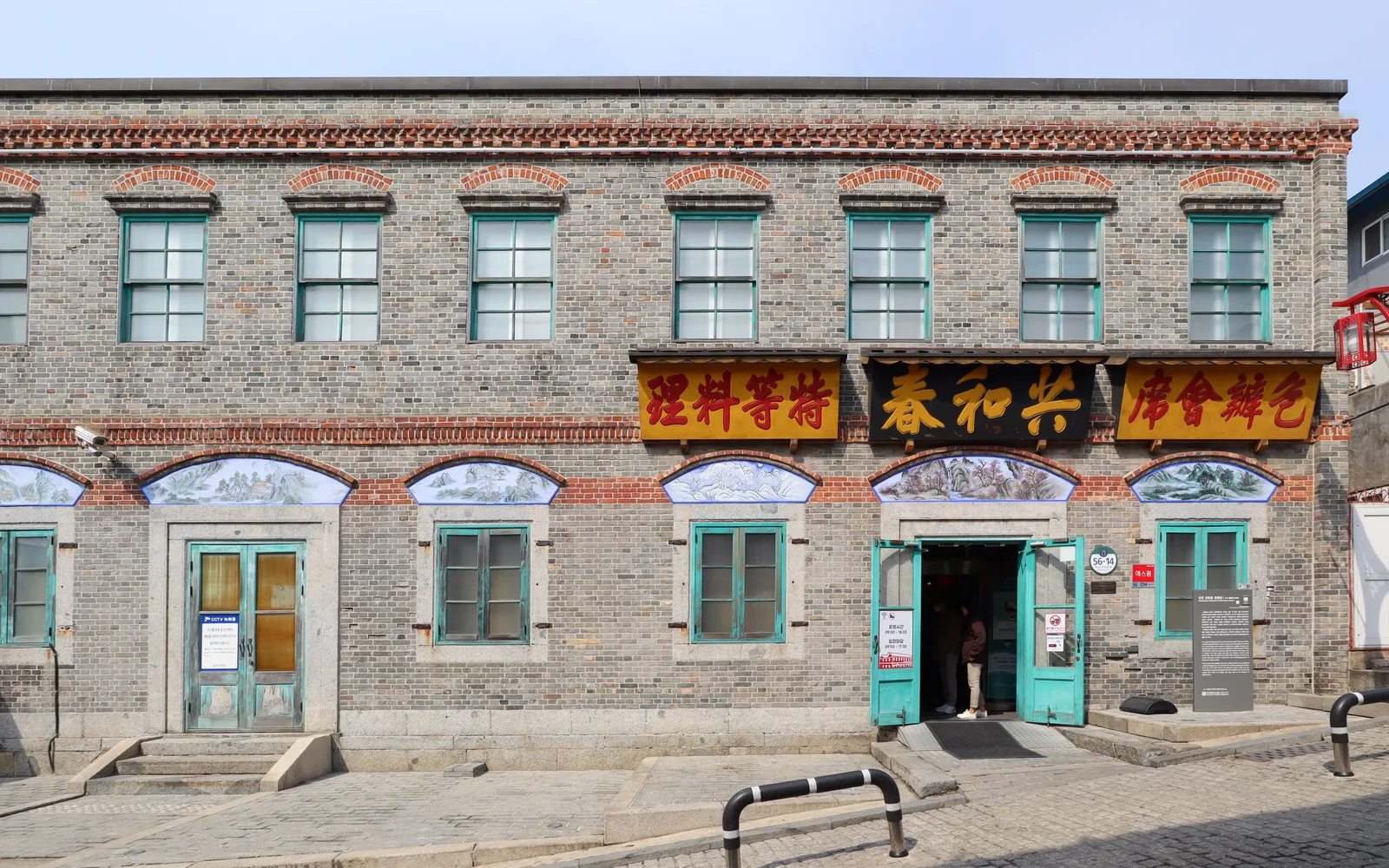
The Jjajangmyeon Museum exterior, photographed April 30, 2023. Check the official museum page above for current hours and access. Photo by Mobius6, CC BY-SA 4.0. Cropped, resized and converted to WebP under the same license.
3. Treat Uiseondang as an optional stop
Uiseondang is a small Chinese-style shrine connected with the local Chinese community's history. Its official page lists 08:30–17:00 and free entry, but the operating record was last updated in 2022. Check the door on the day, keep voices low and do not assume interior access or photography permission.
4. Use the boundary stairs only if the surface suits you
The Qing–Japan Boundary Stairs mark the former divide between concession areas and lead toward Jayu Park. The Chinese- and Japanese-style lamps seen today are later interpretive features, not an untouched 1880s streetscape.
Wheelchair and stroller users should stay on the lower streets. Rain, snow and ice make the stairs risky for everyone, and map distance does not show the difficulty of the climb.
5. Pause in Jayu Park, then decide on Jemulpo Club
Jayu Park is an early Western-style park from Incheon's open-port era. It is listed as open around the clock and free. Official accessibility information describes one approach at about eight degrees and a separate level connection. Confirm the entrance for the level connection before starting uphill; the route from Chinatown is not documented as step-free.
The nearby Jemulpo Club occupies a 1901 building that served as a social club for foreign residents. It currently lists 09:30–17:30, closure every Monday, January 1 and the Seollal/Chuseok holiday periods, and free admission. Its current accessibility record says the main entrance and interior have stairs that make wheelchair access difficult; confirm the day's program and ask about any alternative access before climbing.
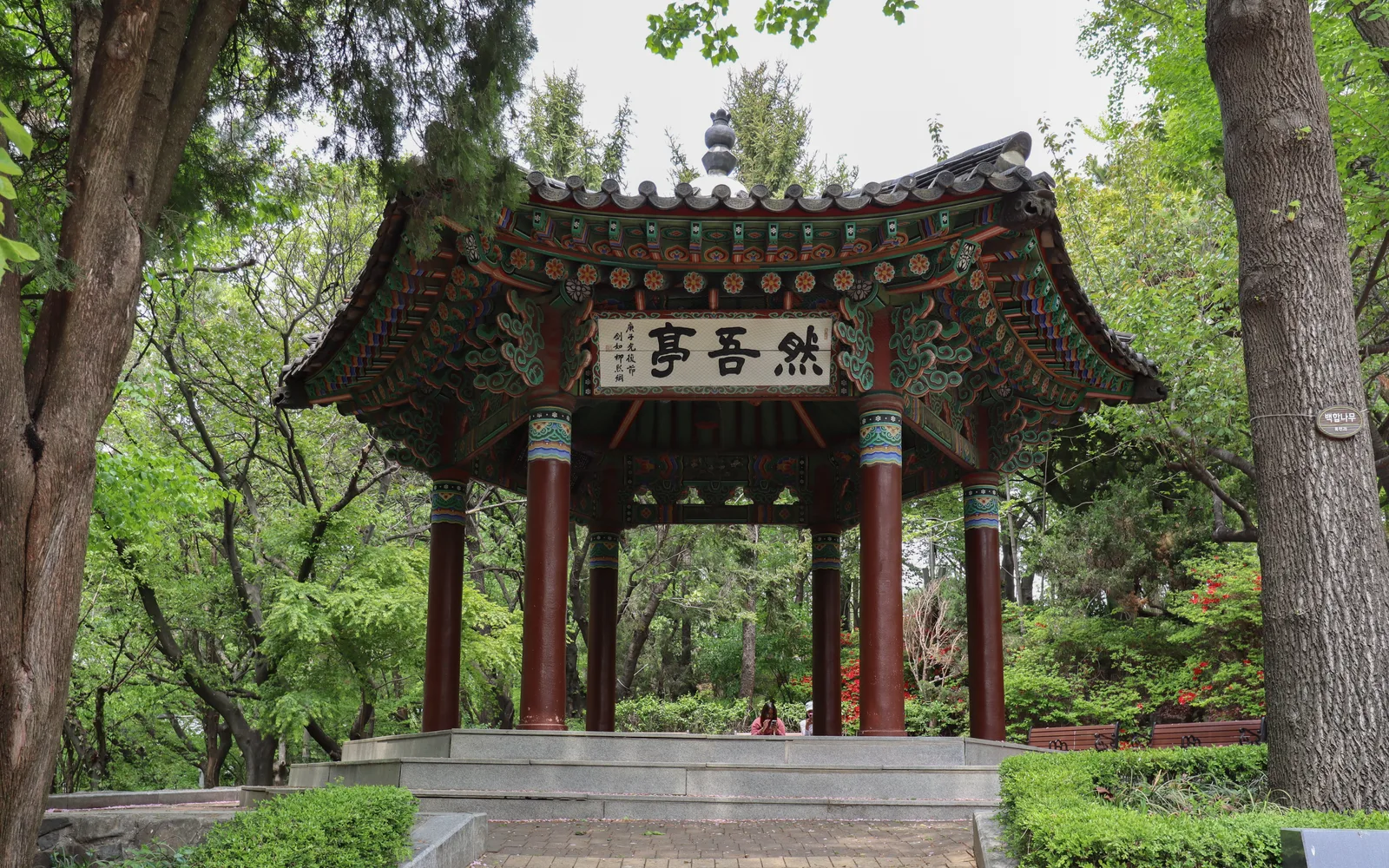
A pavilion in Jayu Park, photographed April 30, 2023. Check current path conditions before climbing. Photo by Mobius6, CC BY-SA 4.0. Cropped, resized and converted to WebP under the same license.
6. Descend through the Open Port museum cluster
The lower Open Port district lets you build a history route without another large detour:
- Daebul Hotel Exhibition and Life History Exhibition: the reconstructed building preserves and interprets excavated hotel remains and local life. One adult ticket for the pair is ₩1,000.
- Incheon Open Port Museum: four permanent galleries inside the former Japanese First Bank branch. Adult admission is ₩500.
- Modern Architecture Exhibition Hall: a compact introduction to the district's modern architecture, also ₩500 for an adult.
- Hanjung Culture Center and Incheon Overseas Chinese History Museum: one ₩1,000 adult ticket covers the combined unit. “Hanjung” is often translated as Korean-Chinese.
- Incheon Art Platform: check the current exhibition list and each exhibition's dates and hours before treating it as an indoor stop.
The official accessibility records for Hanjung Culture Center, the Overseas Chinese History Museum, Open Port Museum, Modern Architecture Hall and Daebul Hotel Exhibition document venue-level features. Wheelchair and stroller users should still check pavement and curb conditions between venues.
7. Choose one nearby extension
Songwol-dong Fairy Tale Village's themed streets date from a modern neighborhood project, so treat this as a separate stop from the nineteenth-century history route. Visit in daylight or early evening, keep noise down and check each café or attraction separately.
Sinpo International Market is the extension to choose if you want another food stop. Its master listing says 10:00–21:00 and closure on the first Monday of the month plus Seollal and Chuseok day, but individual stalls may open late, take breaks or sell out. Use the separate Sinpo Market guide before building the day around one dish.
Wolmido requires separate transport, so plan it as a separate outing.
Museum hours, tickets and closures
The Jemulpo Cultural Foundation publishes the current hours and prices for all five municipal ticket units. The details below were checked September 10, 2026.
Common hours: Tuesday–Sunday, 09:00–18:00; last admission 17:30.
Common closures: Monday, January 1, Lunar New Year Day and Chuseok Day. When Monday is a public holiday, the closure moves to the following day. A maintenance or special-closure notice overrides the standing schedule.
| Ticket unit | Adult | Teen | Military | Child 12 or under |
|---|---|---|---|---|
| Open Port Museum | ₩500 | ₩300 | ₩300 | Free |
| Modern Architecture Exhibition Hall | ₩500 | ₩300 | ₩300 | Free |
| Jjajangmyeon Museum | ₩1,000 | ₩700 | ₩500 | Free |
| Hanjung Culture Center + Overseas Chinese History Museum | ₩1,000 | ₩700 | ₩500 | Free |
| Daebul Hotel + Life History exhibitions | ₩1,000 | ₩700 | ₩500 | Free |
| Combined five-unit ticket | ₩3,400 | ₩2,300 | ₩2,100 | Free |
Visitors aged 65 or older, visitors with disabilities and several other groups may qualify for free admission. Bring the relevant ID and check the full rules on the foundation page. Ask about ticket validity and re-entry before buying the combined ticket.
The history behind Incheon Chinatown and jjajangmyeon
Incheon's port opened in 1883, and a Qing settlement area was designated in 1884. The neighborhood took shape through trade, migration and the extraterritorial concession system. That port history shaped the district's architecture and food.
Korean-style jjajangmyeon developed from this Korean-Chinese port community. The former Gonghwachun building now houses the museum and explains the dish's origins and evolution. A separate present-day restaurant uses the Gonghwachun name; the available historical record does not conclusively identify where the first bowl was served.
The boundary stairs represent the division between former Qing and Japanese concession areas. Jayu Park and the Open Port buildings add the broader story of foreign residence, commerce and colonial-era change.
What to eat in Incheon Chinatown
Choose a restaurant by its current menu, wait, table size and ability to answer ingredient questions. A long queue is not proof that a place fits your group.
| Dish | What to expect | Ask before ordering |
|---|---|---|
| Jjajangmyeon | Wheat noodles in a dark, savory black-bean sauce; the district's signature historical dish | Pork or other meat, wheat, soy, egg and shared wok/oil |
| Jjamppong | A spicy noodle soup, often served with seafood | Shrimp, crab, shellfish, meat broth, wheat and heat level |
| Tangsuyuk | Battered meat with sweet-and-sour sauce, usually ordered to share | Meat, wheat, egg, soy, sauce and shared fryer |
| Dumplings or bakery snacks | A quicker stop when you do not want a full meal | Meat filling, wheat, egg, dairy and shared equipment |
Recipes differ by restaurant. A dish with no visible meat is not automatically vegetarian, vegan, halal or allergy-safe. Korea's official allergen framework is useful background, but ask staff about the exact recipe and cross-contact. If they cannot confirm, do not assume the dish is safe. For a serious allergy, show a Korean allergy card and ask about shared woks, fryers and oil.
Check the posted menu for today's prices and break times before sitting down. For a group order, confirm portion sizes with staff.
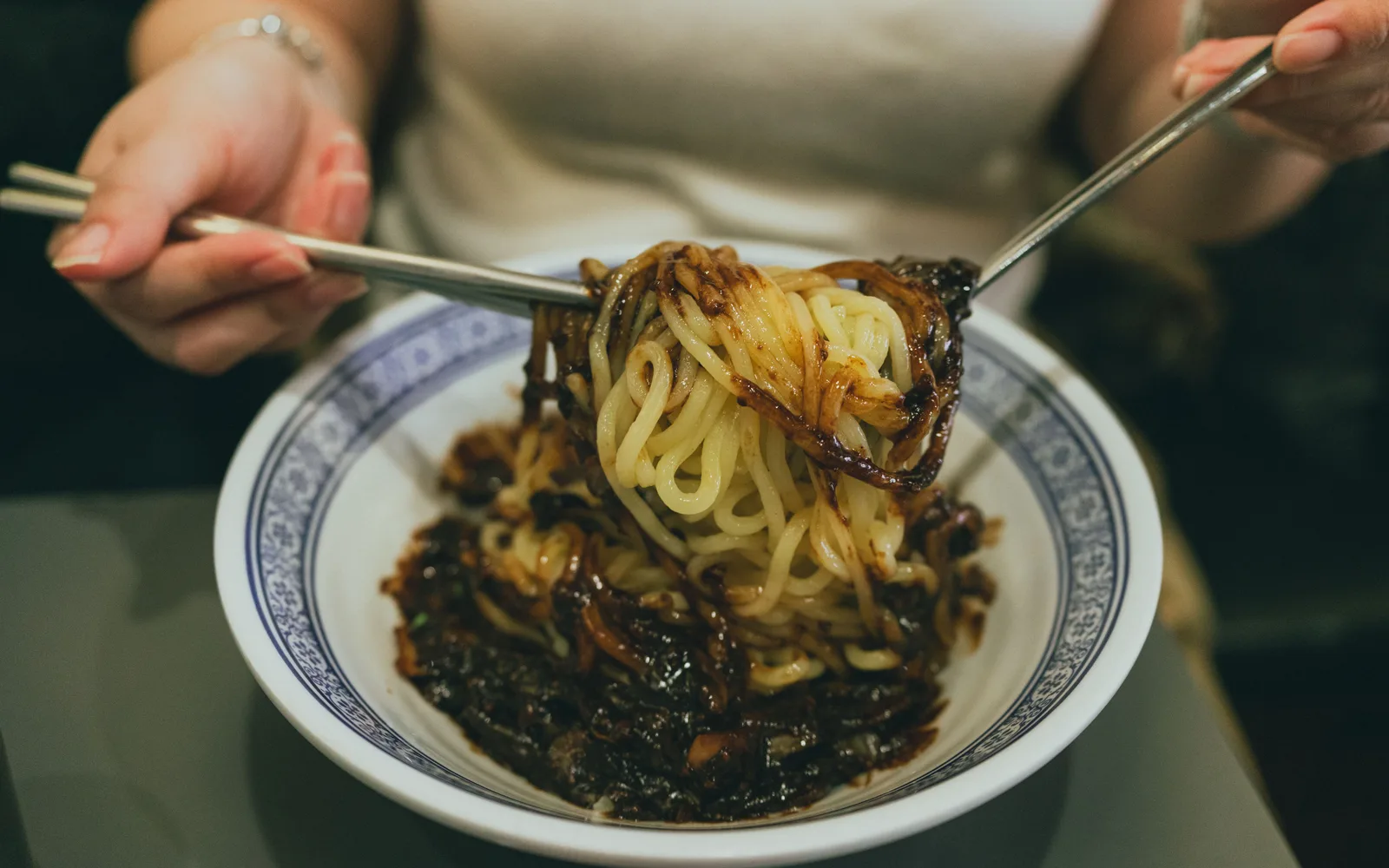
Jjajangmyeon photographed in Seoul as an example, not at a Chinatown restaurant. Recipes and prices vary. Photo by Theodore Nguyen, date not disclosed, Pexels License. Cropped and optimized.
Accessibility, strollers, luggage and toilets
The complete historical loop is not step-free. The concession-boundary route is stairs, the park sits uphill and Jemulpo Club has access constraints. A taxi can reduce the climb, but it does not make every historic doorway accessible.
For a step-minimized visit:
- Confirm the station lift and platform-to-Exit-1 path on the day.
- Use the lower streets and skip the boundary stairs.
- Make Hanjung Culture Center and Jjajangmyeon Museum the main indoor anchors; both document lifts and accessible toilets.
- Add Open Port Museum or Modern Architecture Hall for level or threshold-free entry.
- Confirm the entrance for Jayu Park's documented level connection before starting uphill.
The Jjajangmyeon Museum documents a wheelchair-passable manual entrance. The Daebul access record lists a lift, but visitors who use a service animal should call 032-766-2202 because its current listing conflicts with other venue guidance. Official venue pages do not document one continuous wheelchair route through the district.
The hill loop is not stroller-friendly because the boundary stairs break the default circuit. Jayu Park and Songwol-dong list diaper-changing facilities; Sinpo Market lists a nursing room.
Official pages list toilets at Jjajangmyeon Museum, Hanjung/Overseas Chinese History Museum, Open Port Museum, Jayu Park and Songwol-dong. Uiseondang lists no toilet. A listed toilet is not necessarily an accessible toilet unless the venue's accessibility record says so.
No official listing confirms lockers at Incheon Station. Leave large bags at your hotel or departure station; travelers coming from ICN can check the airport luggage-storage guide for a currently open service. A suitcase is awkward on steep, crowded streets and may not fit safely on a local airport bus.
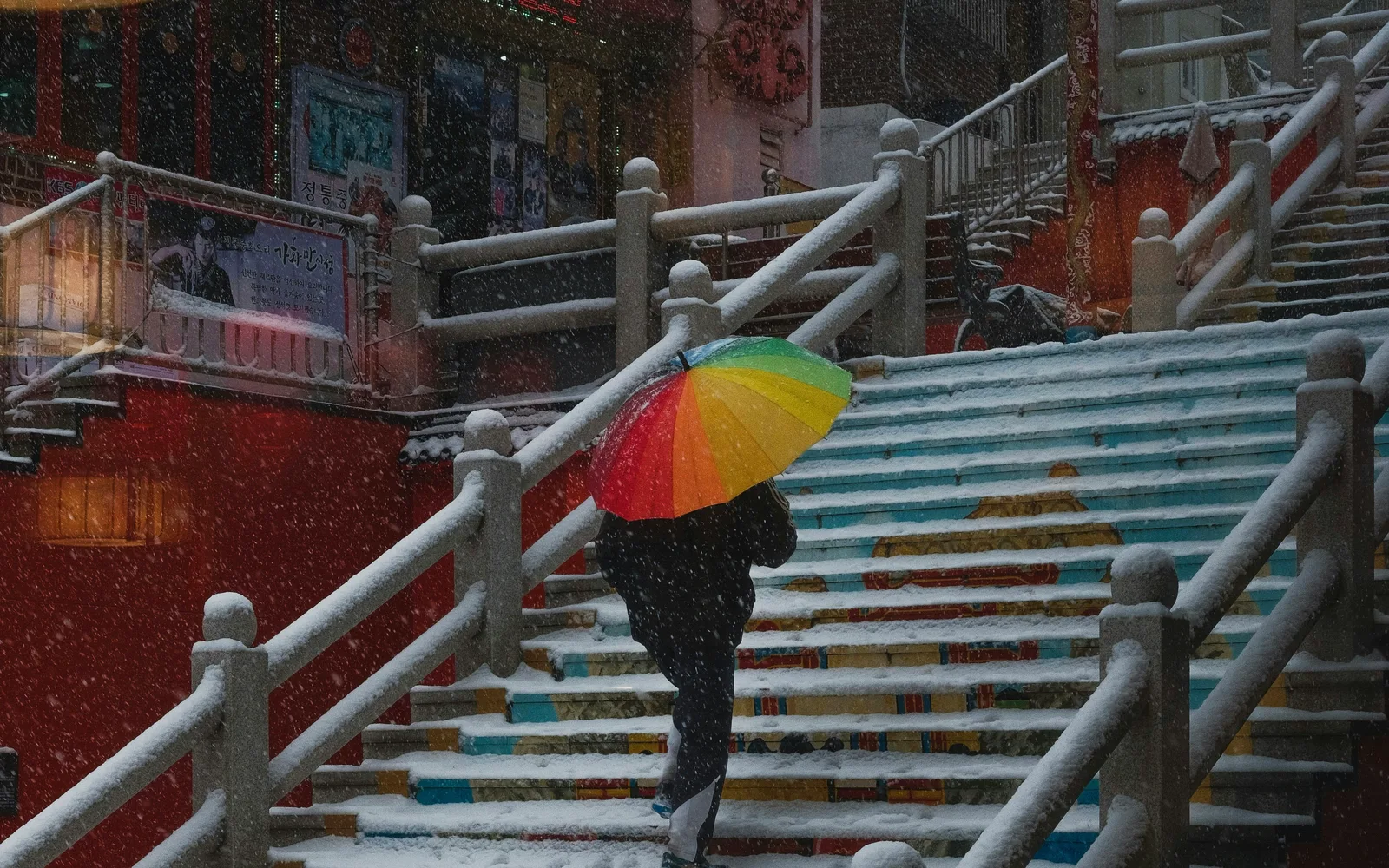
Snow on Chinatown-ro stairs, published January 3, 2023. Winter conditions can make the hill unsafe. Photo by Fabio Verhorstert, Unsplash License. Cropped and optimized.
Plan B for Monday, rain or a late start
Monday
Make it an outdoor-first visit. The five municipal museum units and Jemulpo Club normally close. Walk the gateway, Chinatown streets, boundary area, lower Open Port streets and Jayu Park, then eat. If Monday is a public holiday, the museum closure moves to Tuesday.
Rain or snow
On a museum-opening day, link Jjajangmyeon Museum, Hanjung/Overseas Chinese History Museum and the lower Open Port museums. The walks between them remain outdoors. Skip the boundary stairs and park climb when surfaces are wet or icy.
On a wet Monday, keep the visit to a meal and short street loop. Add Incheon Art Platform only if its current program lists an open indoor exhibition.
After 17:30
Municipal museums stop admitting visitors at 17:30 and close at 18:00. Jemulpo Club also lists a 17:30 close. Treat the evening as an outdoor walk and meal, not a museum plan. Public-street or park access listed as “24 hours” does not apply to shops, restaurants, toilets, museums or visitor services.
Use lit public routes, avoid the park climb in poor weather, and check the final train before ordering dinner.
Driving and parking
Transit is usually simpler because the historic streets are compact and hilly. If driving, the foundation's current parking list includes Hanjung Culture public parking and Fairy Tale Village public parking as 24-hour facilities, plus several lots with shorter hours.
The common published tariff is ₩1,000 for the first 30 minutes, ₩500 per additional 15 minutes and a ₩10,000 daily maximum. Check the lot entrance for available spaces and the current tariff before parking. Choose a lot near the start of your route rather than driving between attractions.
Returning to Seoul or ICN
For central Seoul, use Line 1 and check the displayed destination and final service. If a live planner suggests an express, ride one stop to Dongincheon and transfer there; express service does not begin at Incheon Station.
For ICN, plan from your actual finish point: check bus 307 from the Incheon Station side for T2, or bus 306 from the Open Port side for T1. Rail via Bupyeong and Gyeyang avoids road traffic but requires two transfers. Allow enough time for the correct terminal, check-in, security and immigration.
Before leaving the district, check:
- the correct line, destination and final train;
- the live 306/307 direction, stop and airport bay;
- traffic or rail disruption;
- the operating flight terminal;
- whether your luggage and mobility needs fit the chosen route.
Frequently asked questions
How long do you need in Incheon Chinatown?
Allow 1.5–2 hours for Chinatown streets, one museum and a quick meal. Allow 3–4 hours for the hill, Jayu Park, two museums and a meal; a fuller Open Port or market extension can take 5–6 hours.
Is Incheon Chinatown near Incheon Station?
Yes. Use Incheon Station Exit 1; the main gate is across the road and the Jjajangmyeon Museum is about four minutes away on foot. The streets beyond the gate rise uphill.
Is Incheon Chinatown free to enter?
The public streets have no district admission charge. Adult tickets cost ₩500 or ₩1,000 by unit, or ₩3,400 for the combined five-unit ticket. Food, parking and private attractions cost extra.
Are the Chinatown museums open on Monday?
Usually not. The five municipal museum units close on ordinary Mondays. If Monday is a public holiday, the closure moves to the following day; special notices can override the standing schedule.
How do I get from Seoul to Incheon Chinatown?
Take Seoul Subway Line 1 on a train whose displayed destination is Incheon and stay on to the final stop. Use Exit 1. Some Line 1 branches and express trains terminate before Incheon, so check the platform display.
How do I get from Incheon Airport to Chinatown?
From T2, local bus 307 reaches Incheon Station (Chinatown). From T1, bus 306 reaches the Jemulpo-gu Office/Open Port side, so reverse the walk. A rail-only alternative is AREX to Gyeyang, Incheon Line 1 to Bupyeong, then Line 1 to Incheon.
Is Incheon Chinatown wheelchair or stroller accessible?
Several museums document accessible entrances, lifts or toilets, but the complete neighborhood loop is not step-free. Skip the concession-boundary stairs, focus on the lower streets and accessible venues, and check the station lift and pavement conditions on the day.
Can I visit Incheon Chinatown at night?
You can walk the public streets and Jayu Park after dark, but lighting and path conditions vary. Museums stop admission at 17:30, private businesses keep their own hours, and you should check the final train.
Is jjajangmyeon vegetarian?
Do not assume it is. Jjajangmyeon may contain pork, wheat and soy, while other Chinatown dishes may contain egg, seafood or shared cooking oil. Ask the restaurant about the exact recipe and cross-contact before ordering.
Why do some maps say Jung-gu instead of Jemulpo-gu?
The district was reorganized as Jemulpo-gu on July 1, 2026. Older maps, signs, photo metadata and official pages may still say Jung-gu; they can refer to the same Chinatown and Open Port area.
Official sources
- Jemulpo Cultural Foundation: common museum hours, fees and parking
- Jjajangmyeon Museum
- Hanjung Culture Center and Overseas Chinese History Museum
- Incheon Open Port Museum and Modern Architecture Exhibition Hall
- Daebul Hotel and Life History exhibitions
- Official Open Port Nuri Trail
- Incheon Chinatown history and visitor record
- Uiseondang, Jayu Park and Jemulpo Club
- Songwol-dong Fairy Tale Village and Sinpo International Market
- Venue accessibility: Jjajangmyeon Museum, Hanjung Culture Center, Overseas Chinese History Museum, Open Port Museum, Modern Architecture Hall and Daebul Hotel Exhibition
- Incheon Bus Information System, Incheon public transport and ICN taxi guide
- Incheon administrative reorganization
Prices, schedules and route data were checked against the linked official sources on September 10, 2026. Special notices and live transport data control on the travel date.
Related guides
- Things to do in Incheon
- Food extension: Sinpo International Market
- Full-day plan: One day in Incheon from Seoul
- Waterfront extension: Wolmido
- Airport alternative: ICN Transit Tour