Songdo Central Park:Hours, Boats and a 2-Hour Route
Plan Songdo Central Park with free entry, 24-hour access, Exit 3 directions, a two-hour route, boat checks, and a weather Plan B.
Official sources checked 10 September 2026

Ask Narin.
Find answers in this guide
Narin is a fictional AI host.
Loading your saved chat…
NarinAsk me a question about this guide. Answers include links to the guides.
30-second answer
- Start here: VISITKOREA lists the outdoor park as free and open 24 hours year-round. Take Incheon Subway Line 1 to Central Park Station, Exit 3; the official station page shows a street elevator beside it.
- Time and route: Allow 90 minutes for Exit 3 → Tri-Bowl exterior → canal path → one bridge or hanok-area viewpoint → Exit 3. Use about two hours for a relaxed partial loop; the complete official trail is roughly 4 km.
- Boats: West Boat House runs the scheduled water taxi; East Boat House rents self-drive leisure boats. Check operation before walking to either one.
- From ICN: Start with the Korea Visa Navigator, then compare direct bus 6777 with the rail fallback below.
- Plan B: If wind or rain stops the boats, shorten the canal walk and use one confirmed-open indoor venue near Exit 3.
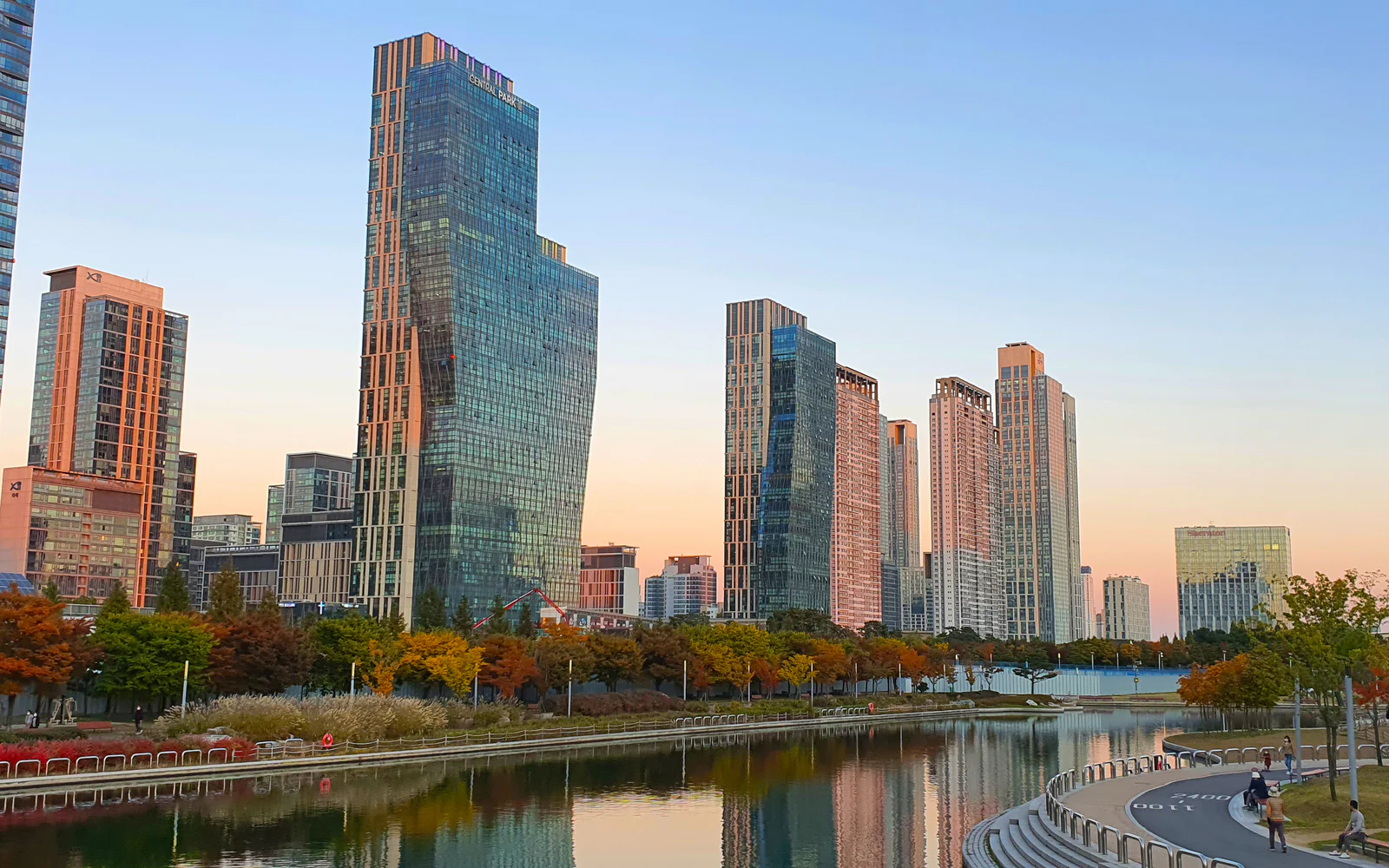
Songdo Central Park's waterway and surrounding skyline on October 27, 2021. Landscaping and the skyline may have changed. Photo by José Carioca, CC BY-SA 4.0, via Wikimedia Commons. Cropped, resized and converted to WebP under the same license.
Jump to: hours and facts · walking routes · boats · indoor stops · transport · access · Plan B
Hours, fee and key facts
| Item | Current answer |
|---|---|
| Korean name | 송도 센트럴파크 |
| Address | 160 Convensia-daero, Yeonsu-gu, Incheon |
| Outdoor park | Free and open 24 hours year-round |
| Closest station | Central Park Station, Incheon Line 1, Exit 3 |
| Short visit | About 90 minutes |
| First-visit plan | About two hours for a partial loop |
| Full trail | Approximately 4 km |
| Canal | Approximately 1.8 km, filled with filtered seawater |
| Park contact | 032-456-2860; English assistance is not confirmed |
The park operator describes an area of about 370,750 m² organized around an artificial seawater canal. Its water-quality FAQ says the water is filtered, recirculated and tested. The canal is scenery and transport for licensed activities; it is not a public swimming area.
The park's 24-hour status applies to the outdoor grounds. It does not extend the hours of boat houses, G-Tower, Tri-Bowl, museums, tourist information, restaurants or toilets inside private buildings.
Choose your walking route
A 90-minute waterfront route
Use this when the park is one stop in a larger Songdo day.
- Leave Central Park Station through Exit 3 and save the station pin for your return.
- Walk to the Tri-Bowl exterior. Treat the building as a visual anchor unless the official calendar lists an open event.
- Join the canal path and walk toward one bridge or a clear water-and-skyline viewpoint.
- Cross only if the return remains simple. Otherwise, turn around on the same side of the canal.
- Return to Exit 3 before adding a café, museum or boat.
This version gives you the water, skyline and Tri-Bowl without committing to the full trail. It also works when a long wait for a boat would disrupt the rest of the day.
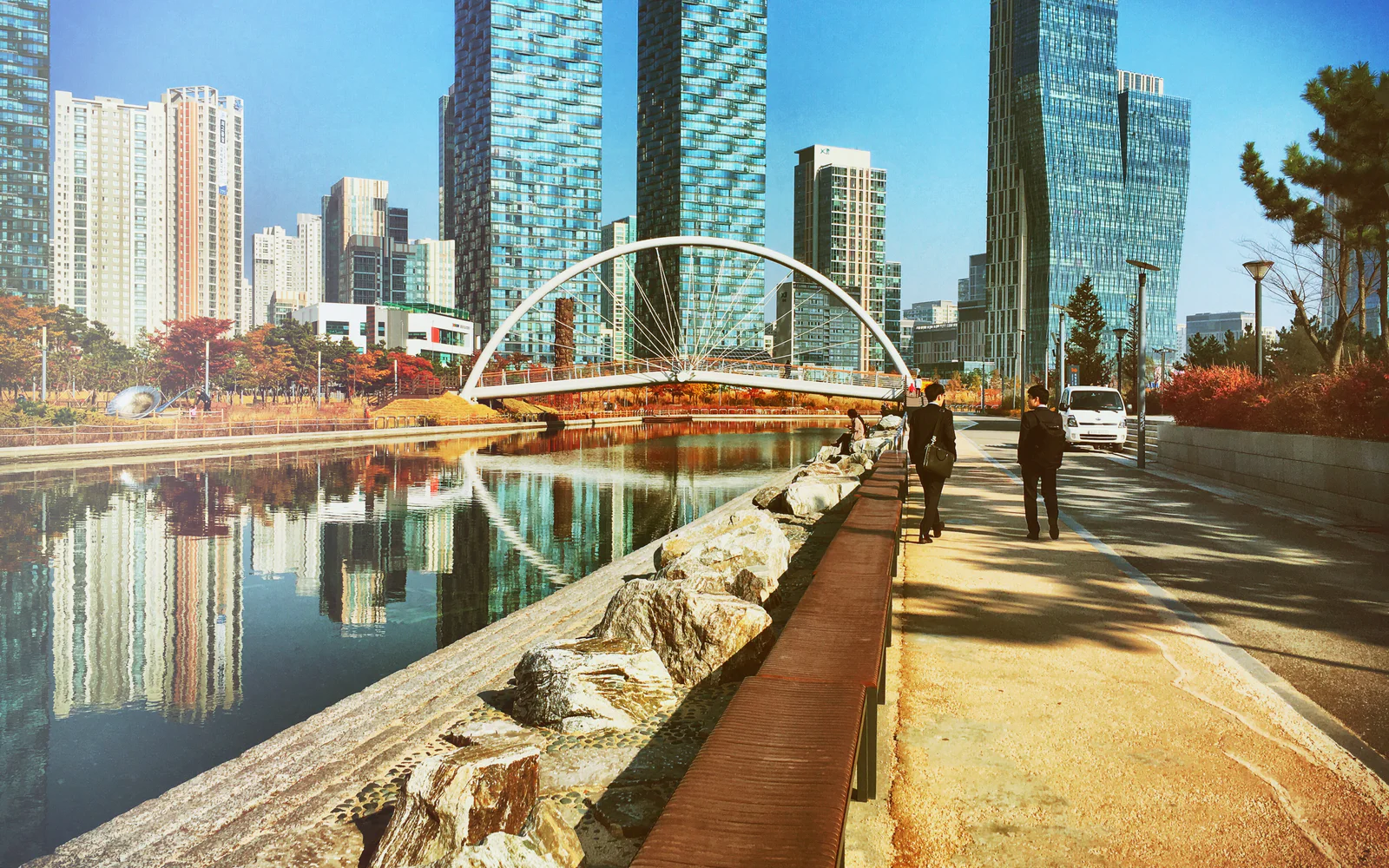
A waterfront path and arched bridge in Songdo Central Park, dated November 2015. The pronounced color treatment comes from the source image; paths and landscaping may have changed. Photo by Hon Kim, CC0 1.0; originally published on Unsplash. Cropped, resized and converted to WebP.
A two-hour first visit
Start with the 90-minute route, then continue toward one more park zone or the hanok-style buildings. Pick a bridge as your turning point before you start. Wide lawns, repeated tower views and photo stops can make a short map distance take longer than expected.
The official Incheon walking course gives an approximately 4 km trail around the park. A full loop is reasonable when walking is the main activity, but two hours should not include the entire trail, a boat, a museum and a meal.
A half day
Reserve three to four hours for the full trail plus one optional activity:
- the West Boat House water taxi;
- one East Boat House rental;
- the G-Tower observatory;
- the Incheon Urban History Museum; or
- a current Tri-Bowl exhibition or performance.
Choose the optional stop before leaving home. Its opening hours determine the route; the outdoor park remains available if it closes or sells out.
Park layout and landmarks
Songdo Central Park is a public park in Songdo International City, a planned district of offices, homes, hotels and cultural buildings. The park operator divides the landscape into named garden zones, but you do not need to visit every installation.
The 1.8 km seawater canal, skyline and pedestrian paths provide the dependable experience. Tri-Bowl, G-Tower and the hanok-style complex give you three different architectural references. The hanok buildings function as an area waypoint; do not assume every interior is public or that a restaurant is open.
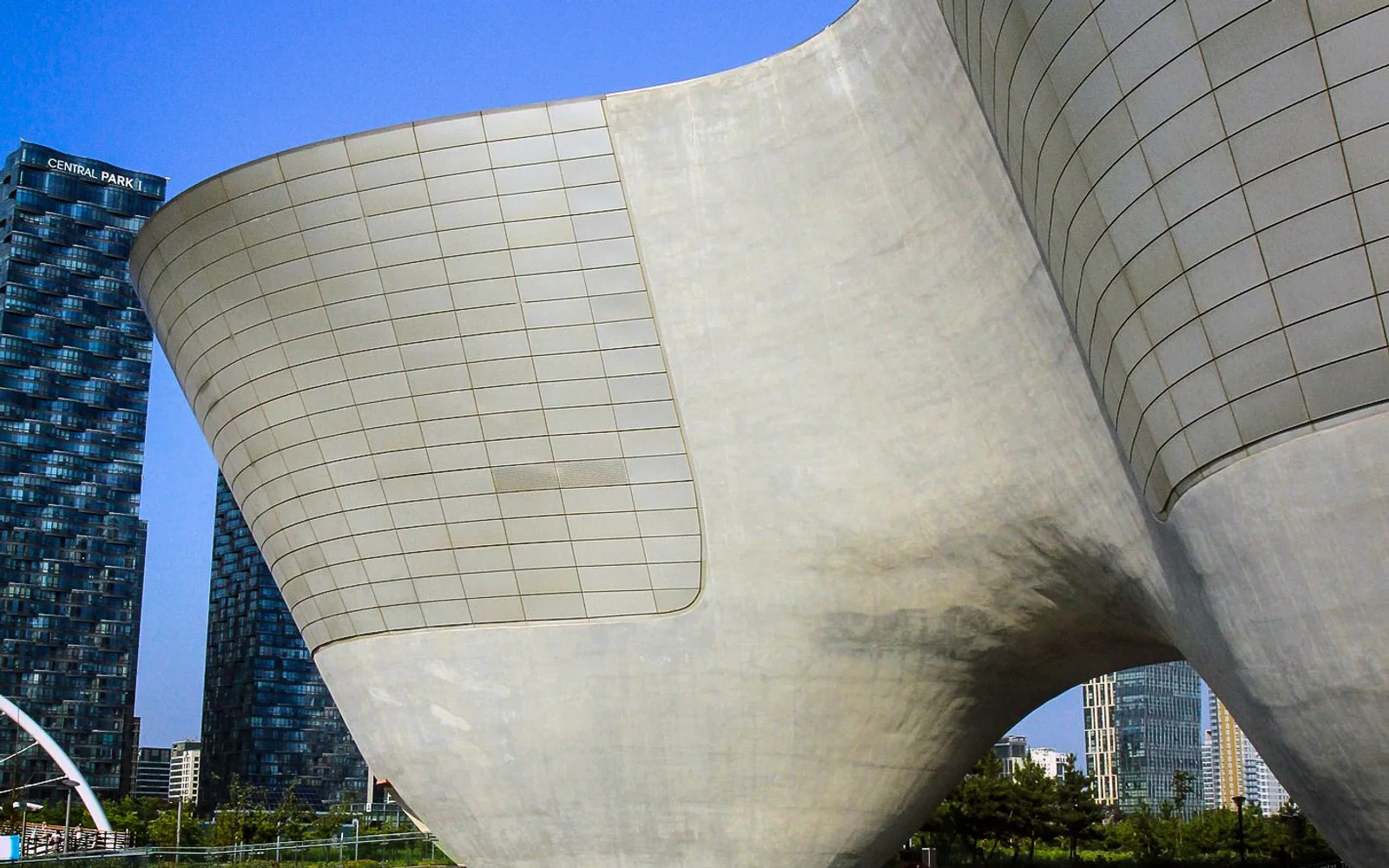
Tri-Bowl's exterior in Songdo; the photograph date is not disclosed and the image was uploaded in July 2016. This view does not establish current exhibition access or opening hours. Photo by siska maria eviline, CC BY-SA 2.0, via Flickr. Cropped, resized and converted to WebP under the same license.
Water taxi and boat rentals
The two boat houses serve different purposes:
- West Boat House: scheduled sightseeing water taxi, currently listed as a roughly 20-minute ride. Confirm today's departures, fare category, weather and boarding access.
- East Boat House: self-drive leisure boats. Motorized boats are generally listed for 30 minutes; kayaks and SUP use longer sessions. Confirm today's craft, price, passenger limit, weather and safety rules.
West Boat House water taxi
The current Incheon Tourism water-leisure guide, checked September 10, 2026, lists a roughly 20-minute ride at ₩4,000 for adults and ₩2,000 for children. It defines the child category as age one through elementary school and lists a ₩3,000 reduced category for passengers 65 or older, veterans and passengers with disabilities. Bring any ID needed for a concession.
The more specific West Boat House record lists summer operation as 10:00–19:00 on weekdays and 10:00–21:00 on weekends, with winter hours of 10:00–18:00. The published departure pattern is on the hour on weekdays and on the hour and half-hour on weekends. The operator can change or cancel trips for weather, maintenance or demand. Call 032-834-4609 or check the board before planning around one departure.
The official accessibility record warns of a step on the ticket-office approach and does not confirm wheelchair-accessible boarding. Ask about the exact route and boarding assistance before paying.
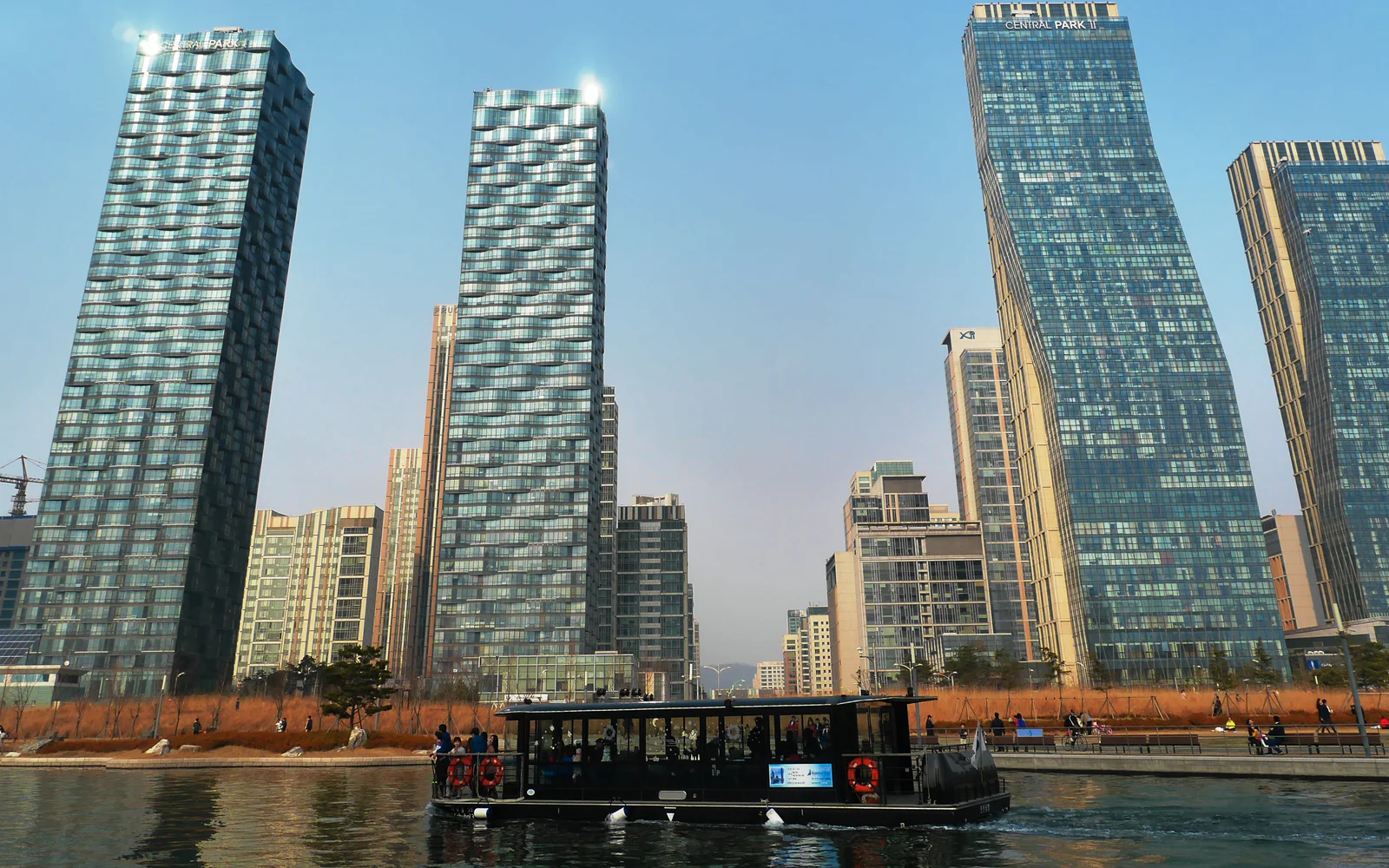
A passenger boat on the Songdo Central Park canal on March 16, 2014. This historical image does not confirm today's boat operator, route, price, schedule or boarding point. Photo by travel oriented, CC BY-SA 2.0, via Flickr. Cropped, resized and converted to WebP under the same license.
East Boat House rentals
The current East Boat House feature describes self-drive electric and leisure boats, normally from 10:00–21:00, with hours and operation subject to season and weather. Official pages show conflicting base prices and promotions, so this guide does not freeze a rental price. Confirm the craft, total price, passenger mix, life jacket, child or pet rule and boarding access at 032-831-4609.
Plan the walk first, then add a boat if it is operating.
Nearby indoor stops
G-Tower observatory
The free IFEZ Promotion Center occupies G-Tower's 33rd floor and gives a high view over Songdo and the park. Current hours are:
- Tuesday–Friday: 10:00–21:00;
- weekends and eligible public holidays: 13:00–21:00;
- Monday: closed;
- final entry: 20:30, with visitors leaving by about 20:50.
It can also close on listed national holidays, January 1, Lunar New Year and Chuseok periods, during repairs, official functions or special events. Admission is free, but the official visitor workflow asks general visitors to reserve online and receive confirmation; plan to reserve at least one day ahead. Check the current IFEZ notice before walking over.
Incheon Urban History Museum
The city museum is free and normally opens 09:00–18:00, with final entry 30 minutes before closing. It closes on January 1 and Mondays, except when Monday is a public holiday. Its directions page uses Central Park Station Exit 3.
Use this as a daytime weather fallback near the station when it is open.
National Museum of World Writing Systems
The museum visitor page lists Tuesday–Sunday 10:00–18:00, with final entry at 17:30. Normal admission is free, while a special exhibition can charge. It closes Monday and on specified holidays; a holiday Monday can shift the closure to the next weekday. Check the museum homepage for temporary closure notices before going.
Tri-Bowl
Tri-Bowl's exterior is visible without a ticket. Interior access depends on a scheduled exhibition or performance. The official notice gives normal exhibition hours only when an exhibition is running; use the event calendar for your date.
How to get there
Save 송도 센트럴파크 and the park address in a Korean map. The essential Korea apps guide explains Naver Map and KakaoMap.
From Central Park Station
Central Park Station is I137 on Incheon Subway Line 1. Use Exit 3 for Central Park, Tri-Bowl, G-Tower, the Urban History Museum, tourist information and Songdo Hanok Village. The station page documents elevators from both platforms to the concourse and a street elevator beside Exit 3.
The park edge is about 2–5 minutes from the exit as a planning range. A specific boat house, museum or hotel requires additional walking.
From Seoul
A one-transfer route from Seoul Station or Hongik University is:
- Take the AREX all-stop train, not the Express, toward Incheon Airport.
- Get off at Gyeyang.
- Change to Incheon Subway Line 1 toward Songdo Moonlight Festival Park.
- Get off at Central Park and use Exit 3.
Allow about 90 minutes from Seoul Station to the park edge and roughly 75–90 minutes from Hongik University. Train waits and transfer time can extend either trip. Fare is distance-based; use the amount shown in the current route planner and pay with a transport card or valid ticket. The T-money guide explains cards and reloads.
Check the full Central Park → Gyeyang → Seoul/Hongdae route before sunset. The last northbound train from Central Park may arrive too late for the AREX connection.
From Incheon Airport
A city visit requires permission to enter Korea and enough time for immigration, baggage, both surface journeys and the full departure process. Check your entry path in the Korea Visa Navigator, then use the layover guide to set a hard return time.
Direct bus 6777
Route 6777 provides a direct public-transport link to Central Park Station when its timetable fits.
- T1: the airport-bus operator's current timetable lists stop 2B-4. A separate 2026 city guide still says 13B, so follow the live terminal display rather than the older number.
- T2: Songdo Convensia's current directions use the Transportation Center on B1, stop 17. Confirm the bay and departure on the live board.
- Listed fare: Songdo Convensia lists ₩8,000 for 6777/6777-1. Check the current fare before buying.
- Tickets: use the airport bus counter or self-service machine; the operator also directs passengers to TmoneyGO for current schedules.
Route 6777-1 also enters Songdo but follows a different stop pattern. Do not assume it serves the Central Park Station entrance you want. The airport limousine has a luggage hold, but capacity and oversize acceptance still require a current operator check.
Rail fallback
Take the AREX all-stop train from T1 or T2 to Gyeyang, change to Incheon Subway Line 1 toward Songdo Moonlight Festival Park, then leave Central Park Station through Exit 3. This route has one transfer and avoids road traffic, but you carry your own luggage and the total fare is the amount shown in the live route planner.
Taxi
Use the official airport taxi stand and show 송도 센트럴파크, 인천 연수구 컨벤시아대로 160. Incheon standard taxis start at ₩4,800; traffic, route, time, night surcharge and any toll determine the final meter. Do not rely on a fixed airport-to-park quote.
From Chinatown, Sinpo or the Open Port district
Historic Incheon and Songdo sit in different city clusters. Use Songdo as the main half-day destination rather than adding it after a complete Chinatown–Open Port–Sinpo route. The one-day itinerary helps choose between them; the Chinatown and Sinpo Market guides cover the historic alternative.
Best time, night visits and weather
Late afternoon can give you daylight and city lights in one visit; a visible sunset depends on cloud cover. Building or bridge lighting can change. The outdoor park remains open after dark, but every boat house, museum, observatory and restaurant follows its own clock.
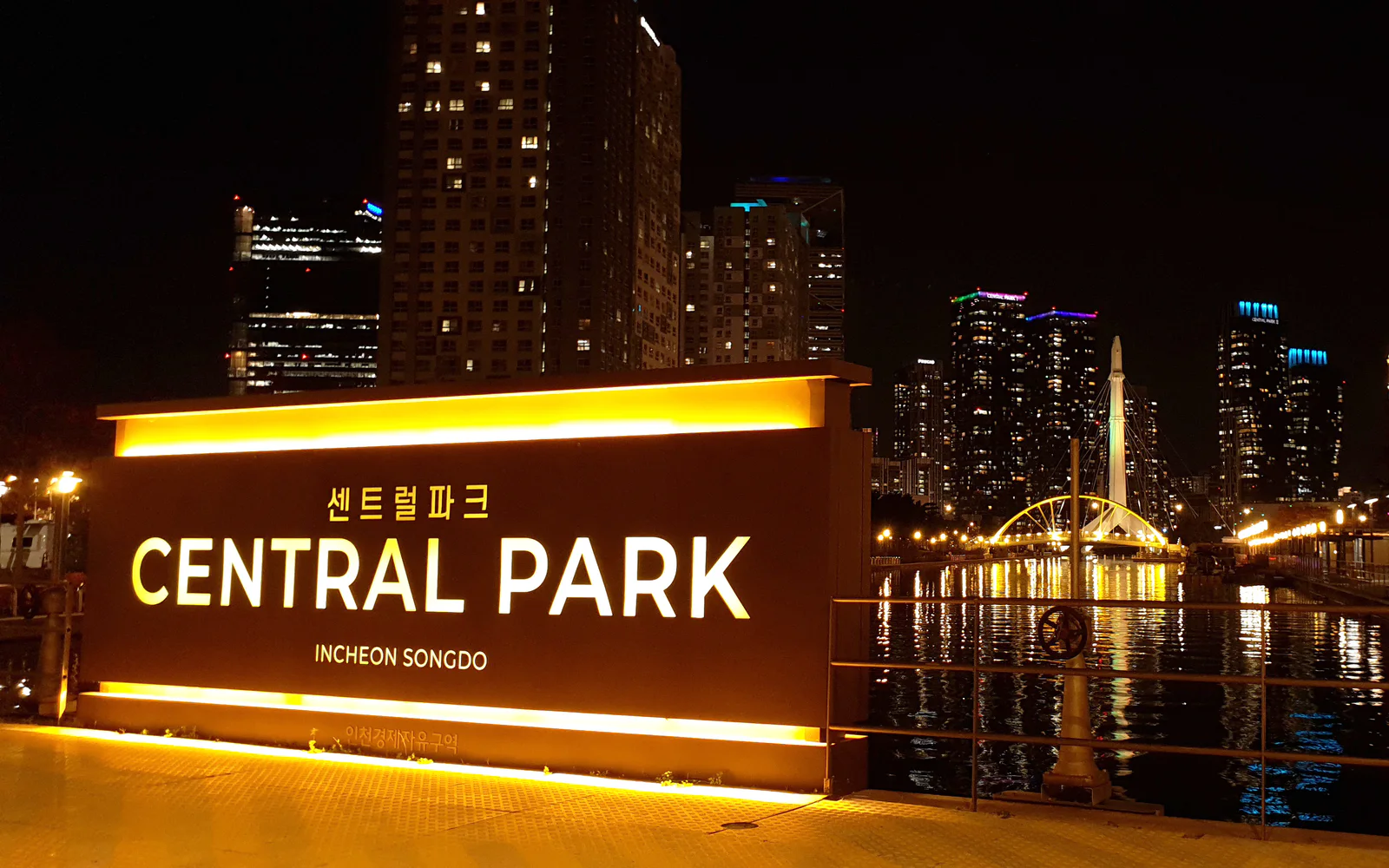
Songdo Central Park's sign, bridge and skyline at night on October 27, 2021. Lighting and access conditions may have changed; check your final transport before an evening visit. Photo by José Carioca, CC BY-SA 4.0, via Wikimedia Commons. Cropped, resized and converted to WebP under the same license.
Use the Korea Meteorological Administration for warnings and AirKorea for particulate readings. Boats can stop for wind, rain, ice, maintenance or low demand even when a tourism page lists seasonal hours.
Food, water and rest stops
Restaurants and cafés cluster around the hanok-style buildings, Canal Walk, hotels and nearby commercial streets. They are private businesses with independent hours, menus and last orders. Check the door or first-party page instead of assuming that a park-side restaurant stays open whenever the park does.
No current official source confirms year-round drinking-water availability, so carry water. Park and station toilets give you options without requiring a café purchase.
For allergies or dietary restrictions, ask the chosen business about broth, sauces, garnish, shared fryers and preparation surfaces. A dish name does not establish that it is vegetarian, vegan, halal or gluten-free.
Accessibility, families, luggage, parking and pets
Step-free access and family facilities
The current accessibility record documents:
- a step-free park entrance;
- paved paths that are generally level or gently graded;
- an accessible toilet;
- 12 accessible underground-parking spaces;
- an elevator from underground parking to park level; and
- a nursing room near tourist information, plus changing facilities.
Central Park Station separately lists elevators, accessible toilets, a nursing room and power-wheelchair charging. The record covers the entrance and listed facilities, not every bridge, temporary detour, private venue or the full 4 km trail. The West Boat House ticket-office approach includes a step, and no source confirms wheelchair-accessible boat boarding. Confirm the exact route when access is essential.
The West Boat House record also lists free wheelchair and stroller loans at the Incheon General Tourist Information Center, normally 09:00–16:00 for up to two hours. Confirm same-day stock before relying on one.
Lockers and large luggage
Central Park Station officially lists lockers, but its page does not give their dimensions, fees or real-time availability. Leave a full-size suitcase at ICN or your accommodation unless you have confirmed that it fits. The airport luggage guide covers verified storage choices.
Parking
Paid underground parking is available, with 12 accessible spaces documented. English VISITKOREA lists ₩1,000 per 30 minutes, while KTO's pet-travel feature lists ₩2,000 per 30 minutes for Central Park Lot 1. The park operator does not publish a controlling current rate, so check the entrance board.
Pets, bicycles and scooters
Leashed pets are allowed in the outdoor park when owners carry waste bags. Confirm boats, museums, restaurants and other indoor venues separately. Ask a boat operator about pet acceptance and safety equipment before paying.
Official tourism material has promoted bicycle rental near the east side, but no current operator tariff or reliable 2026 schedule was found. Confirm the operator and inventory before planning around a rental. No current park source confirms a park-wide e-scooter program or blanket permission on every walking path; follow posted signs.
Plan B
The water taxi or rental boat is not operating
Keep the 90-minute walking route. Add G-Tower or a museum only when its current notice shows that it is open. A boat cancellation does not remove the canal, skyline or Tri-Bowl exterior.
It is raining, windy or very hot
Shorten the exposed section to Exit 3 → Tri-Bowl exterior → nearest canal viewpoint → Exit 3. Use the Urban History Museum during its open hours or G-Tower when its current schedule works. In lightning, severe wind, extreme heat or an official weather warning, skip the waterfront route.
Your airport margin narrows
Leave before the original turn-back time. Do not wait for one more boat departure or sunset view. If the independent outing no longer works, return to ICN and use the airport layover guide.
The final return connection no longer works
Use a live planner to compare an earlier rail departure, the current 6777 direction or a taxi to a station with a usable onward connection. The park's 24-hour opening does not solve a missed transfer.
Check on the day
- Boat operation, departure, fare, passenger rules and boarding access.
- G-Tower, museum and Tri-Bowl notices for temporary closures or events.
- The airport-bus stop, route variant, fare and luggage capacity.
- The complete last rail connection, not only the final train from Central Park Station.
- Lift operation, construction, weather, air quality and surface conditions.
- Locker availability, parking rate and any restaurant's menu or last order.
Frequently asked questions
Is Songdo Central Park free and open 24 hours?
Yes. VISITKOREA lists normal outdoor park entry as free and open 24 hours year-round. Boats, indoor venues, parking and private businesses keep separate hours and charges.
Which station and exit should I use?
Use Central Park Station on Incheon Subway Line 1 and leave through Exit 3. The official station page assigns the park and Tri-Bowl to Exit 3 and documents a street elevator beside it.
How long should I spend at Songdo Central Park?
Allow about 90 minutes for a short waterfront route or two hours for a relaxed partial loop. The official walking trail is about 4 km, so reserve longer for the full circuit, a boat or an indoor stop.
What is the difference between the East and West Boat Houses?
The West Boat House operates the scheduled sightseeing water taxi. The East Boat House rents self-drive leisure boats. Both depend on season, weather, maintenance and current availability.
How much is the Songdo water taxi?
Official Incheon Tourism pages checked September 10, 2026 list the roughly 20-minute West Boat House ride at ₩4,000 for adults and ₩2,000 for children. Confirm the current price and departure at the counter because service changes with season and weather.
How do I get to Songdo Central Park from Incheon Airport?
Route 6777 provides a direct public-transport link when its timetable fits. The operator's current timetable lists T1 stop 2B-4, while current Songdo Convensia directions list T2 Transportation Center B1 stop 17. Official pages conflict on the T1 stop, so confirm the live terminal board before buying.
How do I get to Songdo Central Park from Seoul?
Take the AREX all-stop train from Seoul Station or Hongik University to Gyeyang, change to Incheon Subway Line 1 toward Songdo Moonlight Festival Park, and leave Central Park Station through Exit 3. Allow about 90 minutes from Seoul Station.
Is Songdo Central Park worth visiting at night?
The outdoor park remains open and the skyline is a valid reason to visit after dark. Check the closing time of every boat house, museum, observatory or restaurant and confirm the full return route before sunset.
Is Songdo Central Park suitable in rain or winter?
The outdoor park stays open year-round, but the waterfront is exposed and boats can stop for weather. In strong wind, heavy rain, lightning, extreme temperatures or poor air, shorten the walk and use a confirmed-open indoor venue.
Is Songdo Central Park wheelchair- or stroller-friendly?
Official records describe a step-free park entrance, paved paths that are generally level or gently graded, an accessible toilet and baby-care facilities. Exit 3 has an elevator, but the full 4 km loop, bridges and boat boarding need separate checks.
Are there lockers and parking at Songdo Central Park?
Central Park Station officially lists lockers, but it does not publish their size, fee or availability. Paid underground parking exists, although current official tourism pages disagree on the transient rate, so check the entrance board.
Can I bring a dog to Songdo Central Park?
Leashed pets are allowed in the outdoor park when owners carry waste bags. Boats, museums, restaurants and other indoor venues set their own pet rules.
Official sources
- Incheon Facilities Corporation: park layout and facilities
- VISITKOREA: free entry, 24-hour access and address
- Open Tourism: current accessibility record
- Incheon Tourism: approximately 4 km walking trail
- Incheon Transit Corporation: Central Park Station Exit 3 and facilities
- Incheon Transit Corporation: current Incheon Line 1 timetable
- Incheon Tourism: West Boat House visitor record
- Incheon Tourism: water-taxi operation and fares
- Incheon Tourism: current East Boat House feature
- Tri-Bowl: official operating notice and event calendar
- IFEZ: G-Tower Promotion Center visitor information
- Incheon Metropolitan City: Urban History Museum visitor information
- National Museum of World Writing Systems: visitor information
- Airport Bus: current route 6777 timetable
- Songdo Convensia: transport from Incheon Airport
- Incheon Airport: airport bus tickets and current-board guidance
- Incheon Airport: taxi stands and fares
- AREX: current all-stop timetable notice
- KTO: Songdo Central Park pet and parking record
- Korea Meteorological Administration
- AirKorea
Related guides
- Explore Incheon
- Compare Incheon districts: Things to do in Incheon
- Choose one realistic city day: One-day Incheon itinerary
- Plan the historic alternative: Incheon Chinatown
- Add a food stop in the historic district: Sinpo International Market
- Starting between flights: Incheon Airport layover guide