Incheon Airport to Gimpo Airport:AREX, Bus and Taxi
Compare AREX, direct airport buses and taxis from ICN to Gimpo Airport, with current fares, schedules, terminal stops and connection rules.
Official sources checked 10 September 2026

Ask Narin.
Find answers in this guide
Narin is a fictional AI host.
Loading your saved chat…
NarinAsk me a question about this guide. Answers include links to the guides.
30-second answer
Take the AREX All-Stop Train for a direct rail trip from Incheon Airport to Gimpo Airport Station. Do not take the AREX Express: it runs between ICN and Seoul Station without stopping at Gimpo.
| Start | Scheduled AREX ride | Adult transit-card fare | First / last All-Stop departure |
|---|---|---|---|
| ICN Terminal 1 | About 38–41 min | ₩4,350 | 05:14 / 23:56 |
| ICN Terminal 2 | About 44–47 min | ₩4,950 | 05:08 / 23:50 |
The times above are station to station, based on the current official AREX timetable. Add immigration, baggage and customs at ICN, the walk to its station, the wait for a train, and the walk from Gimpo Airport Station to the correct passenger terminal.
ICN and Gimpo are separate airports with no airside connection. You must clear Korean immigration and enter Korea before traveling between them. Check your entry path in the Korea Visa Navigator, then confirm baggage handling and the receiving airline's check-in or bag-drop cutoff.
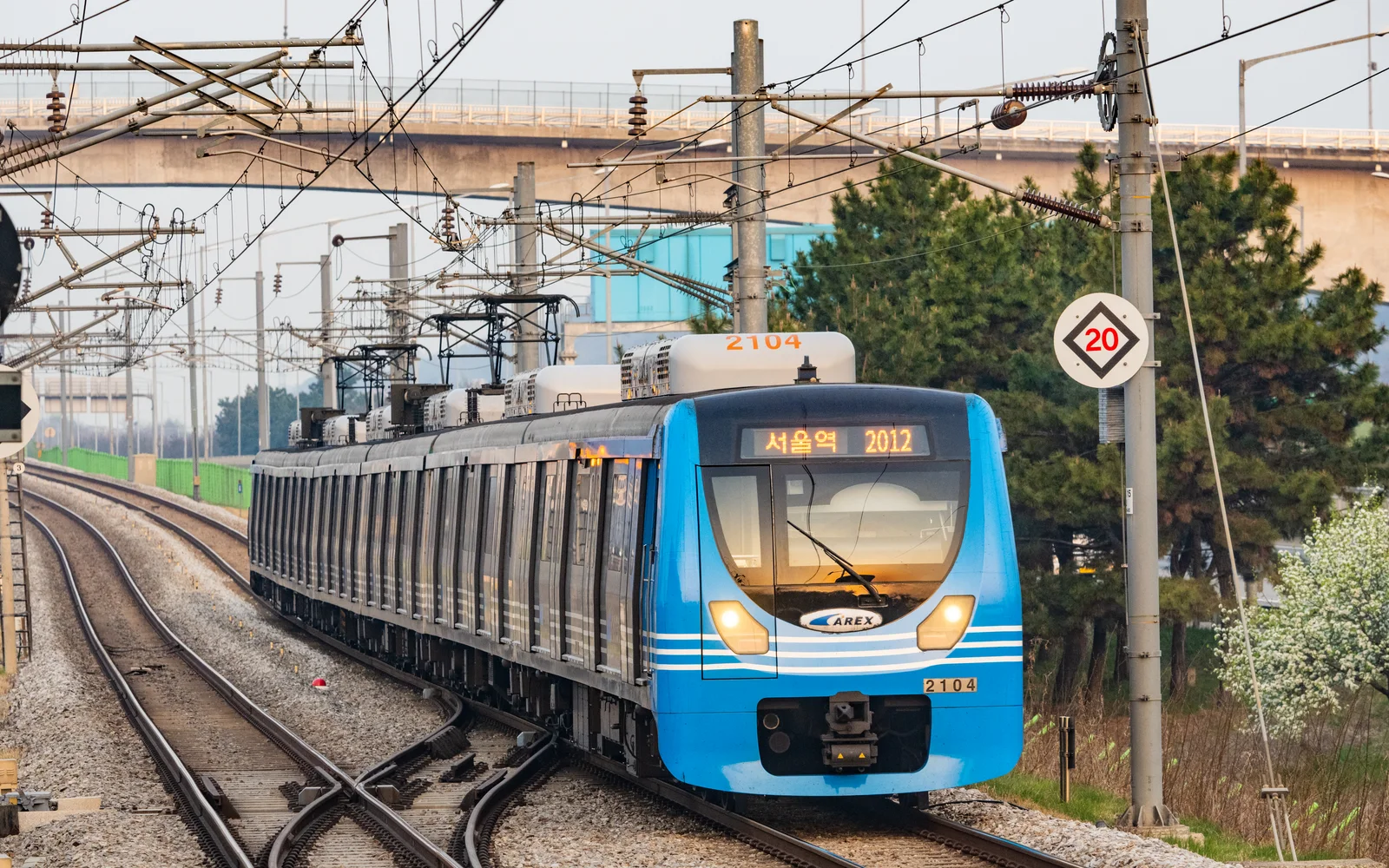
An AREX Class 2000 all-stop train at Gyeyang Station, an intermediate stop on the ICN–Gimpo line, photographed April 7, 2024. Photo: “AREX 2000, Gyeyang (20240407) (54219624992).jpg” by Takeshi Aida, CC BY-SA 2.0, via Wikimedia Commons and Flickr. Cropped, resized and converted to WebP under the same license.
Compare AREX, bus and taxi
| Option | Published trip or estimate | Current price | Where it takes you | Main constraint |
|---|---|---|---|---|
| AREX All-Stop | T1 about 38–41 min; T2 about 44–47 min | Adult transit card: T1 ₩4,350; T2 ₩4,950 | One station connected to both Gimpo terminals | Terminal walks and metro-style luggage space |
| Bus 6003 or 6014 | Scheduled about 32–35 min from T1; 52–55 min from T2 | Adult ₩8,000; child fare ₩6,000 | Gimpo International, then Domestic | Traffic, assigned departure and luggage limits |
| Standard taxi | KAC airport-pair estimate: about 40 min | About ₩45,000 in KAC's reverse-direction estimate | Exact Gimpo terminal requested | Meter, traffic, toll handling and night surcharge |
The train avoids road traffic and runs more often than either direct bus. The bus can reduce the underground walk because it stops at each Gimpo passenger terminal. A taxi is useful outside public-transport hours or when the station route does not suit the group's luggage or mobility needs.
Can you make this connection?
There is no universal ICN-to-Gimpo connection time. Your usable interval begins after the arriving flight reaches its stand and ends at the onward airline's applicable check-in, bag-drop, security or boarding cutoff.
Include every step that applies:
- deplaning at ICN, including a Concourse or remote-gate route;
- Korean immigration;
- checked-baggage claim and customs;
- the walk to the ICN train, bus or taxi pickup point;
- waiting and travel time;
- the route to Gimpo Domestic or International;
- check-in and bag drop;
- security, plus departure immigration for an international flight; and
- the gate walk and boarding cutoff.
Airline minimum connection times apply only to the itineraries they define. Korean Air currently publishes 170 minutes for an eligible T2 international arrival connecting to a Gimpo domestic flight.
Asiana's current airport guide lists these ICN-to-Gimpo minimums:
| Connection | Asiana to Asiana | Asiana to another airline |
|---|---|---|
| Gimpo domestic departure | 2 hr 50 min | 2 hr 40 min |
| Gimpo international departure | 3 hr | 4 hr |
The displayed domestic minimum for an Asiana-to-another-airline connection is 10 minutes shorter than the Asiana-to-Asiana minimum. Confirm that value with Asiana before relying on it.
Those figures do not apply automatically to another carrier, separate tickets or a delayed inbound flight. Ask both operating airlines whether they accept the connection, whether the first carrier will through-check your baggage, and what happens if the inbound flight is late. A self-transfer remains unprotected unless the ticket terms say otherwise.

A waiting area overlooking the apron at Gimpo Airport, with the location supplied by the photographer. The photo was published January 8, 2025; its capture date and exact terminal were not disclosed. Photo by Eun Jun Kim, Unsplash License. Cropped and converted to WebP.
Checked baggage: plan to reclaim and recheck it
For a standard international arrival at ICN, plan to collect checked baggage before customs and check it again at Gimpo unless both operating airlines confirm a different process for your ticket. Asiana explicitly tells ICN international passengers connecting to a Gimpo domestic flight to claim their bags and check them again at Gimpo. Confirm every bag tag at the origin airport and keep the onward airline's bag-drop cutoff available offline.
Keep medication, travel documents, chargers and anything needed during the transfer in carry-on baggage. If an airline gives you different handling instructions, ask it to identify where the bag will clear customs and where it will be delivered.
AREX All-Stop Train
AREX's route map shows Gimpo Airport on the All-Stop line between Magongnaru and Gyeyang. The Express serves only Seoul Station and the two ICN terminals, so it cannot be used for this transfer.
At either ICN station:
- follow signs for Airport Railroad or AREX after entering the public arrivals area;
- choose the All-Stop Train toward Seoul Station;
- confirm Gimpo Airport on the stopping pattern;
- tap a transit card or buy a single-use card; and
- leave at Gimpo Airport Station without changing trains.
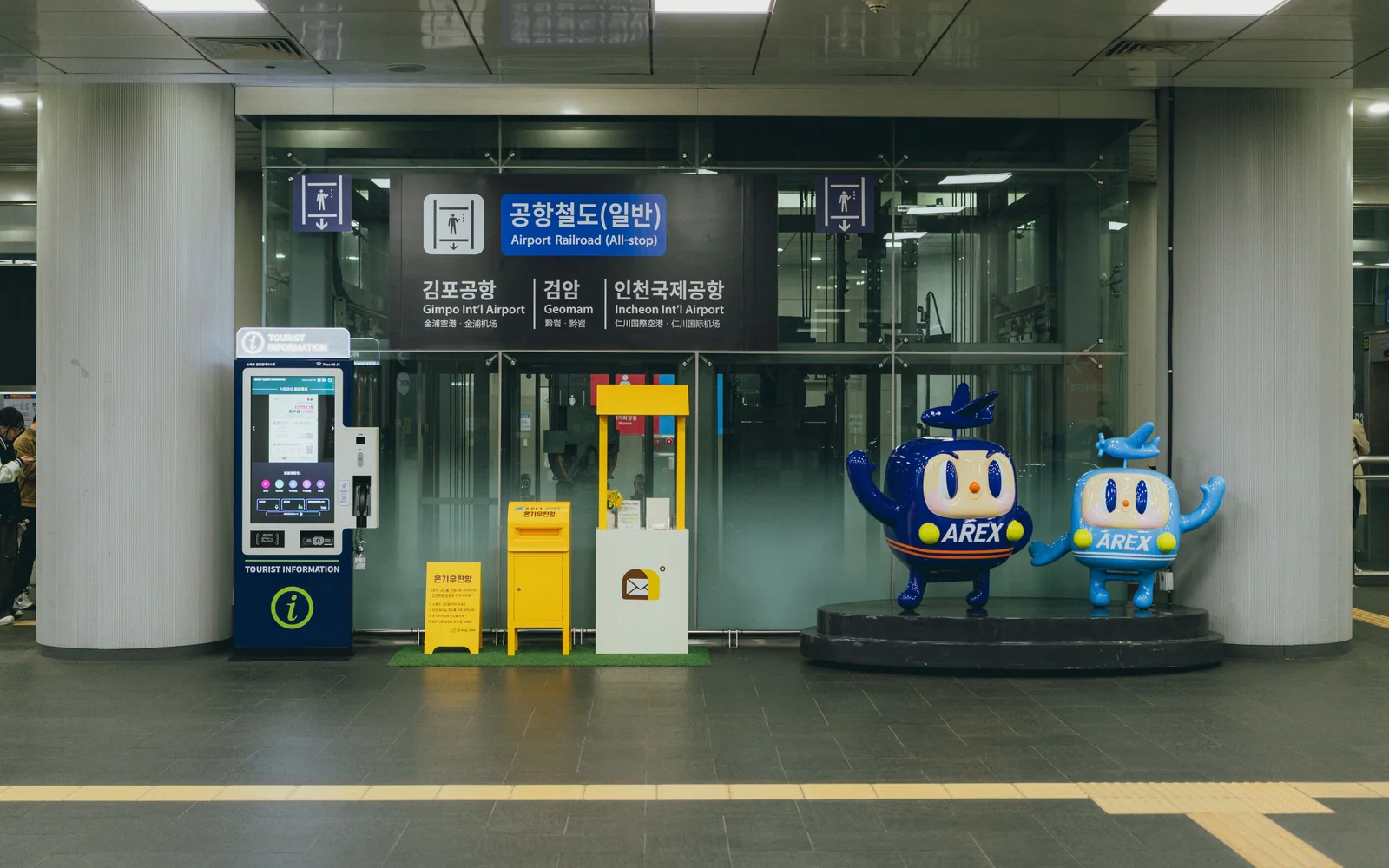
Blue Airport Railroad (All-stop) wayfinding in Seoul lists Gimpo Airport, Geomam and Incheon International Airport. The exact station and photo date were not disclosed. Photo by Theodore Nguyen, Pexels License; source page checked August 14, 2026. Cropped and converted to WebP. The people and brands pictured do not endorse this guide.
Fare and payment
The official AREX fare table lists adult transit-card fares of ₩4,350 from T1 and ₩4,950 from T2. A single-use card adds ₩100 to the fare and requires a ₩500 refundable deposit. Return the single-use card at a deposit-refund machine after the trip.
T-money works on the All-Stop Train. Most foreign visitors need cash to buy or reload a physical prepaid T-money card, so allow time before entering the fare gates. The ICN T-money guide explains current purchase, cash reload and single-use alternatives.
Each passenger needs a separate transit card or single-use card to pass through the fare gate. Child and youth discounts have age and registration rules; an unregistered adult card does not receive a reduced fare.
First and last trains
The timetable linked from the current AREX station pages shows:
| Station | First All-Stop toward Gimpo | Last All-Stop toward Gimpo | Arrival at Gimpo on that last train |
|---|---|---|---|
| ICN Terminal 2 | 05:08 | 23:50 | About 00:34 |
| ICN Terminal 1 | 05:14 | 23:56 | About 00:34 |
Weekday and holiday departure patterns differ during the day even though these first and last trips currently match. Use the T1 station timetable or T2 station timetable on the travel date. A passenger whose flight lands near the last departure may reach the public station after train service has ended.
All-Stop trains usually arrive every 5–10 minutes, but the detailed timetable includes occasional gaps of up to about 19 minutes, especially late. Plan around the next departure shown in the live timetable.
From Terminal 1
After customs, follow Airport Railroad signs from the 1F arrivals hall to the Transportation Center and the B1 ticket area. The station is landside. Do not follow signs for the secure shuttle train used between airport gate buildings.
AREX currently lists four elevators and 12 escalators across the T1 station. On the Seoul-bound platform, the elevator boarding position is marked 2-3. Use that position to find the lift and check its operating status on arrival.
Allow separate time for the terminal-to-station walk, buying or loading fare media, and reaching the correct All-Stop platform. The official online sources do not publish one dependable walk time from every arrival exit, and temporary lift or corridor changes remain a live check.
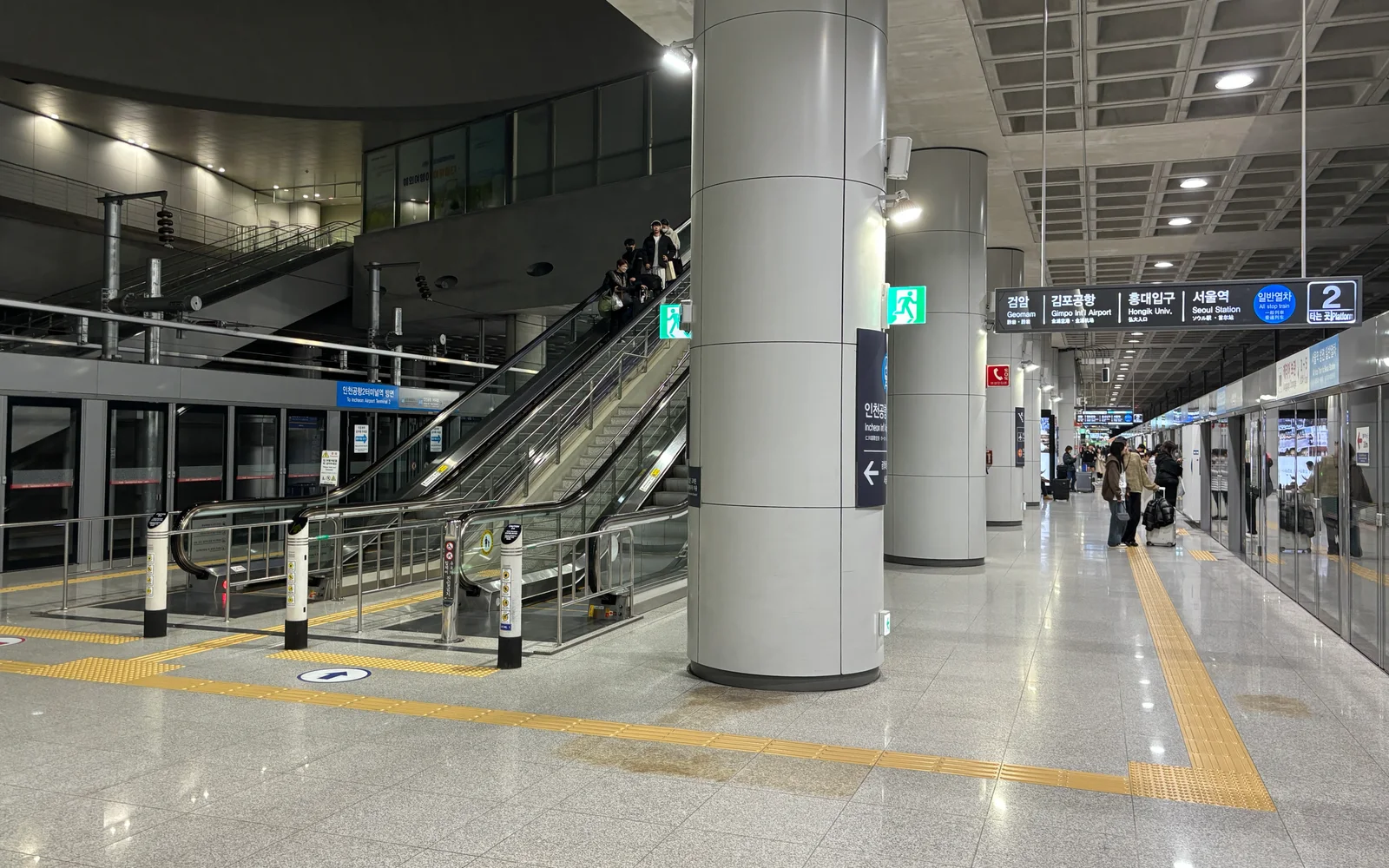
AREX Platform 2 at Incheon Airport Terminal 1; the blue All-stop sign lists Gimpo Airport among the stops. Photographed March 17, 2024. Photo: “202403 AREX Local Platform 1,2 of Incheon International Airport Terminal 1 Station.jpg” by MNXANL, CC BY-SA 4.0, via Wikimedia Commons. Cropped, resized and converted to WebP under the same license.
From Terminal 2
Follow Airport Railroad signs to the T2 Transportation Center and station. The All-Stop train calls at T1 before continuing to Gimpo, which accounts for the longer ride from T2.
AREX currently lists seven elevators and 12 escalators across the T2 station. The Seoul-bound platform elevator positions are marked 3-2 and 4-2. Choose the Seoul-bound All-Stop service and verify Gimpo Airport on the station display.
If the flight arrives at the Concourse
The Concourse has no public curb or AREX station. Follow the controlled arrival route to T1 for immigration, baggage claim and customs, then enter the landside T1 rail route. The ICN terminal map guide separates the secure shuttle train from public AREX and shows why the two should not be confused.
At Gimpo Airport Station
Gimpo Airport Station connects AREX with Seoul Subway Lines 5 and 9, the Gimpo Goldline and the Seohae Line. Follow signs for the Domestic or International Terminal and ignore directions for subway transfers.
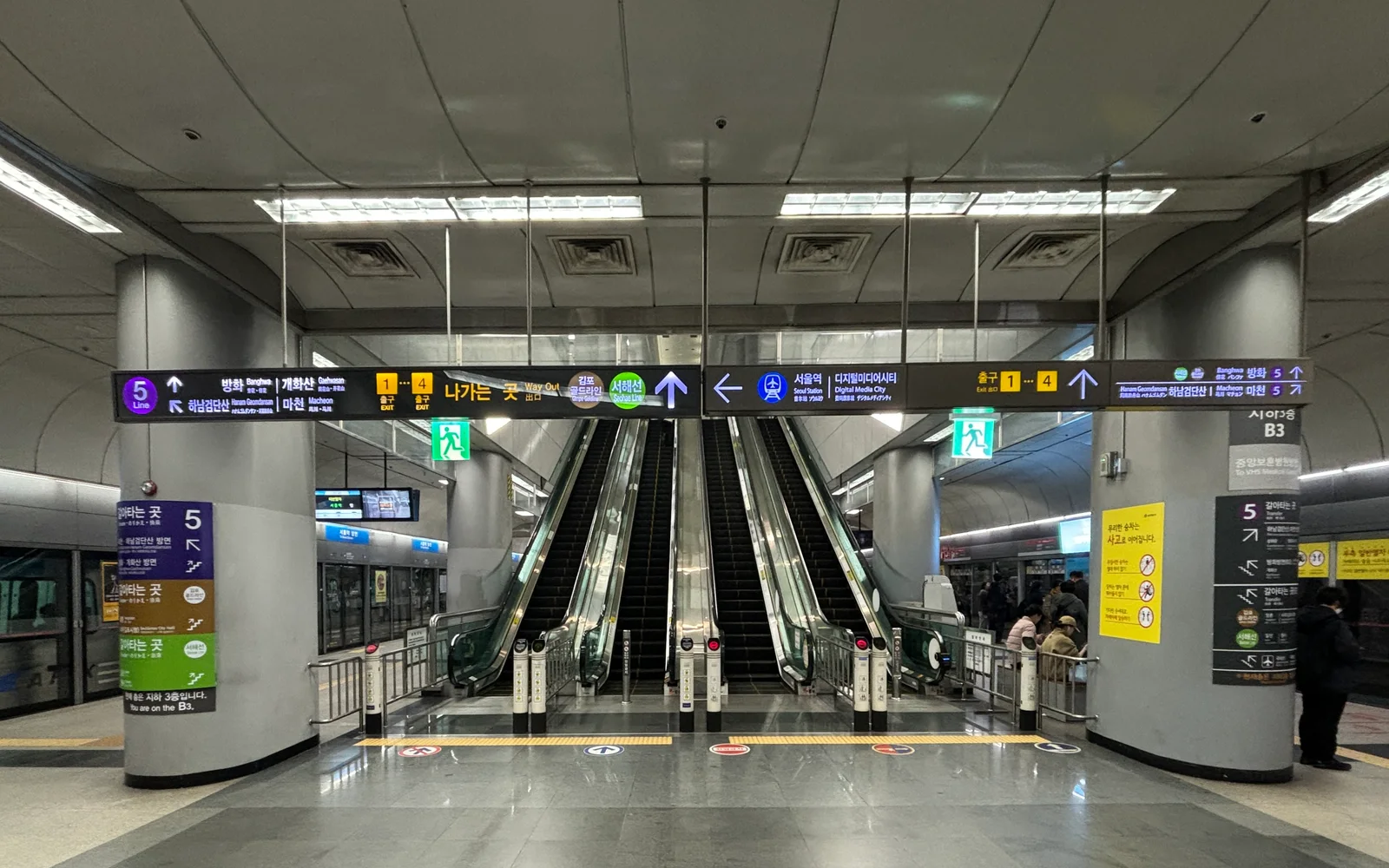
The shared AREX and Line 9 platform level at Gimpo Airport Station, with signs for exits and Line 5 transfers. Photographed March 17, 2024. Photo: “202403 AREX and L9 Eastbound Platform of Gimpo International Airport Station.jpg” by MNXANL, CC BY-SA 4.0, via Wikimedia Commons. Cropped, resized and converted to WebP under the same license.
- For a domestic flight, follow signs for Domestic Terminal and check the operating airline's live departure record.
- For an international flight, follow signs for International Terminal, then allow time for check-in, security and departure immigration.
Korea Airports Corporation places station access on the west side of 1F at both passenger terminals. The route is an underground airport connection, but KAC does not publish one online platform-to-counter walking time that applies to every lift, exit and airline row.
The AREX platform is on B4. AREX currently lists six elevators and 14 escalators at the station; the arriving Seoul-bound platform elevator position is marked 5-4. Recheck lift status if the route must be step-free.
If you reach the wrong passenger terminal, Gimpo also operates a free airport shuttle. Its passenger-terminal loop is currently listed from 08:00 to 23:00, every 12–15 minutes, using stop 5 at International and stop 8 at Domestic. Check the bus label because a separate loop continues through cargo facilities.
Direct airport buses 6003 and 6014
Airport Limousine routes 6003 and 6014 currently travel from ICN T2 to T1, then stop at Gimpo International 1F bay 6 and Gimpo Domestic 1F bay 4 before continuing into Seoul. This order matters: board only the downtown-bound trip, not a bus going back toward Incheon Airport.
ICN boarding points and current timetable
| Route | T2 boarding | T2 first / last | T1 boarding | T1 first / last |
|---|---|---|---|---|
| 6003 | B1, platform 24 | 05:29 / 23:09 | 1F, 6A-3 | 05:49 / 23:29 |
| 6014 | B1, platform 24 | 06:09 / 22:54 | 1F, 6A-4 | 06:29 / 23:14 |
The operator's stop-by-stop timetable gives a scheduled airport-pair trip of about 52 minutes to Gimpo International and 55 minutes to Domestic from T2, or 32 and 35 minutes from T1. Road, weather and operating conditions can change those times.
Use the current operator pages for route 6003 and route 6014, then confirm the selected departure in the IIAC bus search. The airport and operator can change bays or schedules without editing this guide.
Bus fare, tickets and luggage
The operator lists the airport-to-airport fare as ₩8,000 for an adult and ₩6,000 for a child. Buy a ticket before boarding at ICN. The ticket guide lists staffed offices and 24-hour ticket machines at both terminals; a current operator notice specifically directs T2 passengers to the B1 ticket counter or vending machine. Do not assume online purchase is available for this airport departure.
The bus terms allow up to two bags in total per ticket, including carry-on, with each checked piece no more than 20 kg and 160 cm for the sum of length, width and height. A cabin bag must be under 10 kg and 50 × 40 × 20 cm. Oversize or excess baggage can be charged or refused, so confirm unusual items, strollers and mobility equipment before relying on the bus.
One child under six may ride free with each ticketed adult when no separate seat is used, according to the operator's terms. Use the fare shown at ticketing for every traveler because the operator's English pages use inconsistent upper-age labels for the child fare.
Taxi from ICN to Gimpo Airport
Use the designated taxi queue and tell the dispatcher and driver both the airport and passenger terminal:
- Gimpo Airport:
김포공항 - Domestic Terminal:
국내선 - International Terminal:
국제선
The IIAC Taxi Guide lists standard-taxi pickup at 5C, 6C and 6D in T1 and 7C in T2. Ask the dispatcher to place you in the correct queue for Gimpo Airport rather than accepting an arrivals-hall solicitor.
Korea Airports Corporation's Gimpo taxi table publishes a reverse-direction planning estimate of 40 minutes and ₩45,000 for a standard taxi, with the route line labeled as including the toll; its deluxe estimate is ₩70,000. The same page separately says motorway tolls are paid by the passenger. Treat the number as a rough airport-pair estimate and ask how the toll will be charged before departure.
The actual ICN-origin fare depends on the meter and traffic. IIAC says there is no boundary surcharge between Incheon Airport and the Seoul, Incheon, Gimpo, Goyang, Bucheon and Gwangmyeong joint operating area. A night surcharge of about 20% to 40% applies between 22:00 and 04:00, depending on taxi type and time.
A standard taxi may not carry a large group, several full-size cases or a rigid mobility device. Use the official oversized-taxi queue or an operator that confirms the vehicle, price basis, meeting point and cancellation terms in writing.
Luggage, children and accessibility
The AREX All-Stop Train has metro-style seating and shared floor space rather than an assigned luggage compartment. Its current passenger terms generally prohibit ordinary baggage of 32 kg or more, 158 cm or more for the three dimensions combined, or more than two items per passenger. Exceptions include a wheelchair in use, a stroller in use and some same-day airline baggage accepted by staff. Keep bags out of doorways and priority areas; a permitted size does not guarantee convenient room in a crowded car.
Use station lifts when needed, but check lift status on the travel day. General terminal accessibility does not prove that every temporary route, platform gap or vehicle will suit a particular mobility device.
Arrange departure and arrival assistance with each operating airline. At Gimpo, KAC lists wheelchair rental at the information desks and help points for passengers with reduced mobility. Its Porty Care service can provide an e-cart and assistance from the subway connection toward check-in. The Korean eligibility page includes passengers with disabilities, pregnant travelers, adults age 70 or older and people accompanying a child age seven or younger. Call 02-2660-2478 or ask on site; availability is not automatic.
If a lift outage blocks the rail route, ask airport staff for a step-free alternative. Do not assume a standard taxi or bus can carry a wheelchair, scooter or other large device without confirmation.
If the arriving flight is late
Check the onward airline's cutoff before leaving the ICN arrivals area. The last train may still be running while the Gimpo check-in or bag-drop desk is already closed.
When rail has ended, compare the remaining 6003 or 6014 departure with the designated taxi queue. If neither can reach Gimpo before the applicable cutoff, contact the airline before paying for transport.
For a rebooked next-day flight, compare a suitable landside room in the hotels near Incheon Airport guide or accommodation near the airport the airline names. Do not stay airside at ICN when the plan requires collecting bags and entering Korea for a Gimpo departure.
Plan B
- Missed the planned train: take the next All-Stop service and recalculate against the airline cutoff.
- Rail disruption or lift problem: check 6003/6014 and ask staff for an accessible route or suitable vehicle.
- After the last train and bus: use the designated taxi queue.
- Connection no longer works: contact the receiving airline before spending money on a rushed transfer.
- Unclear entry status: confirm eligibility in the Korea Visa Navigator before booking ground transport.
Save the flight record, airline contacts, bus or train timetable and route screenshots offline. A Korean data connection helps with live changes; the ICN SIM and eSIM guide compares current options.
Frequently asked questions
Is AREX direct from Incheon Airport to Gimpo Airport?
Yes. The AREX All-Stop Train runs from ICN T2 and T1 to Gimpo Airport Station without a train change. The AREX Express skips Gimpo Airport.
Do I have to enter Korea to transfer between ICN and Gimpo?
Yes. The airports have no airside link, so you must be admitted to Korea, pass customs and travel landside, even when the Gimpo flight is international. Assume you must collect checked baggage at ICN and check it again at Gimpo unless both operating airlines confirm a different process for the exact ticket.
How long does AREX take from ICN to Gimpo Airport?
The current official timetable shows roughly 38 to 41 minutes from T1 and 44 to 47 minutes from T2, depending on the train. Add the walks at both airports and the wait for a train.
How much is AREX from ICN to Gimpo Airport?
AREX lists adult transit-card fares of ₩4,350 from T1 and ₩4,950 from T2. A single-use card costs ₩100 more and requires a refundable ₩500 deposit.
What are the first and last AREX trains to Gimpo?
The current timetable shows the first All-Stop departure at 05:08 from T2 and 05:14 from T1. The last leaves at 23:50 from T2 and 23:56 from T1, reaching Gimpo at about 00:34. Recheck the timetable on the travel date.
Which direct buses run from ICN to Gimpo Airport?
Airport Limousine routes 6003 and 6014 currently run T2 to T1, then stop at Gimpo International and Gimpo Domestic. Both use T2 platform 24; at T1, use 6A-3 for 6003 or 6A-4 for 6014.
How much connection time should I allow between ICN and Gimpo?
Use the minimum connection time set for the exact airlines and ticket, then add margin for immigration, baggage, customs, the landside trip, check-in, security and the gate walk. A self-transfer is not protected merely because it exceeds another airline's published minimum.
How much is a taxi from ICN to Gimpo Airport?
Korea Airports Corporation publishes a reverse-direction planning estimate of about 40 minutes and ₩45,000 for a standard taxi. Its route table labels that estimate as including the toll, while the same page separately says passengers pay motorway tolls. Ask how the toll will be charged; the ICN-origin meter, traffic and any 22:00–04:00 night surcharge determine the final total.
Which Gimpo terminal do I need?
Use the Domestic Terminal for a domestic flight and the International Terminal for an international flight, but confirm the operating airline and live flight record. AREX serves one station connected to both passenger terminals.
What should I do if the arriving flight is late?
Check the receiving airline's check-in or bag-drop cutoff before paying for transport. Use the designated taxi queue if trains and direct buses have ended, but contact the airline first if the cutoff is already unreachable.
Official sources
- AREX: All-Stop route and ticket types, Express stopping pattern and passenger terms
- AREX: adult fares and single-use card rules
- AREX: current full timetable
- AREX: T1 station, T2 station and Gimpo Airport Station
- Incheon Airport: railroad guide, bus search, taxi guide, arrival procedures and transport FAQ
- Airport Limousine: 6003, 6014, airport-pair fares, ticket offices, T2 ticket notice and baggage terms
- Gimpo Airport: public transport, terminal shuttle, taxi estimate, accessibility, Porty Care and Korean Porty Care eligibility
- Airline examples: Korean Air transfer minimums and Asiana Gimpo transfer guidance
- Visa and entry sources in the Korea Visa Navigator