T-money at Incheon Airport:Where to Buy, Reload and Use It
Find 24-hour T-money sellers in Incheon Airport T1 and T2, plus current prices, cash rules, AREX use, mobile options, refunds and fallbacks.
Official sources checked 10 September 2026

Ask Narin.
Find answers in this guide
Narin is a fictional AI host.
Loading your saved chat…
NarinAsk me a question about this guide. Answers include links to the guides.
30-second answer
Buy a physical T-money card after customs in the public arrivals area. In Terminal 1, the 24-hour CU branches near Exits 2, 5, 11 and 13 explicitly list T-money. In Terminal 2, start with the 24-hour CU near Exit 10.
A general card currently costs about ₩3,000–₩5,000 before travel credit. Bring Korean-won cash: current KTO visitor guidance says a foreign-issued card cannot be used to buy or reload an ordinary physical T-money card. Load ₩10,000–₩20,000 as a practical first amount, then add more when needed.
T-money works at the gates for the AREX All-Stop Train. The reserved-seat AREX Express needs a separate ticket.
| Your situation | Best first move | Important catch |
|---|---|---|
| T1 arrival | Public CU near Exit 2, 5, 11 or 13 | All list 24H; the exact card or design can sell out |
| T2 arrival | Public CU near Exit 10 | Listed 24H and its IIAC record names T-money |
| Taking AREX All-Stop | Buy and load T-money before the gate | Current adult fare is ₩4,750 from T1 or ₩5,350 from T2 to Seoul Station |
| Taking AREX Express | Buy the separate Express ticket | T-money balance does not replace the reserved-seat ticket |
| No Korean cash | Buy the rail trip's separate ticket with a supported foreign card | This solves the train ride, not later bus travel or T-money reloads |
| Staying airside in transit | Use only a store on your permitted route | The main arrival stores are landside; do not enter Korea just to buy a card |
What T-money costs and how much cash to prepare
The card price and its usable balance are two separate amounts. KTO's current comparison gives ₩3,000–₩5,000 as the price range for a general card. Character designs and tourist products may cost more.
| Purchase | Current amount | What it means |
|---|---|---|
| General physical card | ₩3,000–₩5,000 | Nonrefundable product price; no ride credit is included unless the seller says so |
| Suggested first load | ₩10,000 | Covers either current adult All-Stop fare to Seoul Station and leaves some balance |
| More convenient first load | ₩20,000 | Reduces the chance of an early city reload; it is not a required amount |
| One cash reload | ₩1,000–₩90,000 | In ₩1,000 increments |
| Maximum card balance | ₩500,000 | An issuer limit, not a sensible tourist target |
For a plain card with a ₩10,000 balance, budget ₩13,000–₩15,000 in Korean-won cash. Ask the cashier to confirm the card price and the loaded balance separately before leaving.
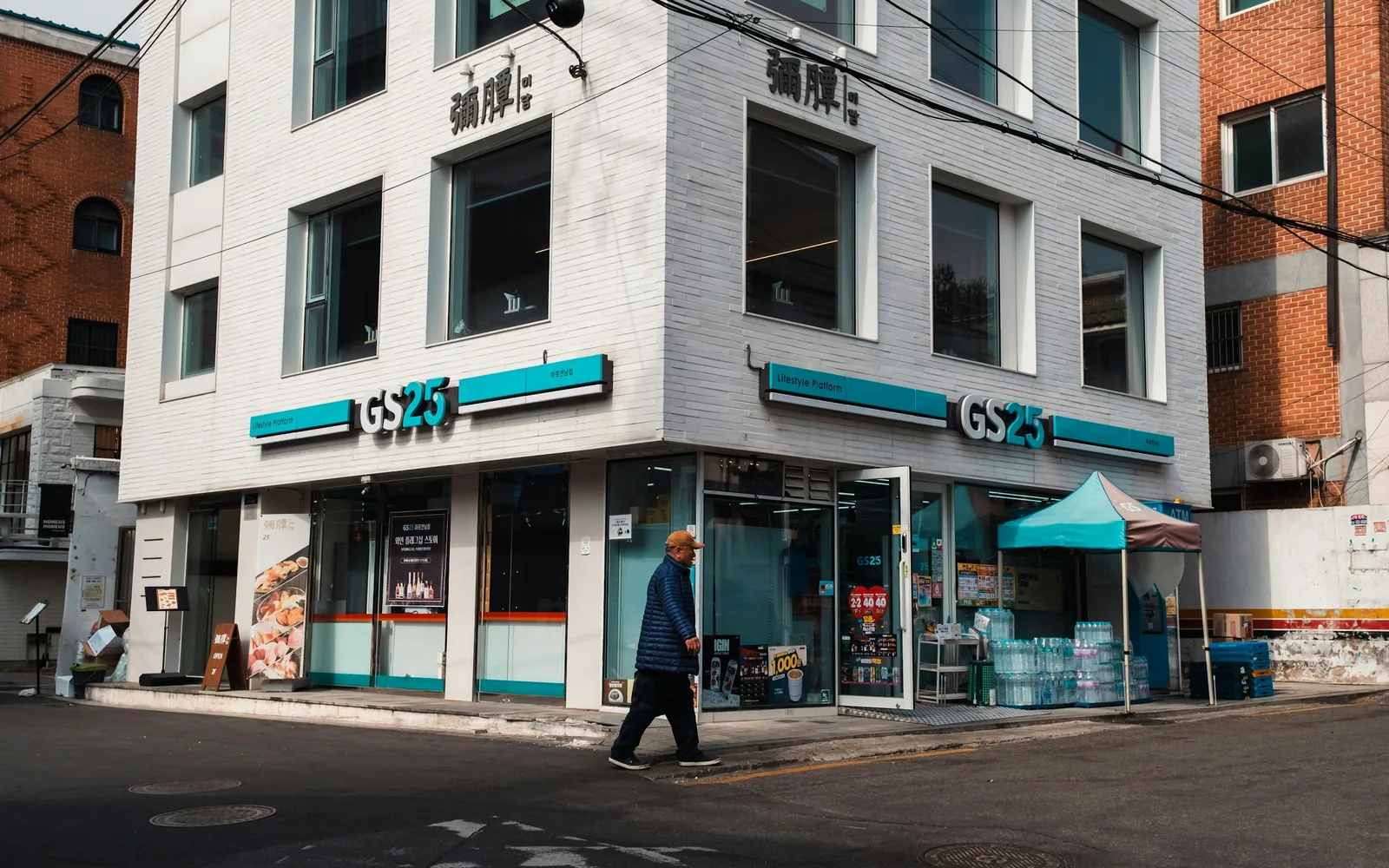
Illustrative GS25 in Korea, not an Incheon Airport branch. The photograph does not prove that this store or every GS25 stocks T-money. Photo: F aint, published March 13, 2025, under the Unsplash License. Cropped and optimized. The person pictured does not endorse this guide.
Where to buy T-money in Terminal 1
An international arrival reaches these stores after immigration, baggage claim and customs. All four are on public 1F and are currently listed by IIAC as open 24 hours.
| T1 public store | Live airport record | Why use it |
|---|---|---|
| CU near Exit 2 | IIAC facility 544 | IIAC explicitly names T-money |
| CU near Exit 5 | IIAC facility 376 | IIAC explicitly names T-money |
| CU near Exit 11 | IIAC facility 339 | IIAC explicitly names T-money |
| CU near Exit 13 | IIAC facility 76 | IIAC explicitly names T-money |
Use the closest one. If it is out of stock, try another public branch or follow Airport Railroad signs to the Transportation Center. The AREX T1 station page lists a Tmoney vending machine and a convenience store. Buy only from a machine that clearly offers the card or reload function you need.
There is also a 24-hour public CU near Check-in Counter H on 3F, but an arriving passenger should not walk upstairs before trying the four 1F branches.
Where to buy T-money in Terminal 2
In Terminal 2, start with the 24-hour public CU near Exit 10. Its IIAC record names T-money.
| T2 public store | Live airport record | What the source proves |
|---|---|---|
| CU near Exit 10, 1F | IIAC facility 2272 | 24H public store; T-money named in the listing |
| GS25 near Arrival Hall A, 1F | IIAC facility 3325 | 24H public store; GS25 is an issuer-listed T-money chain |
| CU in the center of public 1F | IIAC facility 900 | 24H public store; CU is an issuer-listed T-money chain |
| CU in the center of Transportation Center B1 | IIAC facility 1090 | 24H public store on the way to AREX |
CU and GS25 are T-money partner chains, but individual branches can run out. If the Exit 10 store has no cards, try the other 1F stores or the B1 CU. The AREX T2 station page lists ticket, fare-adjustment and deposit-refund machines; unlike the T1 page, it does not list a dedicated Tmoney vending machine.
For more floor landmarks, keep our Incheon Airport terminal map open. Our airport food guide also lists the current public convenience stores if you need water or a meal at the same stop.
Can a transfer passenger buy one airside?
The public T1 and T2 stores above are landside, so reaching them requires entering Korea. Use our Korea Visa Navigator to check your passport and itinerary against the relevant official authority.
IIAC lists a 24-hour CU near Concourse Gate 124 whose description names T-money. The store may not be on your permitted transfer route. Stay on the route for your onward flight and buy a card later if necessary.
How to top up a physical card
For an ordinary visitor card, treat top-up as a cash transaction. T-money's current reload rules permit Korean-won cash reloads at participating convenience stores and supported subway facilities. The current range is ₩1,000–₩90,000 per cash reload, in ₩1,000 increments, with a maximum balance of ₩500,000. KTO's May 2026 visitor guide says foreign-issued cards are not accepted for ordinary physical T-money purchase or reload.
At a store, hand the card to the cashier, say the amount and pay in cash. At a supported machine:
- Confirm that the machine says transport-card reload, not only single-use or Express ticket sales.
- Select English if available.
- Place the card on the marked reader.
- Choose the reload amount.
- Insert Korean-won cash in a denomination the machine accepts.
- Leave the card on the reader until the machine confirms completion.
- Check the new balance and take the receipt.
A foreign-card logo on an AREX ticket machine does not mean the same card can reload physical T-money. Ticket payment and stored-value reload are separate transactions with different rules.
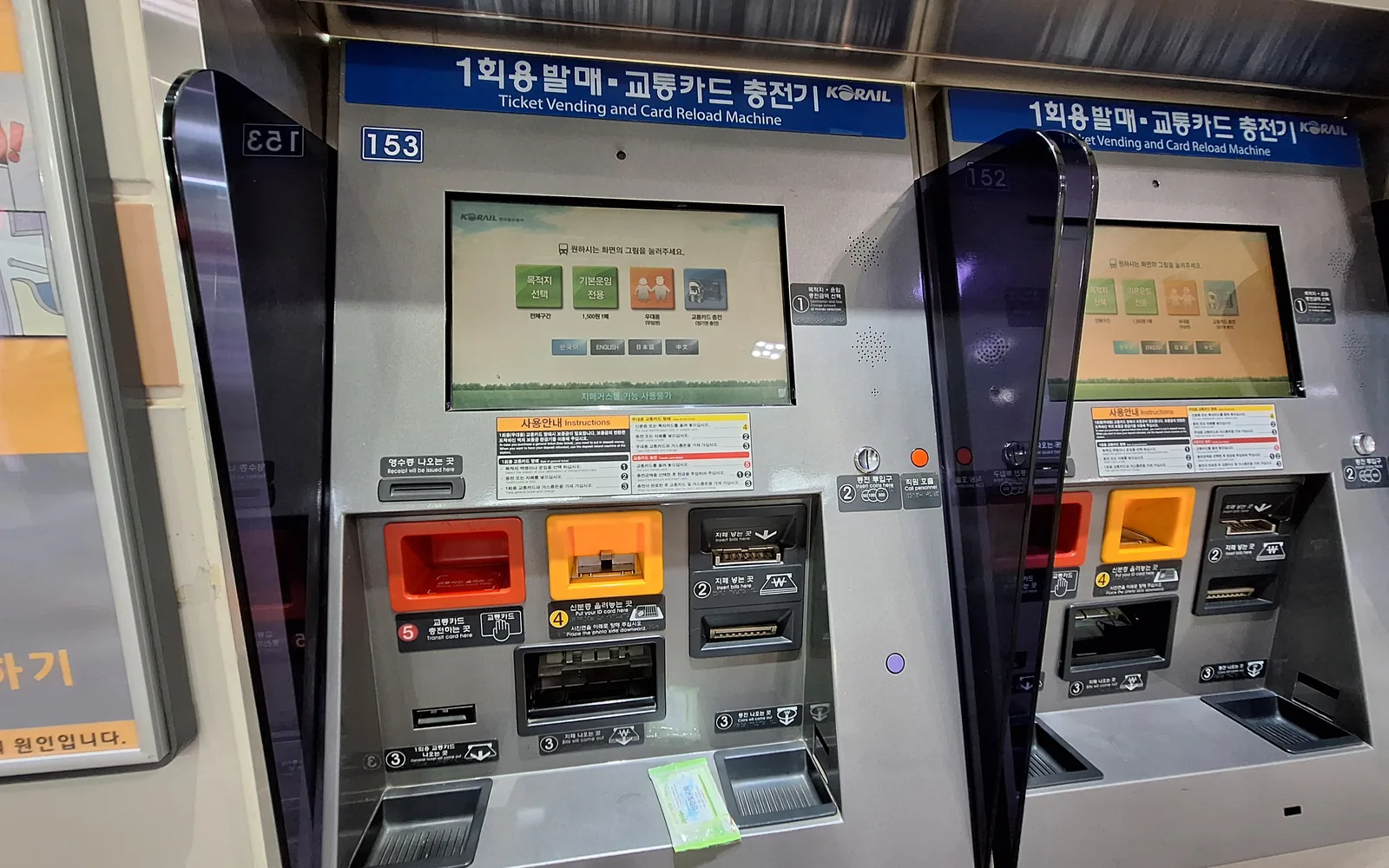
Ticket vending and transport-card reload machines at Soraepogu Station in Incheon, photographed July 13, 2024. This is not ICN; the interface and fare visible on the screen are historical and are not the source for today's prices. Photo: LandAndTree, CC BY 4.0. Cropped, resized and converted to WebP.
Using T-money on AREX
AREX runs an All-Stop Train and a reserved-seat Express. They use different gates and ticket rules.
| AREX service | Can T-money open the gate? | Current adult price to Seoul Station | What to buy |
|---|---|---|---|
| All-Stop from T1 | Yes | ₩4,750 with a transport card | Load T-money and tag in/out |
| All-Stop from T2 | Yes | ₩5,350 with a transport card | Load T-money and tag in/out |
| Express | No; T-money balance is not the reserved ticket | Check the live Express checkout | Separate assigned-seat Express ticket |
The All-Stop fares above are from AREX's current official fare table, checked September 10, 2026. A single-use card costs ₩100 more than the corresponding adult transport-card fare and carries a refundable ₩500 deposit.
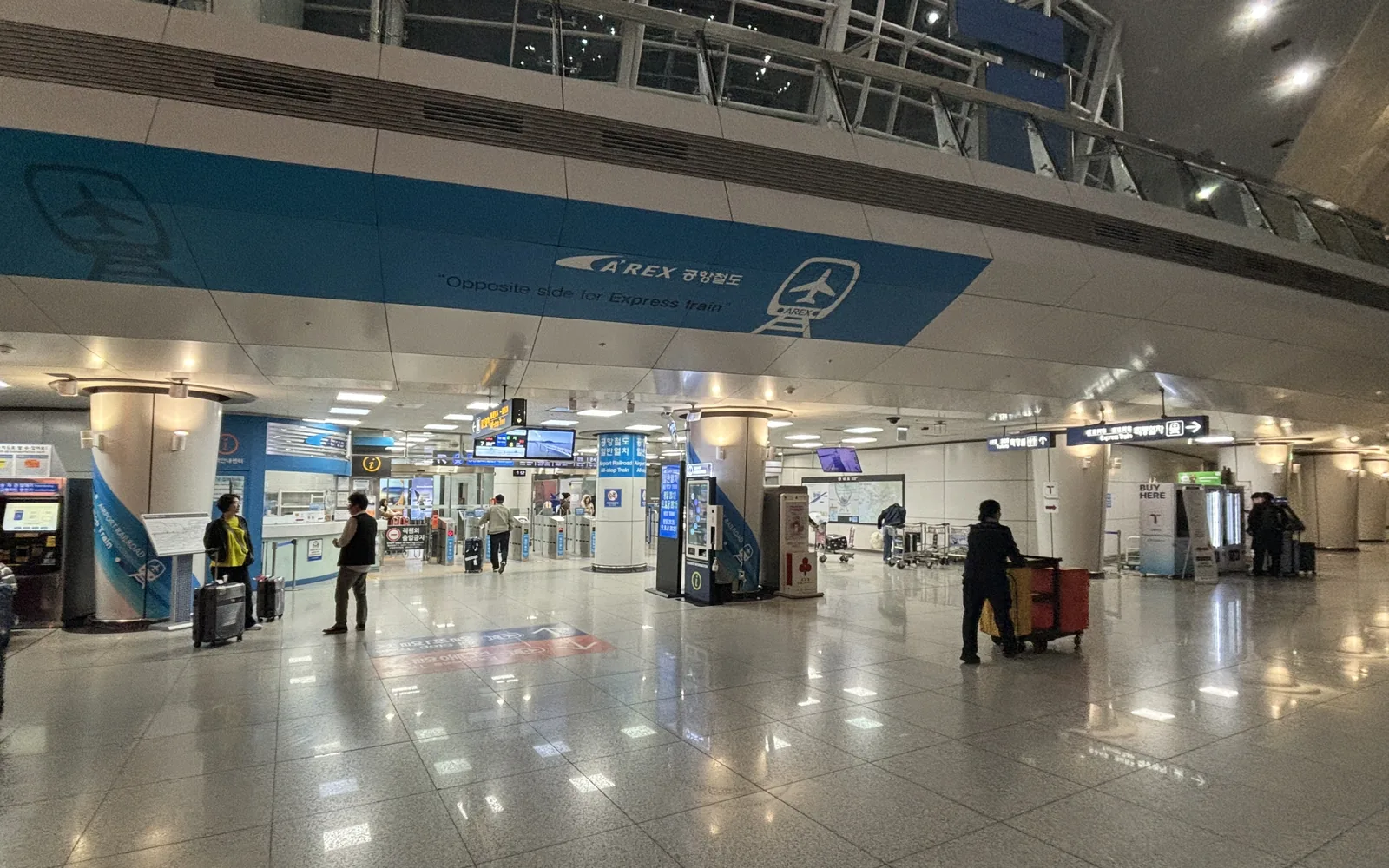
AREX All-Stop concourse at Incheon Airport Terminal 1 station, photographed March 17, 2024. The image shows the All-Stop area and signage pointing to the separate Express side; signs can change. Photo: MNXANL, CC BY-SA 4.0. Cropped, resized and converted to WebP under the same license. People pictured do not endorse this guide.
Use a loaded T-money card at the All-Stop gate and tag out at your destination. If the balance is too low at exit, use the fare-adjustment facility or ask station staff.
For Express, buy a reserved-seat ticket through an official AREX Express channel. T-money remains useful after arrival for subway and bus trips.
No cash or no card: the rail-only workaround
KTO says current AREX machines at T1 and T2 can sell a single-use subway card with a credit card. It gets you through the All-Stop and connecting metro journey, but it is not a reusable T-money card and will not solve a later city-bus fare. Return it at a deposit-refund machine after the final subway exit to recover the ₩500 deposit.
Using T-money on subways, buses and taxis
Give each traveler a separate card for subway entry and ordinary transfer travel. At a subway gate, tag in and out. On a city bus, tag when boarding and again when leaving so the system can calculate the distance and an eligible transfer.
Seoul's official transfer rules allow eligible subway-to-bus, bus-to-subway and bus-to-bus transfers when you board within 30 minutes of tapping out, extended to 60 minutes from 21:00 to 07:00. A connected journey can include up to four transfers, or five boardings. Returning to the same bus route or vehicle does not qualify.
A Seoul bus driver may manually charge several passengers to one card if you state the number before tapping. For a group bus transfer to qualify, everyone must board and leave together and the passenger count must stay the same. It cannot be used for a subway transfer; separate cards are simpler if the group may split up.
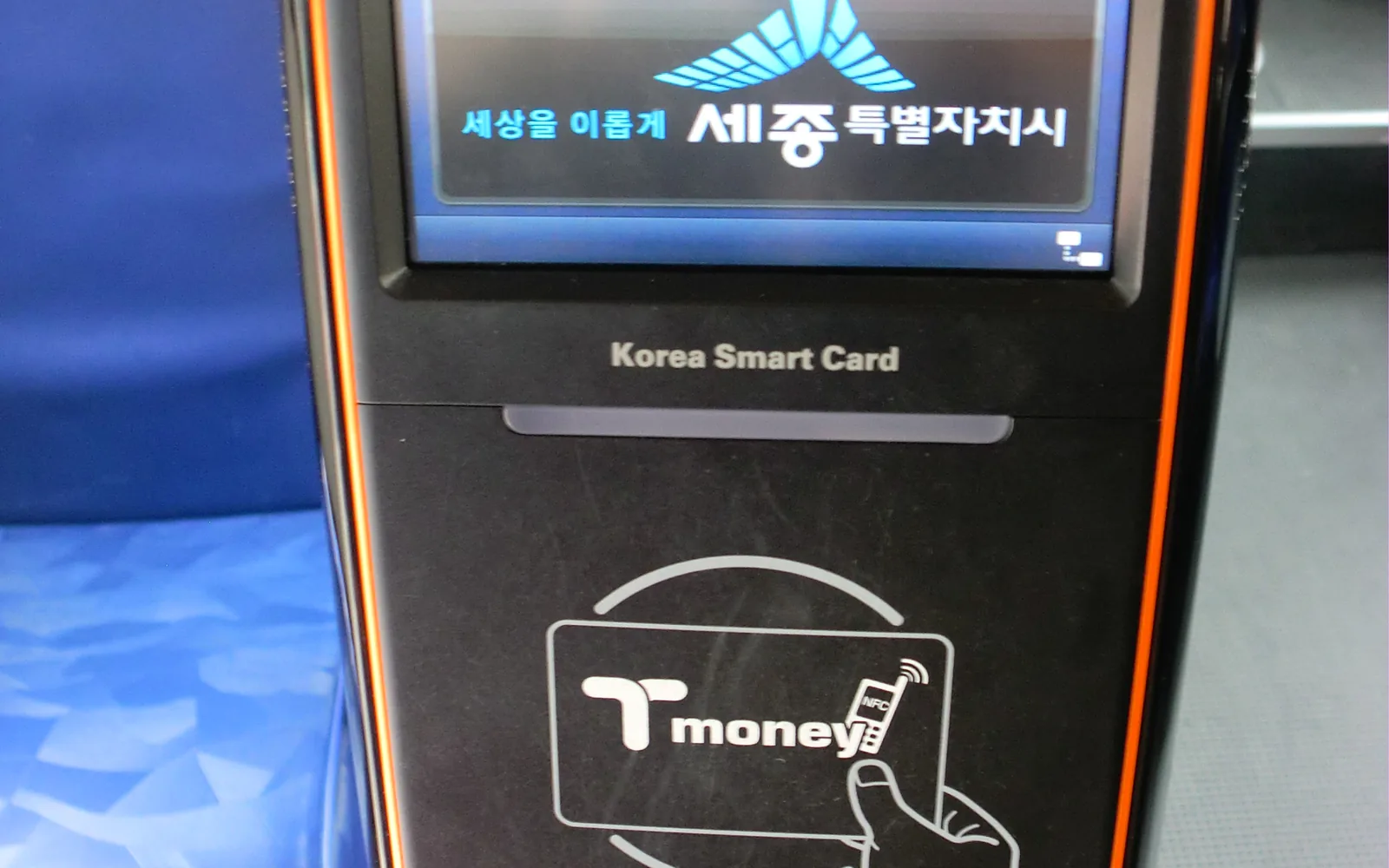
Historical example of a T-money reader inside a Sejong city bus, photographed July 1, 2014. Current readers can look different, and this is not an airport-bus acceptance guarantee. Photo: hyolee2, CC BY-SA 3.0. Cropped, resized and converted to WebP under the same license.
Airport buses are operator-specific
Do not board an airport limousine bus assuming the reader will accept T-money. KTO's current guide says only selected airport buses accept it. At ICN, the normal airport-to-city flow is often to buy the operator's ticket at the terminal counter or machine. Check the route, direction and operator before relying on stored value.
Taxis and stores
T-money can pay at compatible taxi readers, including many Incheon and Seoul taxis, but acceptance is not universal. Show the card or ask before the ride ends and keep another payment method.
The balance also works at affiliated merchants displaying the Tmoney logo, including participating convenience stores. A chain name alone does not prove that every branch or every service accepts it.
Child and youth fares
An adult can use an ordinary standard card without creating a visitor account. A child or teenager needs the correct fare category and date-of-birth registration.
Ask the convenience-store clerk to register the date of birth when buying the card. If the card is bought elsewhere or cannot be registered immediately, T-money says the category and birth date must be registered within 10 days of first use or adult fare applies. Whether an airport clerk can complete the step and what proof they request remain same-day checks.
AREX currently defines a child as age 6 to under 13 and youth as 13 through 18. Do not assume those exact ages apply to every regional operator in Korea.
Physical card, phone or another travel card?
For most arrivals, a plain physical card avoids phone, app-store and payment-card compatibility checks and keeps transit spending in one balance.
| Product | Best for | Airport limitation |
|---|---|---|
| Standard physical T-money | Simple pay-as-you-go transit | Buy and reload with Korean-won cash; lost ordinary balance is normally unrecoverable |
| Korea Tour Card / tourist T-money | You will use its current visitor benefits | Card price and benefits vary; it is not automatically better for transit |
| Apple Wallet Tmoney | Supported iPhone or Apple Watch with a workable funding method | Direct Wallet purchase/reload requires a Korean-issued bank card |
| Android Mobile Tmoney | A compatible phone, app region and verified funding route | Foreign Android hardware and international payment acceptance are not universal |
| Climate Card short-term pass | Heavy travel inside the published Seoul coverage area | You cannot board AREX at ICN T1 or T2 with it |
| WOWPASS | You also want its prepaid payment/exchange features | Its payment balance and built-in T-money transit balance are separate |
| NAMANE | You want app/kiosk top-up or a custom design | Pay Balance and Transit Balance are separate; it is not standard T-money |
| EZL | The store has it and its coverage fits your trip | Separate issuer, app and refund rules; do not apply this guide's T-money refund table |
T-money in Apple Wallet
Apple and T-money launched Apple Pay Tmoney on July 21, 2025. Apple currently lists iPhone XS/XR or later with iOS 17.2+, and Apple Watch Series 6/SE 2 or later with watchOS 10.2+. Express Mode lets a supported device tap without unlocking.
Apple's support terms require a Korean-issued credit or debit card for direct Wallet purchase or reload. KTO's current app guide says the Mobile Tmoney app supports selected international card brands, so confirm the available payment method in the current app before relying on a phone alone.
Climate Card at ICN
Seoul's current Climate Card rules allow a passenger who started inside the valid area to exit at ICN T1 or T2, but do not allow boarding at either airport station. It is not an arrival-from-airport substitute for T-money or an AREX ticket.
WOWPASS and NAMANE balances
WOWPASS separates its prepaid payment balance from its built-in T-money transportation balance. NAMANE also separates Pay Balance from Transit Balance, although its app can convert between them under its own rules. Choose WOWPASS for its payment and exchange features or NAMANE for its app, kiosk and custom-card features; check the transit balance separately in either case.
For phone setup and mapping tools, see our essential Korea travel apps guide.
Checking balance and getting a refund
Check a physical card at a supported reload machine, participating store or compatible phone reader. Many gates also show the remaining value after a tap. Keep the balance modest: a standard unprotected physical card behaves like cash if lost.
For a working physical card, T-money currently publishes these refund limits. The normal convenience-store refund is paid in Korean-won cash after a ₩500 fee; the card purchase price is not returned.
| Refund channel | Eligible balance | Important detail |
|---|---|---|
| GS25 | Less than ₩20,000 | Participating outlet; full balance less ₩500 |
| 7-Eleven and named independent outlets | ₩20,000 or less | Participating outlet; full balance less ₩500 |
| CU and emart24 | ₩30,000 or less | Participating outlet; full balance less ₩500 |
| Metropolitan subway customer center | ₩50,000 or less | Full or permitted partial refund under current issuer rules |
| Tmoney Town | Higher balances, subject to identity and payout rules | Use for amounts above the ordinary station/store limits |
Can you refund it at Incheon Airport?
Treat an airport refund as a backup. Airport CU and GS25 branches belong to refund-partner chains, but IIAC does not confirm refund service or cash availability for each branch. Spend down the balance first, then ask at a participating branch within its limit.
An AREX single-use ticket deposit-refund machine returns the ₩500 deposit on that ticket. It does not refund an ordinary T-money balance.
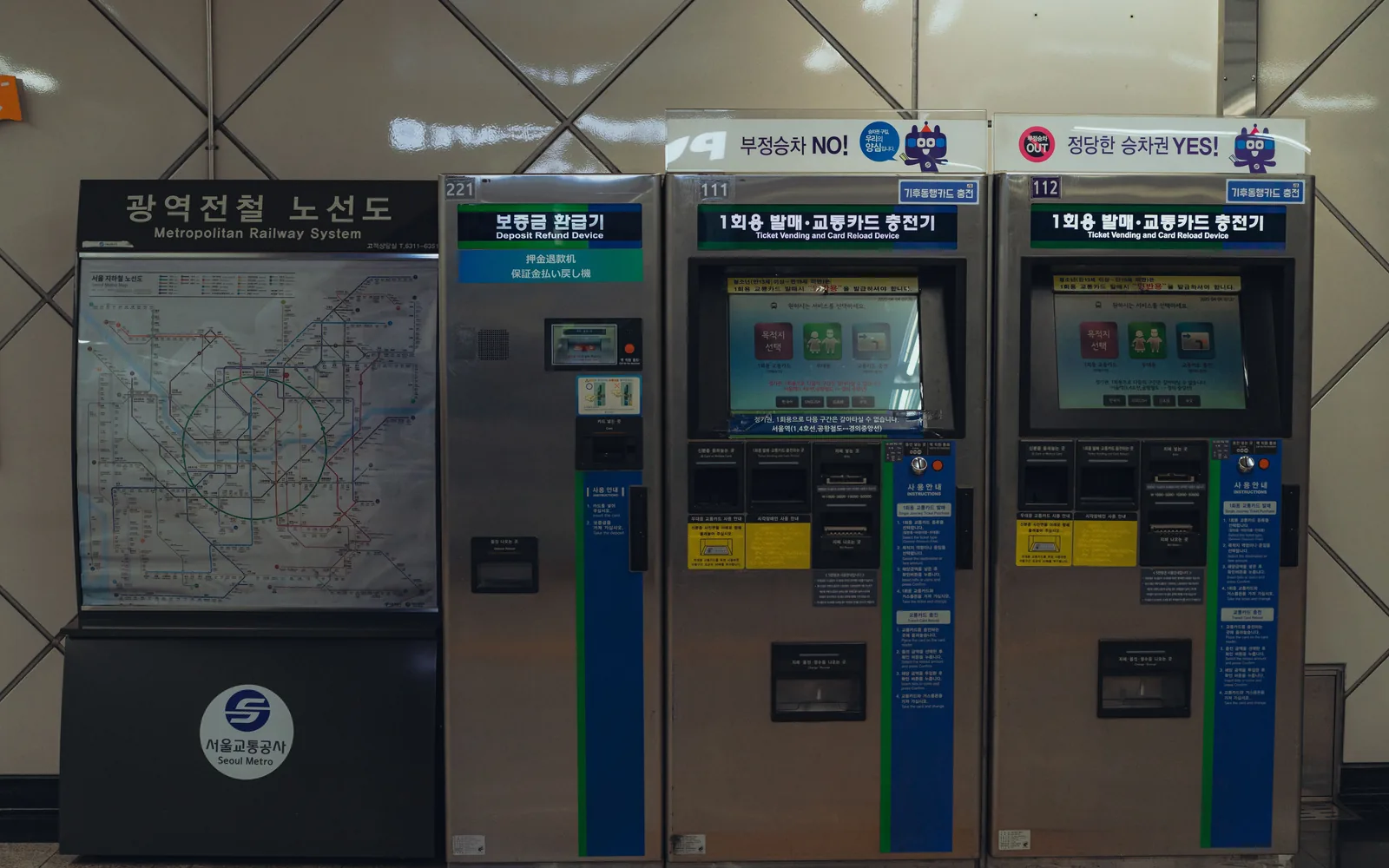
Seoul Metro ticket and card-reload machines beside a single-use-card deposit refund device. This is not Incheon Airport, and the screens and map can change. The deposit device is not a T-money balance-refund machine. Photo: Theodore Nguyen, Pexels License; photograph date not disclosed, page checked August 9, 2026. Cropped and optimized.
What happens if the card is lost?
If you lose an ordinary physical T-money card, expect to lose its balance. Fare-category registration does not add loss protection. Mobile and special products have their own rules, so load only what you expect to spend.
Common problems
The store is open but has no plain cards
Ask whether another T-money design is available and confirm its card-only price. If the design is expensive, try the next public CU or the station vending option rather than buying a souvenir product by mistake.
The cashier will sell the card but cannot load it
Buy it only if you can reach a supported reload machine with Korean-won cash. The plastic alone cannot open a fare gate.
The machine shows credit cards but rejects your reload
The card logo may apply to an AREX single-use or Express ticket, not T-money stored value. Cancel the transaction, keep the physical card on hand and use Korean-won cash at a reload machine or participating store.
The gate reports insufficient balance
Use the nearby fare-adjustment or reload facility. Do not tailgate or repeatedly tap different cards; ask staff before creating another incomplete entry record.
You tapped the wrong card
Remove other contactless cards from the wallet and speak to station staff. Tapping again without understanding the first record can make the entry/exit mismatch harder to resolve.
Plan B
If T-money is unavailable, choose the fallback for the trip you are taking now:
- AREX All-Stop or connecting subway: buy the separate single-use card. Current KTO guidance says the airport machines accept credit cards for it; the fare is ₩100 above the adult transport-card fare plus a refundable ₩500 deposit.
- AREX Express: buy its own assigned-seat ticket from the official counter, machine or website.
- Airport bus: check the exact operator and direction. Most airport-to-city services direct passengers to a terminal counter or machine, but late-night and other operators may use different boarding or payment rules. Do not assume T-money is accepted.
- Taxi: confirm the payment method before departure and keep a physical bank card available.
- Store offers EZL instead: it can be a workable separate transit card, but use EZL's own reload and refund rules.
The single-use rail card does not work on a later city bus. Buy T-money or another accepted reusable card after reaching Seoul if airport stock is gone. If the last train has departed, switch to a current airport bus or taxi instead of continuing to search for a card.
Check before you travel
Online sources do not settle these live details:
- stock of a plain card, a particular design or a child/youth product;
- the exact price of the card SKU in front of you;
- whether the cashier can load it in the same transaction and which banknotes can be changed;
- whether a station machine is online, offers English and accepts the cash denomination;
- whether an airport branch can register a child/youth birth date or process a refund;
- acceptance on one exact airport-bus route or taxi;
- phone, app-store region and payment compatibility for Mobile Tmoney;
- temporary closures, queues and terminal outages.
Frequently asked questions
Where can I buy T-money at Incheon Airport?
After customs, T1 has 24-hour public CU branches near Exits 2, 5, 11 and 13 whose IIAC listings explicitly name T-money. In T2, start with the 24-hour public CU near Exit 10. Stock remains a same-day check.
Can I buy or reload physical T-money with a foreign credit card?
Do not rely on it. Current KTO visitor guidance says ordinary physical T-money purchase and reload use Korean-won cash and do not accept foreign-issued cards. A foreign card can buy a separate AREX single-use or Express ticket; that is not a T-money reload.
How much should I load at Incheon Airport?
A general card costs about ₩3,000–₩5,000 before stored value. A ₩10,000 load covers the current adult All-Stop fare to Seoul Station and leaves some balance. Load ₩20,000 if you prefer to delay the first city reload.
Does T-money work on AREX?
Yes on the All-Stop Train. Tag at entry and exit. The AREX Express needs a separate reserved-seat ticket.
Can I use Apple Wallet instead of a physical card?
Yes on supported iPhone and Apple Watch models, but direct Wallet purchase or reload requires a Korean-issued credit or debit card. Verify another funding route in the current Mobile Tmoney app before traveling without a physical fallback.
Can a transfer passenger buy T-money airside?
IIAC lists a 24-hour CU near Concourse Gate 124 that names T-money, but it may not be on the permitted transfer route. The main T1 and T2 arrival options are landside after entry into Korea.
Can two people share one card?
Give each traveler a separate card for subways and normal transfer journeys. A Seoul bus driver may manually charge several people to one card if asked before tapping, but this does not preserve clean individual transfer records.
Do children need a registered card?
Yes for the discounted category. Ask the convenience-store clerk to set the correct child or youth category and register the birth date. If that cannot be done at purchase, follow T-money's registration process within 10 days of first use.
Can I refund the balance at the airport?
Maybe. A participating airport CU or GS25 may process a working-card refund within its chain limit, normally less a ₩500 fee, but the airport directory does not guarantee the function. Spend down the balance before relying on it.
Official sources
- T-money: traveler guide, transfer and fare-category rules
- T-money: where to buy a card
- T-money: reload methods and limits
- T-money: normal physical-card refund rules
- Korea Tourism Organization: current transportation-card comparison
- Korea Tourism Organization: May 2026 visitor transport guide
- Korea Tourism Organization: foreign-card AREX single-use ticket notice
- Korea Tourism Organization: Mobile Tmoney app guide
- Incheon Airport: live general-shopping directory
- AREX: All-Stop Train overview
- AREX: current All-Stop fare table
- AREX: Express ticket guide
- Seoul Metropolitan Government: Climate Card rules
- Apple and T-money: Apple Pay Tmoney launch
- Apple Support: add and reload T-money
- WOWPASS: separate payment and T-money balances
- NAMANE: Pay Balance and Transit Balance
- EZL: visitor use and refund guide