Ganghwa Island Day Trip:Bus and Car Routes
Plan a realistic Ganghwa Island day trip from Seoul or Incheon Airport, with current buses, focused routes, hours, fees, accessibility, and return advice.
Official sources checked 10 September 2026

Ask Narin.
Find answers in this guide
Narin is a fictional AI host.
Loading your saved chat…
NarinAsk me a question about this guide. Answers include links to the guides.
30-second answer
Ganghwado, usually called Ganghwa Island, has no rail station and is too spread out for an island-wide day trip by bus. Without a car, take bus 3000 from the Sinchon–Hongdae–Hapjeong corridor to Ganghwa Bus Terminal, walk the old-town cluster, and add the History/Natural History museums and dolmen only when the live return bus fits. See the complete route from Seoul.
Coming from ICN? No official source currently confirms a direct airport bus. Take the AREX all-stop train to Geomam, then bus 90 or 800 toward Ganghwa. See how to get from Incheon Airport to Ganghwa.
With a car, choose the Peace Observatory, museums, and dolmen in the north or Jeondeungsa and the eastern forts in the south and east. Set aside a separate day for Manisan.
Ganghwa is a poor airport-layover choice. If you must enter Korea before starting any landside trip, check the site's Visa Navigator, then choose a shorter Incheon Chinatown route when the margin is tight.
| Your situation | Best first plan | What to drop |
|---|---|---|
| No car, first visit | Old town + museum/dolmen cluster | Peace Observatory and south coast |
| No car, border priority | Peace Observatory as the main event + old town only if time remains | Every southern stop |
| Car, history and border | Observatory → museums/dolmen → old town | Manisan and Dongmak |
| Car, temple and forts | Jeondeungsa → Chojijin → Deokjinjin → Gwangseongbo | Northern sights |
| Hiking priority | Manisan round trip | Observatory and cross-island sightseeing |
| Monday, rain, or late start | Use the Plan B before committing | The full checklist |
Jump to: transport · no-car route · car routes · hours and prices · Manisan · accessibility · Plan B
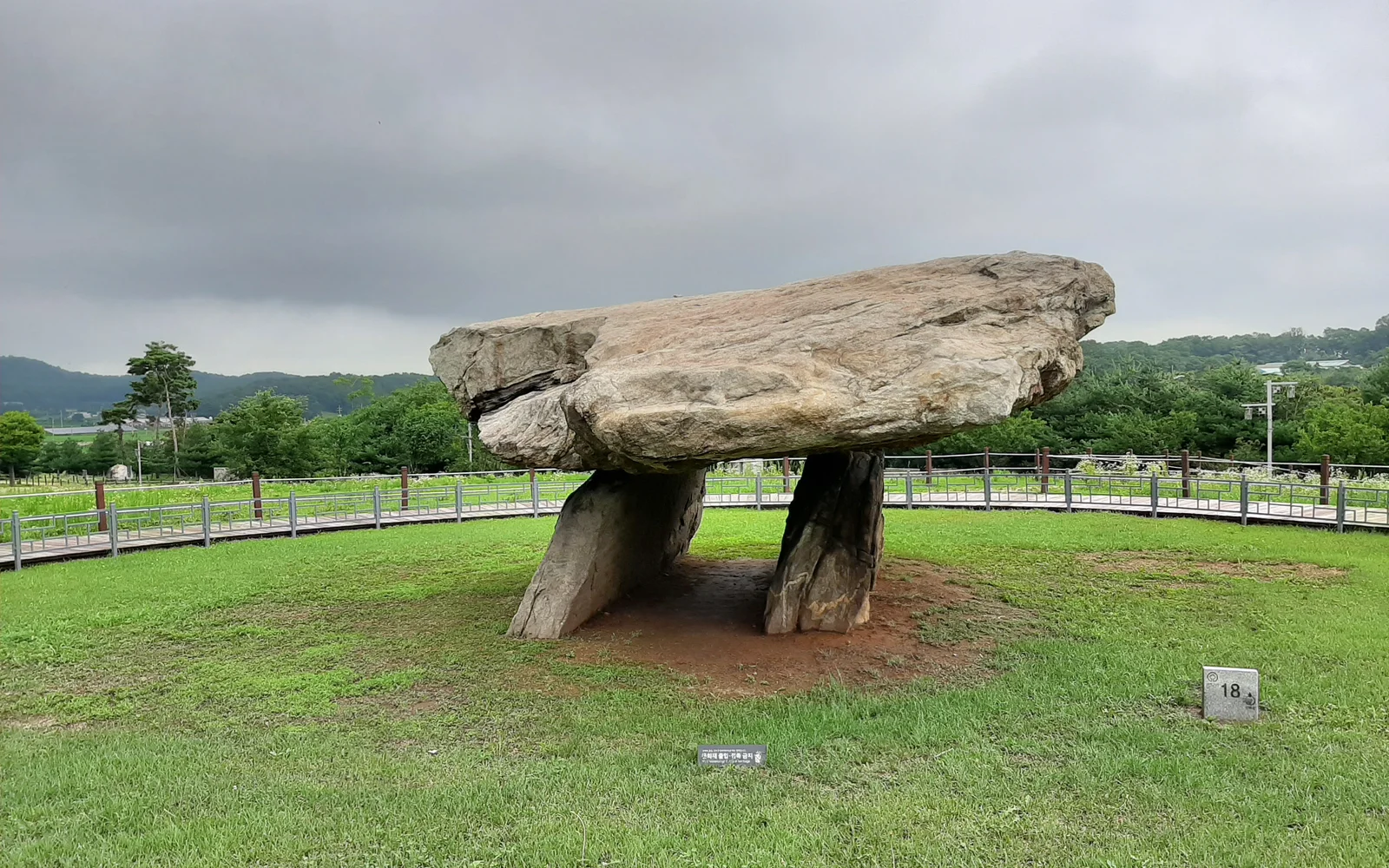
A dolmen at the Ganghwa Island Dolmen Site, photographed August 1, 2019. Railings and visitor access may have changed. Photo by Taewangkorea, CC BY-SA 4.0. Cropped, resized and converted to WebP under the same license.
Getting to Ganghwa Island
From Seoul
The simplest direct public-transport route is bus 3000 from Sinchon Station, Line 2 (신촌역2호선) toward Ganghwa Bus Terminal (강화터미널). It also serves Hongik University Station (홍대입구역) and Hapjeong Station (합정역). Check the live curb and direction before boarding rather than relying on a static subway-exit number.
The county route page for 3000 lists 45 trips a day, an approximate 30-minute interval, and a scheduled end-to-end time of 1 hour 20 minutes to 1 hour 50 minutes. Endpoint departures are listed as 04:20–22:00 from Ganghwa and 06:00–23:40 from Sinchon; intermediate stops have different times. The operator warns that road and operating conditions can change the timetable, so allow extra time on weekends and holidays.
At Ganghwa Terminal, bus 3000 uses Bay 1 for the Seoul return. Save the live departure before leaving the terminal area. The county publishes a ₩3,000 adult card base fare; distance pricing may raise the final total.
Bus 88 is the useful alternative from Songjeong Station on Line 5. Its official route page lists 40 trips a day and a broad full-route time of 1.5–2.5 hours. Use it when its live departure is clearly better than crossing Seoul for 3000.
There is no operating Seoul Station–Ganghwa M-bus yet. In a July 2026 county release, Ganghwa still described it as a requested future service.
From central Incheon
Current county routes include 90 from Bupyeong, 800 from Incheon Bus Terminal via Geomam, and 70/71 from western Incheon corridors. They are useful only when your starting point already lies near the route. Their published “route time” covers the full line, not your exact segment.
For the southern island, bus 70 runs through Geomam, Jeondeungsa, and Ganghwa Terminal. Bus 71 connects the Incheon Asiad side with Hwado Terminal, the Manisan-area hub, and Ganghwa Terminal. Check the current Ganghwa intercity-bus list and a live Korean map before choosing between them.
From Incheon Airport
No official source currently confirms a through bus from ICN to Ganghwa. The best-documented public-transport route is:
- From T1 or T2, follow signs to the B1 Transportation Center and board the AREX all-stop train (
일반열차), not the non-stop Express. - Leave at Geomam Station (
검암역). The Express does not stop there. - Walk to Geomam Station Entrance (
검암역입구) and confirm the roadside stop for Ganghwa direction (강화 방면). - Take bus 90 toward Ganghwa Terminal or bus 800 toward Ganghwa West Gate; bus 800 calls at Ganghwa Terminal before West Gate.
The AREX interchange page lists buses 90 and 800 at Geomam Station Entrance. Adult transport-card fares to Geomam are ₩3,200 from T1 and ₩3,800 from T2. Official sources do not give a reliable total journey time or combined fare, so allow a generous transfer buffer and check both legs live.
Bus 60-5 is from Gimpo Airport, not Incheon Airport. It leaves Gimpo International stop 2 and Domestic stop 10 toward Jeondeungsa, Hwado Terminal, and Ganghwa Terminal, but the county lists only 17 trips a day. It can suit a south-island plan from Gimpo; it is not an ICN shortcut.
For a rental car, ICN lists counters in the public area of T1 1F near Exits 13–14 and in the west side of the T2 B1 Transportation Center. Before paying, confirm the accepted driver's license and International Driving Permit, minimum age, deposit, insurance, toll method, and return time with the rental company. The airport rental-car directory shows current operators and counter hours.
Useful Korean names
| English | Search in Korean |
|---|---|
| Ganghwa Bus Terminal | 강화터미널 |
| Ganghwa History Museum | 강화역사박물관 |
| Ganghwa Natural History Museum | 강화자연사박물관 |
| Ganghwa Burgeun-ri Dolmen | 강화 부근리 지석묘 |
| Goryeogung Palace Site | 고려궁지 |
| Ganghwa Anglican Church | 대한성공회 강화성당 |
| Peace Observatory | 강화평화전망대 |
| Jeondeungsa | 전등사 |
| Manisan | 마니산 |
| Dongmak Beach | 동막해변 |
Fares, T-money, and the terminal routine
Use T-money or another accepted Korean transit card. Tap on when you board and off when you get off. The current Incheon fare table lists a ₩1,500 adult card base fare for ordinary trunk buses, ₩1,550 for seat routes such as 60-5 and 800, and ₩3,000 for 3000. Longer seat and express rides use distance pricing, so the base fare may not be the final fare. Do not rely on cash, even if a county fare table displays a cash column.
Ganghwa Bus Terminal is at 43 Jungang-ro. On arrival:
- Photograph the current bay board.
- Save the Korean name and direction of the stop for your first local bus.
- Save the return time for your stop, not only the route's last departure from its terminal.
- Choose a return bus 3000 with at least one later departure available as backup.
- If the connection fails, remove an attraction instead of using the return buffer.
Only bus 3000's Bay 1 is confirmed in the current official material reviewed here. Check the terminal board for every other route. The county directory lists the terminal tourist-information desk 09:00–18:00 at +82-32-930-3515, closed January 1, Lunar New Year Day, and Chuseok Day. Call before relying on it.
Route 1: no car, old town, museums, and dolmen
This is the best public-transport plan for a first visit. You start near Ganghwa Terminal, return there for the northbound local bus, and finish there for the bus to Seoul.
Morning: Ganghwa-eup old town
Walk or take a short taxi from Ganghwa Terminal. The sparse local route 09 is not worth building the day around. A practical order is:
- Yongheunggung Park and the nearby textile-history streets.
- Ganghwa Anglican Church, an active religious site listed by the county 10:00–18:00 and closed Monday.
- Goryeogung Palace Site, open 09:00–18:00 with last admission 17:00 and adult admission of ₩1,200 on the current operator page.
- Sochang Experience Center when open. The county lists 10:00–18:00, with a 12:00–13:00 preparation interval. It closes January 1, Lunar New Year Day, Chuseok Day, and every Monday—or Tuesday when Monday is a public holiday. Building access does not guarantee a workshop or English-language activity.
Ganghwa County's story-walk page gives a 2.5 km experience/exhibition course and a 7.6 km walls/history course. Its time labels describe the route, not a full visit with interiors, hills, lunch, and photographs. Allow roughly 1.5–3 hours for the old-town cluster.
Afternoon: museums and the UNESCO dolmen landscape
Return to the terminal area for lunch, then take a local bus serving Ganghwa History Museum. The county local-bus pages list routes 23, 23A, 25, 27, and 30 at the museum stop. Because service is sparse and some timetable records were last updated in 2024, confirm both the outbound and return departures at the terminal before boarding.
The History and Natural History museums occupy one complex beside Ganghwa Dolmen Park. The current museum visitor guide lists 09:00–18:00 Tuesday–Sunday, with last admission/ticketing at 17:30, and a combined ticket of ₩3,000 adult or ₩2,000 youth, child, or military. Both museums close Monday, January 1, Lunar New Year Day, and Chuseok Day.
The outdoor Burgeun-ri Dolmen is free. It forms the Ganghwa component of the UNESCO-listed Gochang, Hwasun and Ganghwa Dolmen Sites, a serial World Heritage property.
Finish only when the confirmed bus leaves enough margin for the terminal and Seoul return. If the museum connection does not work, keep the old-town day and skip the northern cluster.
Route 2: no car, Peace Observatory as the main destination
Choose this route only when the Peace Observatory is the day's main goal. Route 26 and route 28 serve it from Ganghwa Terminal, but the published directory lists only ten daily loops for route 26 and six for route 28. Confirm the return from your exact stop before boarding; loop buses may use the same stop name in both directions.
The operator page does not list a blanket nationality ban or advance-reservation rule for ordinary visits. It says one vehicle driver presents ID as the vehicle representative; VISITKOREA nevertheless advises visitors to carry a passport or Korean residence card. Every visitor should carry physical ID and follow checkpoint instructions.
Temporary military or security controls can override regular hours. The operator page lists no blanket photography ban, but follow signs and staff instructions. The separately organized DMZ Peace Road program has its own eligibility and reservation rules.
If poor visibility or a security closure removes the observatory, use the museum/dolmen cluster instead. Do not cross the island to Jeondeungsa or Dongmak by local bus to rescue the checklist.
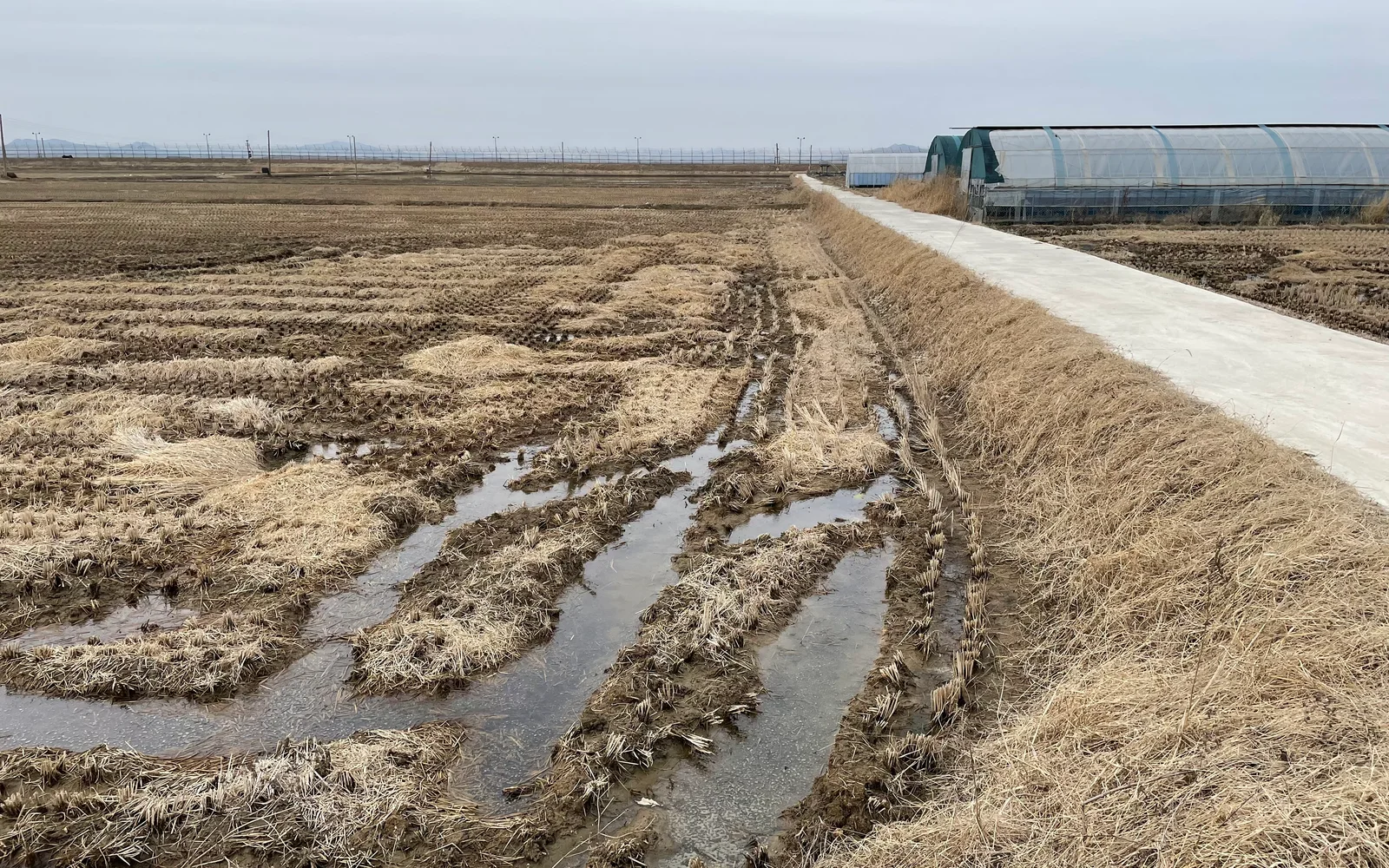
Winter fields near Insa-ri on Gyodong Island, photographed March 17, 2023; the source identifies the distant hills as North Korea. This is regional border context, not the view from the Peace Observatory, and visibility varies. Photo by Vincent van Zeijst, CC BY-SA 4.0. Cropped, resized and converted to WebP under the same license.
Route 3: by car, northern history and border landscape
Drive to the Peace Observatory first so you can switch to the museums if checkpoint or visibility conditions rule it out. Continue to the History and Natural History museums and Burgeun-ri Dolmen, then finish in Ganghwa-eup old town and the market.
This order keeps the remote, security-sensitive stop first and the most flexible cluster last. If the observatory is closed, spend more time at the museums and old town instead of driving south.
The official observatory standing hours are 09:00–18:00 March–November, last admission 17:00, and 09:00–17:00 December–February, last admission 16:00. Adult admission is ₩2,500, youth/military ₩1,700, and child ₩1,000. Parking is listed as free.
Route 4: by car, Jeondeungsa and the eastern forts
Use this order: Jeondeungsa → Chojijin → Deokjinjin → Gwangseongbo → return. Add Dongmak Beach only when the tide, daylight, and road conditions justify the detour.
Jeondeungsa stands inside Samnangseong; plan them as one stop. General admission to the temple grounds is free. Official pages disagree on closing time and parking price: the county attraction page lists 18:00 and parking at ₩3,000 for small vehicles or ₩8,000 for large vehicles, while a 2026 accessible-tourism record lists 17:30 and the county fee master shows ₩2,000/₩4,000. If the interiors matter, arrive before 17:00 and call 032-937-0125 for the current rules.
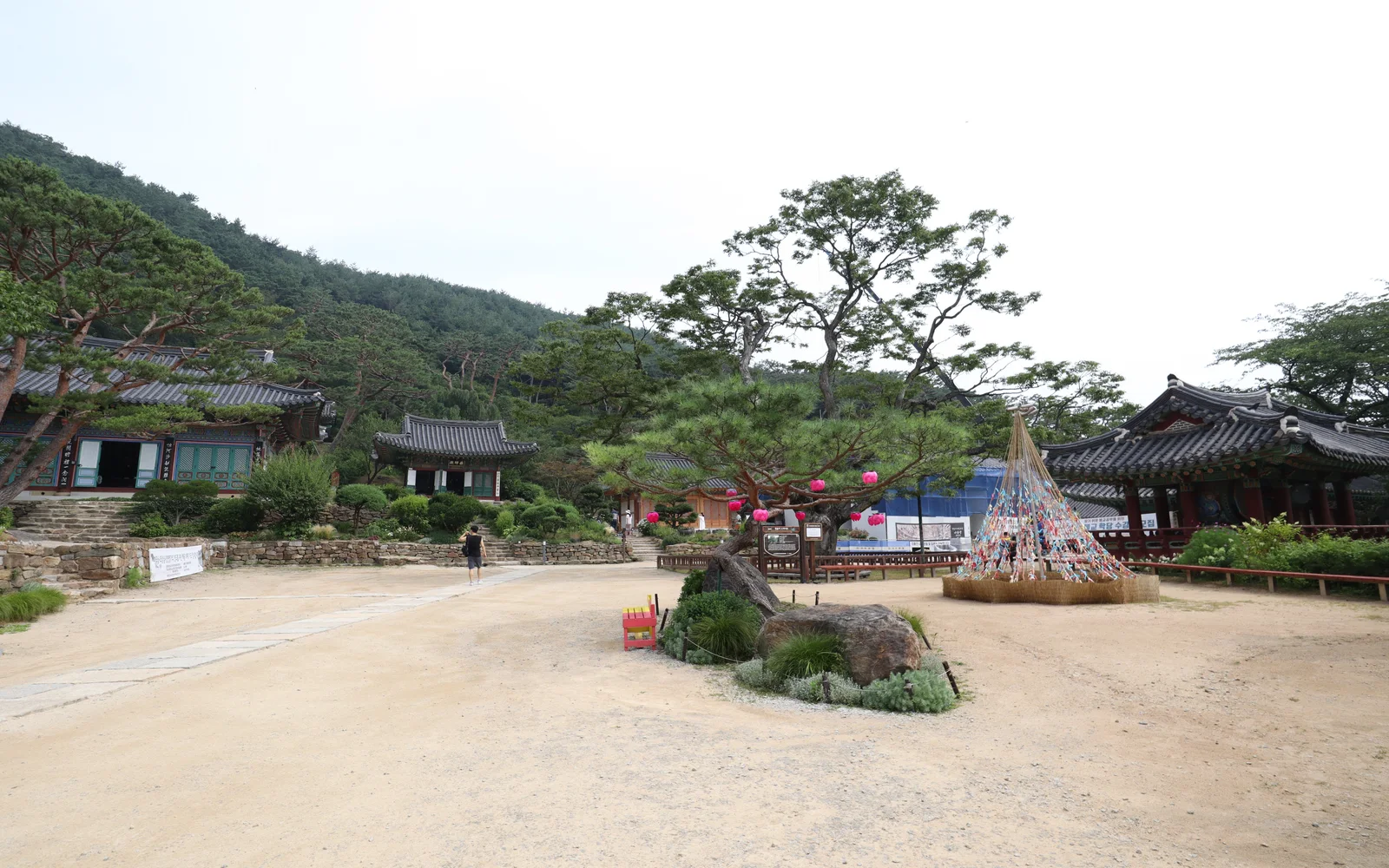
The courtyard at Jeondeungsa Temple, photographed July 18, 2020. Decorations, barriers, and visitor access may have changed. Photo by Mobius6, CC BY-SA 4.0. Cropped, resized and converted to WebP under the same license.
The three forts form a coherent military-history line:
- Chojijin: 09:00–18:00, free admission and free parking on the current operator page. Lower grounds have documented access; steps block the full viewpoint.
- Deokjinjin: 09:00–18:00, free admission and free parking on the current operator page.
- Gwangseongbo: 09:00–18:00, last admission 17:00; adult ₩1,500 and youth/child/military ₩1,100 on the current operator page. Its long outdoor route is not level throughout.
One substantial fort visit is better than three rushed parking-lot photos. Heat, wind, rain, ice, and uneven ground can affect how much of each site you can comfortably visit.
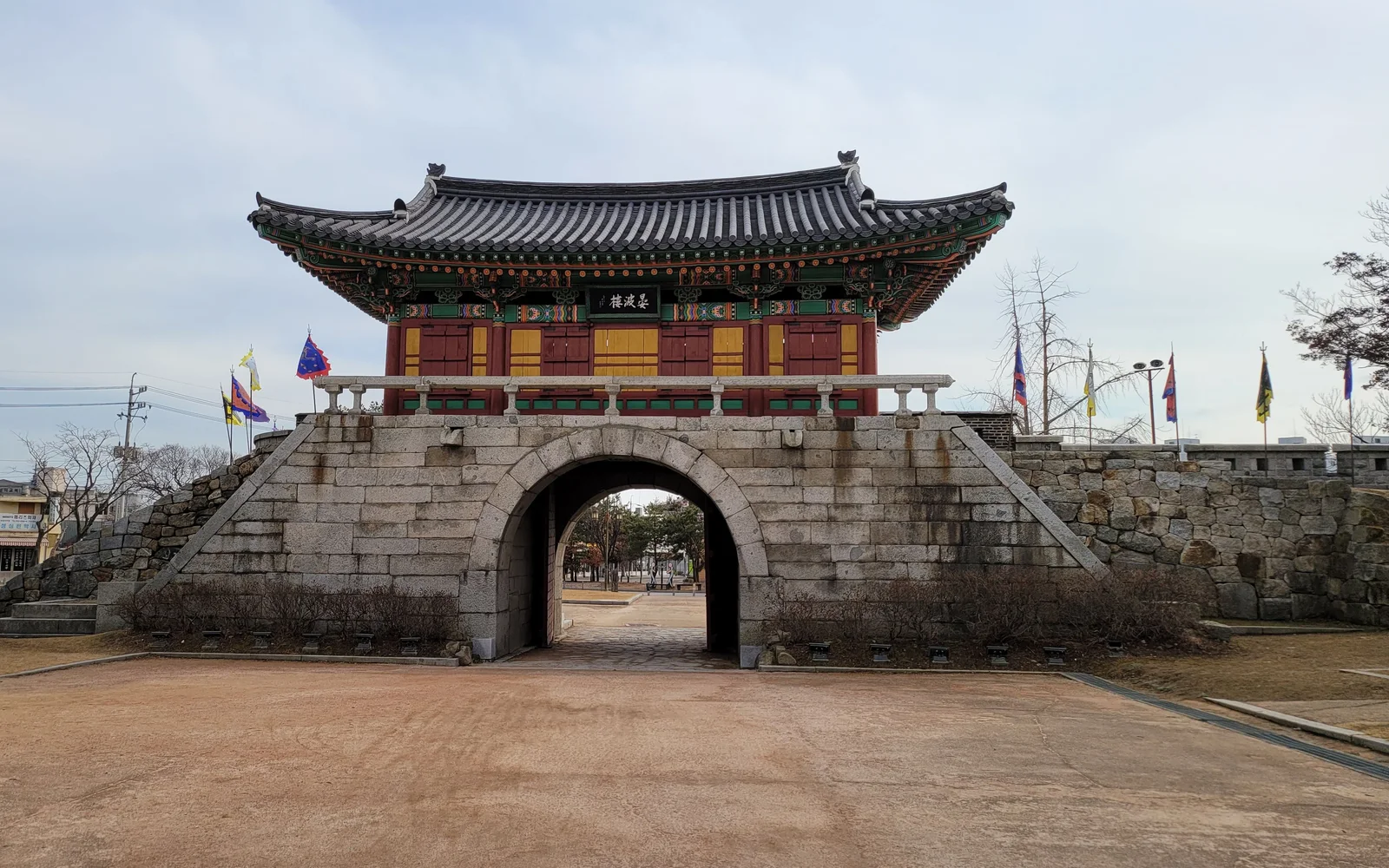
The Ganghwa Fortress South Gate, as identified by the source page. The photograph date is not disclosed; flags, signs, traffic, and access may have changed. Photo by 경수 채 on Pexels, Pexels License. Cropped, resized and converted to WebP; source checked August 17, 2026.
Manisan is a separate hiking day
Plan Manisan as a dedicated hike. The operator's trail descriptions list:
| Route | Published distance and time | Planning note |
|---|---|---|
| Course 1, stairs route | 4.8 km round trip, about 2.5 hours | Shortest return to the same base; many stairs |
| Course 5, Dangun route | 7.2 km round trip, about 3.5 hours | Longer round-trip option |
| Course 2 | 6.4 km, about 3 hours | Point-to-point toward Hamheodongcheon |
| Course 3 | 5.3 km, about 3.5 hours | Point-to-point toward Jeongsusa; rock ridge |
Adult admission is ₩2,000, youth/military ₩1,000, and child ₩700. Official pages disagree on the exact daily operating window: the operator gives a broad 07:00–18:00 range with a sunset rule, while the county publishes seasonal bands. Check the last entry time for your date and any closure notice at 032-930-7068/7069.
The operator can close the trail for heavy rain, typhoons, snow, or weather warnings and does not permit night hiking. Choose a round-trip route unless a driver is waiting or you have confirmed a bus from the other trailhead. Wear hiking footwear and start early enough to finish before dark.
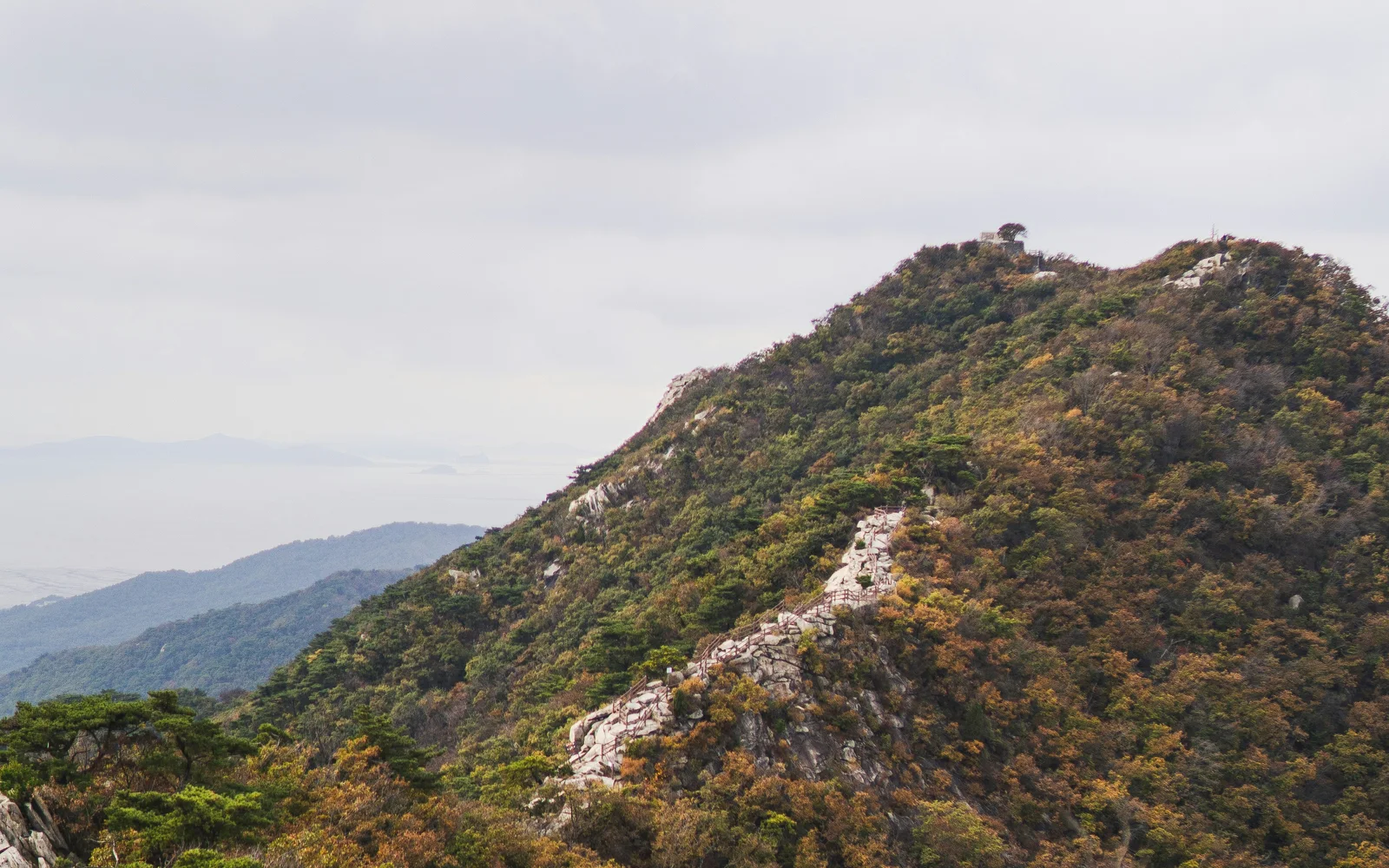
A view identified by the photographer as Manisan near Chamseongdan, published October 31, 2023. It does not document current trail conditions, closures, or visibility. Photo by Jinhan Moon, Unsplash License. Cropped, resized and converted to WebP.
Dongmak Beach and the tide
Dongmak's view changes with the tide. At low tide, expect a wide tidal flat rather than open water. Check the Korea Hydrographic and Oceanographic Agency tide service and the Korea Meteorological Administration forecast before detouring.
The county Dongmak page lists ₩2,000 parking and specific 2026 operating dates and prices for the pine camping area, showers, and changing rooms. Treat those amenities as seasonal.
Public bus 04 calls at Dongmak but has only eight published loops a day. The terminal timetable does not show the last pickup from the beach. For sunset, confirm the return from the Dongmak stop or prearrange a taxi.
Hours, prices, and closures
These are standing official details checked September 10, 2026. Temporary notices can override them.
| Place | Standing hours | Adult price | Main constraint |
|---|---|---|---|
| Goryeogung Palace Site | 09:00–18:00; last entry 17:00 | ₩1,200 | Palace site, not an intact Goryeo palace |
| Ganghwa Anglican Church | 10:00–18:00 | Free | Closed Monday; worship or events can restrict entry |
| Sochang Experience Center | 10:00–18:00; preparation 12:00–13:00 | Free building entry | Closed Jan 1, Seollal, Chuseok, and Monday—or Tuesday after a Monday holiday; programs vary |
| History + Natural History museums | Tue–Sun 09:00–18:00; last entry 17:30 | ₩3,000 combined | Closed Monday, Jan 1, Seollal and Chuseok day |
| Burgeun-ri Dolmen park | Outdoor site | Free | Grass and ground conditions affect access |
| Peace Observatory | Mar–Nov 09:00–18:00; Dec–Feb 09:00–17:00 | ₩2,500 | Last entry one hour before close; ID and security checks |
| Jeondeungsa | Official pages conflict: 09:00–17:30 or 09:00–18:00 | Free grounds | Confirm closing and parking; arrive before 17:00 |
| Chojijin | 09:00–18:00 | Free | Steps block the full viewpoint |
| Deokjinjin | 09:00–18:00 | Free | Outdoor terrain and weather |
| Gwangseongbo | 09:00–18:00; last entry 17:00 | ₩1,500 | Long outdoor route |
| Manisan | Seasonal bands and operator cutoff vary | ₩2,000 | Weather, daylight, and trail closure |
Food without a restaurant gamble
County tourism material highlights Ganghwa turnip kimchi, jeotguk-galbi (a pork-rib stew seasoned with salted shrimp), ginseng, and local seafood. Look for them along the route you already chose.
For the no-car route, eat around Ganghwa-eup or Ganghwa Pungmul Market before boarding the rural bus. On the southern route, eat near Jeondeungsa or your confirmed return corridor. Check the menu, price, and last order at the door.
If you have dietary restrictions, ask about shellfish, shrimp paste, fish sauce, pork, shared broth, and cross-contact. Turnip kimchi may contain animal ingredients, and a dish name will not reveal every allergen. Carry water and a snack; rural stops can have long gaps between open businesses.
Accessibility, families, toilets, and luggage
An accessible entrance at one attraction does not make the whole day step-free. Official route pages do not guarantee a low-floor vehicle on any rural departure. Between attractions, you may still encounter old-town slopes, heritage thresholds, grass, stone, and remote bus stops.
| Place | Documented help | Important limit |
|---|---|---|
| History/Natural History museums | Lifts/escalators, accessible toilet, loan wheelchair and stroller | Outdoor dolmen grass can impede movement |
| Peace Observatory | Accessible parking, ramp, lift, 1F accessible toilet, loan equipment, nursing room | Checkpoint and current lift operation still matter |
| Jeondeungsa | Wheelchair approach and accessible toilet in 2026 record | Slopes, stone paving, and thresholds; not wholly step-free |
| Chojijin | Accessible parking, lower ramp, accessible toilet | Steps prevent full viewpoint access |
| Manisan | Toilets and services at the base | Summit routes are not wheelchair or stroller routes |
The museum/dolmen cluster is the strongest family choice because it combines indoor shelter, toilets, and loan equipment. Reduce transfers with young children. Confirm child restraints directly when booking a taxi; a standard street taxi does not guarantee one.
Bring only a day bag. The official sources reviewed list no public lockers or staffed left-luggage service at Ganghwa Bus Terminal, and local buses do not guarantee luggage bays. ICN lists T-Luggage and storage points in both terminals and at selected rail stations, including Gimpo Airport, Seoul, and Hongik University. Check size limits, capacity, hours, and the collection deadline before leaving a bag.
Eligible riders can book Incheon special-mobility transport at 1577-0320 / 032-430-7000, but Ganghwa service has eligibility, schedule, and booking limits. Confirm every leg in advance; this is not an on-demand visitor taxi.
Driving, taxis, parking, and the official Saturday tour
The current Incheon taxi table lists Ganghwa taxi meters from ₩4,800 for 1.6 km; meter increments and night surcharges apply. Arrange a return pickup before visiting a remote attraction because taxis may not be available on demand. ICN lists no flat taxi fare to Ganghwa.
Operator pages list free parking at the museums, Peace Observatory, Goryeogung, Manisan, and the three eastern forts. Dongmak charges ₩2,000. Jeondeungsa's official pages disagree on parking prices. On peak weekends, even free lots can fill.
Ganghwa County also lists a Saturday city tour from Incheon Station through Gyodong and the Peace Observatory. The page gives an eight-hour itinerary, advance booking, an ID requirement, and a ₩19,000 adult fare, but says operation began June 14, 2025. Before paying, confirm the 2026 schedule, language, pickup, remaining seats, and cancellation rules.
Plan B for Monday, rain, or a late start
| Problem | Best response | Avoid |
|---|---|---|
| Monday | Use outdoor sites only after checking access, or postpone | Building the day around the closed museums, Sochang, or Anglican Church |
| Rain with museums open | History/Natural History museums + brief dolmen look if safe | Long fort or coast circuit |
| Peace Observatory closed or invisible | Museums/dolmen, then old town | Crossing south to preserve the checklist |
| Manisan closed or the start is late | Jeondeungsa if current hours work; otherwise museums/old town | Starting a “short” summit route near cutoff |
| Missed rural bus | Drop the next attraction and return to the terminal | Waiting without a confirmed later service |
| Wrong tide for the expected beach view | Accept the mudflat landscape or omit Dongmak | Racing across the island for a promotional-photo view |
| You have not yet left Seoul or ICN | Switch to Incheon Chinatown or another dense city route | Turning a late start into a risky island day |
Before leaving, recheck the facts that can change day to day: the next bus and exact curb, the return from a remote stop, road congestion, Jeondeungsa's closing time and parking, Manisan closures and cutoff, Peace Observatory security notices, tide, weather, visibility, and any accessibility feature essential to your trip.
Frequently asked questions
Can you visit Ganghwa Island in one day?
Yes, if you choose one cluster and start early. Without a car, combine Ganghwa-eup old town with the museum and dolmen cluster only when the live return bus works. With a car, choose either the north or the south and east, not the whole island.
How do I get from Seoul to Ganghwa Island?
Bus 3000 runs from the Sinchon, Hongik University, and Hapjeong corridor to Ganghwa Bus Terminal. The county publishes 45 trips a day and a scheduled end-to-end time of 1 hour 20 minutes to 1 hour 50 minutes, but weekend traffic can take longer.
How do I get from Incheon Airport to Ganghwa Island?
No official source currently confirms a direct ICN-to-Ganghwa bus. Take the AREX all-stop train to Geomam, walk to the Geomam Station Entrance bus stop, and take bus 90 or 800 toward Ganghwa. Check the curb, direction, and both legs in a live Korean map before leaving the airport.
Do you need a car for Ganghwa Island?
Not for a focused old-town and museum day. For the Peace Observatory, southern temple and forts, coast, or several rural stops, a car or prearranged driver is the practical choice. Public buses run too infrequently for an island-wide checklist.
Can I use T-money on buses to Ganghwa?
Yes. Use T-money or another accepted Korean transit card, tapping on when you board and off when you get off. Distance pricing can raise the final fare on longer routes, so carry a backup payment method and do not rely on cash.
Can foreign visitors enter Ganghwa Peace Observatory?
Current visitor information for ordinary observatory visits does not list a blanket ban on foreign nationals. Carry a physical passport or Korean residence card and follow checkpoint instructions. The separately organized DMZ Peace Road program has different eligibility rules.
Is Ganghwa Island good on Monday?
Monday is a poor first-visit day because the History and Natural History museums, Sochang Experience Center, and Anglican Church normally close. Outdoor sites may remain possible, but security, weather, and operator notices can still change access.
Is Manisan suitable for a casual day trip?
Treat Manisan as a dedicated hike. Published routes take about 2.5 to 3.5 hours, several include extensive stairs or exposed rock, and entry can close for weather or daylight. Choose a round-trip route unless transport is arranged at the other trailhead.
Can I store luggage at Ganghwa Bus Terminal?
The official sources reviewed list no public lockers or staffed left-luggage service at Ganghwa Bus Terminal. Leave large bags in Seoul, Incheon, Gimpo Airport, or ICN and travel with a day bag.
Is Ganghwa suitable for an Incheon Airport layover?
Usually not. There is no verified direct ICN bus, road and local-bus delays are hard to absorb, and international passengers need time for entry and return procedures. Choose an airport or central Incheon plan instead.
Official sources
Transport: Ganghwa intercity buses · Ganghwa local buses · route 3000 · route 88 · route 90 · route 800 · route 60-5 · Incheon fares · AREX Geomam connections · ICN rail and luggage
Old town and heritage: story walks · Goryeogung · Sochang Experience Center · museums · UNESCO dolmen property · Peace Observatory
South, hike, and coast: Jeondeungsa · current Jeondeungsa accessibility record · Manisan · Chojijin · Deokjinjin · Gwangseongbo · Dongmak · weather · tide
Related guides
- Things to do in Incheon
- Easier first visit: One day in Incheon from Seoul
- Compact airport alternative: Incheon Chinatown walking route
- Airport orientation: Incheon Airport terminal map
- Entry decision: Visa Navigator